• N&PD Moderators: Skorpio

Unusual Opiates

hussness

Bluelighter
Joined
Mar 12, 2005
Messages
513
Location
Western U.S.
I have been running into a number of unusual narcotic analgesics lately, so I thought I'd start a thread for them.

The latest one I found is Diampromide aka N-[2-[Methyl(2-phenylethyl)amino]propyl]-N-phenylpropanamide. Anyone know anything about this drug?
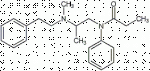
 

Attachments

  • Dampromide.gif
    Dampromide.gif
    3.1 KB · Views: 175
It's effectively seen as an open ring version of fentanyl (note the many structural similarities such as the N-phenethyl group and the N-propionylamide derivative of a substituted aniline). There are several closely related compounds known and some are used clinically although none approach the potency of the ones based on enclosing the nitrogen carrying the phenethyl group in a heterocyclic ring.

There's a basic skeleton for a lot of opioids - aromatic ring attached to a quaternary carbon atom, the nitrogen/amine function being fully substituted (tertiary amine) and being separated from the aromatic ring by a distance equivalent to a three carbon chain

59655basic_requirement_for_opiate.JPG
[/IMG]

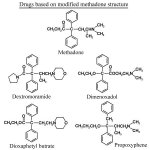
There are much more unusual opioids that don't so much break the above skeletal structural requirements, but bend them very severely, good examples being dimethylthiambutene and etonitazene. There are some compounds that you'd never guess were mu agonist opioids at an initial glance, but that on further examination do again 'sort of' conform to something like the above skeleton. On initial viewing, 2-(dimethylamino)ethyl O-ethylbenzilate (dimenoxadrol) looks like it should be an anticholinergic or antihistaminic drug due to similarities to other drugs of those two groups, but is in fact primarily a mu agonist as evidenced by it's status as a class A drug in the UK (if you look closely you start to see a lot of similarities with the opioid based on the structure of methadone).

Because of the diverse range of structures that act as an agonist at the mu receptor, the range of opioids is probably larger than any other of the pharmacological classes of 'drugs of abuse' (a total nightmare for agencies seeking legal control of them)
 

Attachments

  • modified methadone structure.JPG
    modified methadone structure.JPG
    57.1 KB · Views: 472
Dihydroetorphine
Diprenorphine
Etorphine (Immobilon)
Levo-Alpha Acetyl Methadol (LAAM)
Levorphanol (Levo-Dromoran)
Tilidine (Valeron)
 
Pharcyde said:
Dihydroetorphine
Diprenorphine
Etorphine (Immobilon)
Levo-Alpha Acetyl Methadol (LAAM)
Levorphanol (Levo-Dromoran)
Tilidine (Valeron)

As an elephant or similarly large animal, I enjoy said compounds.
 
hey, that's quite interesting.
where did you get the information, that some 2-aminotetralines are opioid-agonists?

until now, i've just read of one 2-piperidinotetraline in a paper of the dea.
 
thanks :)

it seems that the quaternary carbon is an essential feature of the 2-aminotetralines, just my first thoughts to this paper.
 
I can see room to manoeuvre here to make novel analogs. Since this is a harm reduction forum I appreciate people get a little ticked off when people draw up maps for sailing into completely unchartered waters.

More on this later.
 
I guess my questions will be alright in this thread. Anyone has this book by chance? I'm not interested in synthesizing anything (if there are any syntheses discussed in complete...), I'm far more interested in how 7-substituted, 14-substituted, 6-substituted etc. morphinan derivatives act at different opioid receptors, selectivity, their analgesic potency etc.
 
This thread is now nearly 3 years old! Very odd to revive it, in particular for this reason :\
Anyway, some comments:

1. That ain't no book, but a journal article.

2. Yes, it is in my possession. PM me your mail-adress.

3. Bluelight ain't the right place to request articles, at least in my experience.

Have a nice day,

Murphy
 
It's effectively seen as an open ring version of fentanyl (note the many structural similarities such as the N-phenethyl group and the N-propionylamide derivative of a substituted aniline). There are several closely related compounds known and some are used clinically although none approach the potency of the ones based on enclosing the nitrogen carrying the phenethyl group in a heterocyclic ring.

There's a basic skeleton for a lot of opioids - aromatic ring attached to a quaternary carbon atom, the nitrogen/amine function being fully substituted (tertiary amine) and being separated from the aromatic ring by a distance equivalent to a three carbon chain


I guess that's right, but the tertiary amine should be seperated from the quaternary carbon by a 2 carbon chain, as it's written the location of the quaternary carbon in that 3 carbon chain isn't spelled out.

a little pedantic, but I was confused when I first read this and thought it was completely wrong, obviously it's not.
 
Top