• Psychedelic Drugs Welcome Guest
    View threads about
    Posting RulesBluelight Rules
    PD's Best Threads Index
    Social ThreadSupport Bluelight
    Psychedelic Beginner's FAQ
  • PD Moderators: Esperighanto | JackARoe |

Tryptamines Psilocybin extraction methods

So?
Facts are if someone has the gumption in the world and wants to make money there is a market for 8 mg psilocybin pills, perhaps dutch gangs
thats a part of the game yes
but how hard is it to get some 151 white russian with touch vanilla extract, weed cocoa butter oil, 1/8 shrooms, blender em up, and drink/eat the slurry
Your enzymatic bowels and your own HCl do the acid base buffering (buffering might be right term we're getting deep on specific perfect terms)
Some places ya can grow your own mycelium, weed, brew up some booze, add lil whatever else and drink the stuff

Or run around, probably loud plaintext trying source drugs,

the beauty of shrooms and weed and booze (you can do the shaman thing in your home from scratch (no gangs, no cops, no drug ops, etc)
I do this for knowledge and would-be eventual party personal enjoyment (not in this for the $ nor game, one side or another)
 
thats a part of the game yes
but how hard is it to get some 151 white russian with touch vanilla extract, weed cocoa butter oil, 1/8 shrooms, blender em up, and drink/eat the slurry
Your enzymatic bowels and your own HCl do the acid base buffering (buffering might be right term we're getting deep on specific perfect terms)
Some places ya can grow your own mycelium, weed, brew up some booze, add lil whatever else and drink the stuff

Or run around, probably loud plaintext trying source drugs,

the beauty of shrooms and weed and booze (you can do the shaman thing in your home from scratch (no gangs, no cops, no drug ops, etc)
I do this for knowledge and would-be eventual party personal enjoyment (not in this for the $ nor game, one side or another)
Unless you have a cop stalker suffering from psychosis he needs to get you.
 
Ive summed all our proposals and i now rely upon two sources of information notwithstanding all the other patent info we have dumped into this thread (frankly you could take em conglomerate em into one big paper and feed it into Ai's theres so much info here)
Source 1: Patent: https://patents.google.com/patent/US11851452B2/en

Methanol Acetone, HCl, EtOH, H2O, EtOAc (ethyl acetate buyer back there) all can produce the salt precip
Source 2: Crystallization of Organic Compounds, 2nd Edition O Reilly and other crystallization techniques (past org2 level stuff)

Going back to the "Psilocybin crystallization for beginners" in this thread

Whether simply evaping some HCl(aq) will precip psilocybin - WITH NO SEED CRYSTAL (once ya have the seed crystal then yes all ya need do is temp control for more nucleation seeding) but the other person (that "we" shit) we mentioned psilocybin HCl


US11851452B2 — Google Patents

Patent anchor​

The key direct passage is that psilocybin was slurried in 1:1 EtOH/EtOAc, HCl was added, and the resulting material was identified as crystalline psilocybin hydrochloride Form A. The patent therefore directly establishes the HCl/Form-A relationship, but it does not establish that EtOAc itself is required. Google Patents

Compound / solvent → temperature/history → crystal​

  • Psilocybin + HCl
    → HCl protonates the tertiary amine and supplies the Cl⁻ counterion
    → psilocybin hydrochloride
    → this is the fundamental salt-forming / ion-pairing step.
    → The subsequent crystal can be Form A, B, or C depending on the solid-state environment.
  • Psilocybin·HCl + EtOH
    → patent used pre-existing non-crystalline hydrochloride
    → EtOH solution was cooled from 40 °C to room temperature
    → HCl Form A crystallized.
    → This is the strongest evidence that EtOAc is not inherently necessary for Form A.
  • Psilocybin + HCl + EtOH/EtOAc
    → HCl establishes the hydrochloride
    → room-temperature crystallization
    → HCl Form A.
    → This is the patent's direct demonstration of forming the HCl salt and Form A from psilocybin itself.
  • Psilocybin·HCl + EtOH/EtOAc
    → elevated-temperature slurry treatment
    → HCl Form A.
    → Again, EtOAc is a compatible crystallization medium, not proven to be part of the Form-A lattice.
  • Psilocybin·HCl + acetone
    → room-temperature slurry
    → HCl Form A.
    → This is especially important because it demonstrates Form A in a completely different solvent environment.
  • Psilocybin + HCl + EtOH/EtOAc + Form-B nucleation history
    → room-temperature slurry with Form B present
    → HCl Form B.
    → This demonstrates that nucleation history can redirect the crystallization outcome even within the same general solvent system.
  • Psilocybin + HCl + EtOH
    → salt-screen slurry
    → HCl Form C was observed in the patent's screen.
    → Form C was subsequently characterized as approximately an ethanol solvate.
    → Therefore EtOH does not automatically mean Form A.
  • Psilocybin·HCl + EtOH + toluene antisolvent
    → crystallization/antisolvent environment
    → HCl Form C, the ethanol-containing form.
    → This reinforces the importance of solvent environment.
  • Psilocybin + MeOH/H₂O
    → fast evaporation
    → ordinary psilocybin Form B, characterized as the trihydrate.
    → This is not HCl Form A and is important evidence that water can strongly influence the solid form.
  • Ordinary psilocybin Form A + water exposure
    → high relative humidity, 75–95% RH
    → water uptake
    → ordinary psilocybin Form B/hydrate.
    → Again, this demonstrates water's ability to redirect the solid-state structure.

The hierarchy we're left with​

HCl = decisive salt-forming component (HERE I WAS RIGHT)

Psilocybin + HCl → R₃NH⁺ Cl⁻

EtOH / water / EtOAc / other solvents = crystallization environment

Temperature + solvent loss + supersaturation + nucleation history = solid-form selection


So the patent evidence supports:

HCl → hydrochloride identity → crystallization environment → Form A/B/C

rather than:

HCl + EtOAc → Form A

That is the key distinction.

And importantly, the patent gives us Form A from EtOH alone and from acetone, so EtOAc cannot be considered a necessary structural component of Form A.


What remains unproven is whether an EtOH/H₂O/HCl environment specifically selects Form A rather than a hydrated/solvated competitor. Google Patents
During the simultaneous evaping and dry gassing HCl into it (because tossing in muriatic wet HCl has water content that mucks up solubility for crystallization)

thats where im at, we proved the zwitterionic state allows us to form all kinds of forms

using the patent's naming:

Zwitterionic psilocybin

  • Form A — unsolvated
  • Form B — trihydrate
  • Form C — mono-ethanolate Google Patents
Psilocybin hydrochloride

  • HCl Form A — essentially unsolvated crystalline HCl form
  • HCl Form B — distinct HCl polymorph
  • HCl Form C — ethanol-containing solvate/“ethanoate” form Google Patents
One caveat: the broader literature sometimes uses different nomenclature for zwitterionic psilocybin (e.g. anhydrates/hydrates and A/A′ terminology), so the labels need to be tied to the particular paper/patent.


Lastly, the solvent used, the patents show little bit of solvent gets locked into the final crystal salt lattic (again solvent choice toxicity noted)

 
Last edited:
Ive summed all our proposals and i now rely upon two sources of information notwithstanding all the other patent info we have dumped into this thread (frankly you could take em conglomerate em into one big paper and feed it into Ai's theres so much info here)
Source 1: Patent: https://patents.google.com/patent/US11851452B2/en

Methanol Acetone, HCl, EtOH, H2O, EtOAc (ethyl acetate buyer back there) all can produce the salt precip
Source 2: Crystallization of Organic Compounds, 2nd Edition O Reilly and other crystallization techniques (past org2 level stuff)

Going back to the "Psilocybin crystallization for beginners" in this thread

Whether simply evaping some HCl(aq) will precip psilocybin - WITH NO SEED CRYSTAL (once ya have the seed crystal then yes all ya need do is temp control for more nucleation seeding) but the other person (that "we" shit) we mentioned psilocybin HCl


US11851452B2 — Google Patents

Patent anchor​

The key direct passage is that psilocybin was slurried in 1:1 EtOH/EtOAc, HCl was added, and the resulting material was identified as crystalline psilocybin hydrochloride Form A. The patent therefore directly establishes the HCl/Form-A relationship, but it does not establish that EtOAc itself is required. Google Patents

Compound / solvent → temperature/history → crystal​

  • Psilocybin + HCl
    → HCl protonates the tertiary amine and supplies the Cl⁻ counterion
    → psilocybin hydrochloride
    → this is the fundamental salt-forming / ion-pairing step.
    → The subsequent crystal can be Form A, B, or C depending on the solid-state environment.
  • Psilocybin·HCl + EtOH
    → patent used pre-existing non-crystalline hydrochloride
    → EtOH solution was cooled from 40 °C to room temperature
    → HCl Form A crystallized.
    → This is the strongest evidence that EtOAc is not inherently necessary for Form A.
  • Psilocybin + HCl + EtOH/EtOAc
    → HCl establishes the hydrochloride
    → room-temperature crystallization
    → HCl Form A.
    → This is the patent's direct demonstration of forming the HCl salt and Form A from psilocybin itself.
  • Psilocybin·HCl + EtOH/EtOAc
    → elevated-temperature slurry treatment
    → HCl Form A.
    → Again, EtOAc is a compatible crystallization medium, not proven to be part of the Form-A lattice.
  • Psilocybin·HCl + acetone
    → room-temperature slurry
    → HCl Form A.
    → This is especially important because it demonstrates Form A in a completely different solvent environment.
  • Psilocybin + HCl + EtOH/EtOAc + Form-B nucleation history
    → room-temperature slurry with Form B present
    → HCl Form B.
    → This demonstrates that nucleation history can redirect the crystallization outcome even within the same general solvent system.
  • Psilocybin + HCl + EtOH
    → salt-screen slurry
    → HCl Form C was observed in the patent's screen.
    → Form C was subsequently characterized as approximately an ethanol solvate.
    → Therefore EtOH does not automatically mean Form A.
  • Psilocybin·HCl + EtOH + toluene antisolvent
    → crystallization/antisolvent environment
    → HCl Form C, the ethanol-containing form.
    → This reinforces the importance of solvent environment.
  • Psilocybin + MeOH/H₂O
    → fast evaporation
    → ordinary psilocybin Form B, characterized as the trihydrate.
    → This is not HCl Form A and is important evidence that water can strongly influence the solid form.
  • Ordinary psilocybin Form A + water exposure
    → high relative humidity, 75–95% RH
    → water uptake
    → ordinary psilocybin Form B/hydrate.
    → Again, this demonstrates water's ability to redirect the solid-state structure.

The hierarchy we're left with​

HCl = decisive salt-forming component (HERE I WAS RIGHT)

Psilocybin + HCl → R₃NH⁺ Cl⁻

EtOH / water / EtOAc / other solvents = crystallization environment

Temperature + solvent loss + supersaturation + nucleation history = solid-form selection


So the patent evidence supports:

HCl → hydrochloride identity → crystallization environment → Form A/B/C

rather than:

HCl + EtOAc → Form A

That is the key distinction.

And importantly, the patent gives us Form A from EtOH alone and from acetone, so EtOAc cannot be considered a necessary structural component of Form A.


What remains unproven is whether an EtOH/H₂O/HCl environment specifically selects Form A rather than a hydrated/solvated competitor. Google Patents
During the simultaneous evaping and dry gassing HCl into it (because tossing in muriatic wet HCl has water content that mucks up solubility for crystallization)

thats where im at, we proved the zwitterionic state allows us to form all kinds of forms

using the patent's naming:

Zwitterionic psilocybin

  • Form A — unsolvated
  • Form B — trihydrate
  • Form C — mono-ethanolate Google Patents
Psilocybin hydrochloride

  • HCl Form A — essentially unsolvated crystalline HCl form
  • HCl Form B — distinct HCl polymorph
  • HCl Form C — ethanol-containing solvate/“ethanoate” form Google Patents
One caveat: the broader literature sometimes uses different nomenclature for zwitterionic psilocybin (e.g. anhydrates/hydrates and A/A′ terminology), so the labels need to be tied to the particular paper/patent.


Lastly, the solvent used, the patents show little bit of solvent gets locked into the final crystal salt lattic (again solvent choice toxicity noted)

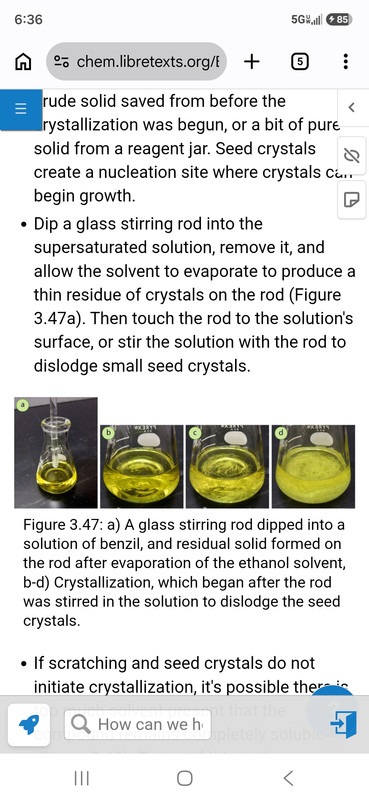
Dipping a glass rod into the solution, removing it to let the solvent evaporate, and re-introducing the rod leaves behind a microscopic seed crystal that triggers crystallization

 
Dipping a glass rod into the solution, removing it to let the solvent evaporate, and re-introducing the rod leaves behind a microscopic seed crystal that triggers crystallization

yeah, the glass rod scratching technique (creating tiny quantum scratches on glass beakers,) works,
dropping a pre-exisiting seed crystal the size of a particle of sand (which is what that libretext discussed from what i read on its site) or dust works (i was actually thinking drop a tiny grain of silica dioxide sand in there) BUT theres still a hypothesis problem here:

Not every crystallization technique, including methods involving nucleation sites created by scratching with a glass rod, will work effectively for all compounds.As mentioned earlier, the nature of intermolecular forces (hydrogen bonding, dipole-dipole, London dispersion, ionic) dictates how molecules or ions interact with each other to form a crystal lattice

Each compound has a distinct solubility profile in various solvents at different temperatures. A successful crystallization requires the solution to be brought into a supersaturated state
To be an effective nucleation site, the compound's molecules must be able to interact favorably with these surface groups. If the interactions are weak or unfavorable, the scratch might not be an effective nucleation site.
Molecules must be able to adsorb onto the nucleation site and remain there long enough to form a stable cluster. If the binding is too weak, they'll desorb before nucleation can occur. If the binding is too strong or non-specific, it might lead to a disordered aggregate rather than an ordered crystal.

None of the above crystal formation techniques are guaranteed for psilocybin and spontaneous crystallization and nucleation (insofar as the cold ethanol/water/hcl technique,) this is something needs be tested with product in lab setup, or some research paper specific to crystallography of psilocybin
 
yeah, the glass rod scratching technique (creating tiny quantum scratches on glass beakers,) works,
dropping a pre-exisiting seed crystal the size of a particle of sand (which is what that libretext discussed from what i read on its site) or dust works (i was actually thinking drop a tiny grain of silica dioxide sand in there) BUT theres still a hypothesis problem here:

Not every crystallization technique, including methods involving nucleation sites created by scratching with a glass rod, will work effectively for all compounds.As mentioned earlier, the nature of intermolecular forces (hydrogen bonding, dipole-dipole, London dispersion, ionic) dictates how molecules or ions interact with each other to form a crystal lattice

Each compound has a distinct solubility profile in various solvents at different temperatures. A successful crystallization requires the solution to be brought into a supersaturated state
To be an effective nucleation site, the compound's molecules must be able to interact favorably with these surface groups. If the interactions are weak or unfavorable, the scratch might not be an effective nucleation site.
Molecules must be able to adsorb onto the nucleation site and remain there long enough to form a stable cluster. If the binding is too weak, they'll desorb before nucleation can occur. If the binding is too strong or non-specific, it might lead to a disordered aggregate rather than an ordered crystal.

None of the above crystal formation techniques are guaranteed for psilocybin and spontaneous crystallization and nucleation (insofar as the cold ethanol/water/hcl technique,) this is something needs be tested with product in lab setup, or some research paper specific to crystallography of psilocybin
This would be quite simple to find out. Plus, lowering solvent temperature reduces a compounds solubility. Easy easy easy. Go find out, since you are the interested one
 
This would be quite simple to find out. Plus, lowering solvent temperature reduces a compounds solubility. Easy easy easy. Go find out, since you are the interested one
lols (not directed towards anyone on the forum more an abstract comment)


He gonna throw dirt n sand in his sh*t to make precious crystals
Why not toss in particles of dusted organic shrooms

:)


someone around er' has attempted to make a damn psilocybin crystal, we clandestines will figure it out in time
 
lols (not directed towards anyone on the forum more an abstract comment)


He gonna throw dirt n sand in his sh*t to make precious crystals
Why not toss in particles of dusted organic shrooms

:)


someone around er' has attempted to make a damn psilocybin crystal, we clandestines will figure it out in time
Head back to your personal mushroom factory, grab some of your dried shrooms mash em up with some alcohol for a few hours filter the mushie out shove it in the freezer for a few hours and something should crash out so you can take some mind altering substance what are you on drugs?
 
Top