Didgital
Bluelight Crew
I figured Bluelight could use a dedicated and easy to find thread that can act as a guide for dosing mescaline of different salts.
Mescaline is almost never distributed as a freebase as it's an oil (or oily solid) at most temperatures that humans like. I'm going to say right now a lot of this is not necessary for most people consuming mescaline. The vast majority of mescaline that people are going to encounter are Mescaline hydrochloride, mescaline sulfate
Mescaline hydrochloride is the most common, potent (and therefore convenient) salt form so I will use that as the standard to compare other salt forms. If a standard dose of Mescaline HCL was 300mg we would multiply 300 by the % mescaline in that particular salt form. 300 * .8528 = 255.84mg of the freebase.
I like to think that any chemist worth their own salt would make an anhydrous form whether it be hydrochloride or sulfate but I included the hydrated forms as there's a lot of lazy chemists. Hydrated forms do not mean mehscaline they are just weaker and more difficult to dose precisely.
If you're trying to get the equivalent dosage of say the monosulfate to 300mg of the hydrochloride we would divide 300 by its % compared to the HCL (.8007) to get 374.67 mg (Notice that I divided 300 by .8007 and not 80.07 so move the decimal over 2 spaces to the left.)
If we wanted to calculate an equivalent dosage of say mescaline monosulfate to the freebase we would divide 255.84 by .6829 to get 374.63mg. I must have rounded somewhere but it should be the exact same.
Consider the doses approximate, but accurate enough for practical purposes. Numbers were rounded. There are some other salt forms that theoretically exist but are so uncommon I did not include them. Let me know if you think I should include any others. I didn't know hemimalate was a thing but I guess sometimes in research malic acid has been utilized? Anyway I'm trying to be comprehensive maybe the table will be useful for chemists and researchers as well as psychonauts.
Discussion on hemi vs mono salts.
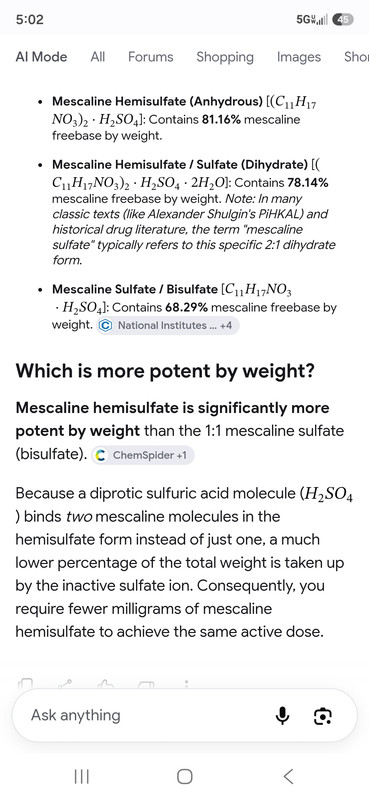
The primary difference is that a hemi-salt contains one acid molecule for every two base molecules, while a mono-salt contains a 1:1 ratio of one acid molecule to one base molecule.
For example the hemisulfate is 2 molecules of mescaline joined to one molecule of sulfuric acid whereas mescaline (mono)sulfate is one molecule of mescaline to one molecule of sulfuric acid. At least with the sulfates, the difference in producing one or the other is the final pH of the solution when salting out mescaline with sulfuric acid. Around pH 6, it exists primarily as the hemisulfate whereas pH 3 it is primarily monosulfate. Therefore mescaline sulfate could be either hemi, mono, or a mixture of both. This, along with it being the most potent, is why the hydrochloride is considered the gold standard. I am less sure about the other hemi and mono salts but please enlighten me if you know about them specifically.
One could test this by taking 100g of Mescaline hemisulfate, dissolving in water and basifying to pH 11. Then, using sulfuric acid slowly bring down to pH 3 with stirring, filter and dry the crystals they will weigh 119.3g. You will get more of a less potent salt form by doing this.
How to determine how much mescaline sulfate is the monosulfate or hemisulfate is likely impractical.
Also the nomenclature is somewhat inconsistent with different salts so I just chose to use hemi and mono salts instead of monomescaline or dimescaline or bis-mescaline. Hopefully it all makes sense.
Mescaline is almost never distributed as a freebase as it's an oil (or oily solid) at most temperatures that humans like. I'm going to say right now a lot of this is not necessary for most people consuming mescaline. The vast majority of mescaline that people are going to encounter are Mescaline hydrochloride, mescaline sulfate
Mescaline hydrochloride is the most common, potent (and therefore convenient) salt form so I will use that as the standard to compare other salt forms. If a standard dose of Mescaline HCL was 300mg we would multiply 300 by the % mescaline in that particular salt form. 300 * .8528 = 255.84mg of the freebase.
I like to think that any chemist worth their own salt would make an anhydrous form whether it be hydrochloride or sulfate but I included the hydrated forms as there's a lot of lazy chemists. Hydrated forms do not mean mehscaline they are just weaker and more difficult to dose precisely.
If you're trying to get the equivalent dosage of say the monosulfate to 300mg of the hydrochloride we would divide 300 by its % compared to the HCL (.8007) to get 374.67 mg (Notice that I divided 300 by .8007 and not 80.07 so move the decimal over 2 spaces to the left.)
If we wanted to calculate an equivalent dosage of say mescaline monosulfate to the freebase we would divide 255.84 by .6829 to get 374.63mg. I must have rounded somewhere but it should be the exact same.
Consider the doses approximate, but accurate enough for practical purposes. Numbers were rounded. There are some other salt forms that theoretically exist but are so uncommon I did not include them. Let me know if you think I should include any others. I didn't know hemimalate was a thing but I guess sometimes in research malic acid has been utilized? Anyway I'm trying to be comprehensive maybe the table will be useful for chemists and researchers as well as psychonauts.
Form | Molecular weight | % Mescaline | % Mescaline compared to the HCL | Equivalent mg dose to 300mg of the HCL |
| freebase | 211.26 | 100 | N/A | 255.84 |
| hydrochloride (anhydrous) | 247.72 | 85.28 | 100 | 300 |
| hydrochloride monohydrate | 265.74 | 79.49 | 93.22 | 321.81 |
| hydrochloride dihydrate | 283.75 | 74.45 | 87.3 | 343.64 |
| monosulfate (hydrogen sulfate) | 309.34 | 68.29 | 80.07 | 374.63 |
| sulfate dihydrate (hemi dihydrate) | 556.62 | 75.9 | 89.00 | 337.07 |
| hemisulfate (anhydrous) | 520.594 | 81.16 | 95.9 | 319.5 |
| citrate (anhydrous) | 403.38 | 52.37 | 61.4 | 488.5 |
| citrate (sesquihydrate) CIELO | 430.4 | 49.08 | 57.5 | 521.27 |
| acetate | 271.31 | 77.87 | 91.3 | 328.58 |
| monomalate | 345.35 | 61.17 | 71.7 | 418.24 |
| hemimalate | 556.61 | 76.1 | 89.3 | 335.9 |
| phosphate | 309.26 | 68.3 | 80.01 | 374.95 |
| monofumarate | 327.33 | 64.5 | 75.6 | 396.82 |
| hemifumarate | 538.59 | 78.45 | 91.9 | 326.44 |
| benzoate | 333.38 | 63.36 | 74.29 | 403.8 |
| tartrate | 361.35 | 58.46 | 68.56 | 437.6 |
| hemitartrate | 572.61 | 73.78 | 86.5 | 346.8 |
Discussion on hemi vs mono salts.
The primary difference is that a hemi-salt contains one acid molecule for every two base molecules, while a mono-salt contains a 1:1 ratio of one acid molecule to one base molecule.
For example the hemisulfate is 2 molecules of mescaline joined to one molecule of sulfuric acid whereas mescaline (mono)sulfate is one molecule of mescaline to one molecule of sulfuric acid. At least with the sulfates, the difference in producing one or the other is the final pH of the solution when salting out mescaline with sulfuric acid. Around pH 6, it exists primarily as the hemisulfate whereas pH 3 it is primarily monosulfate. Therefore mescaline sulfate could be either hemi, mono, or a mixture of both. This, along with it being the most potent, is why the hydrochloride is considered the gold standard. I am less sure about the other hemi and mono salts but please enlighten me if you know about them specifically.
One could test this by taking 100g of Mescaline hemisulfate, dissolving in water and basifying to pH 11. Then, using sulfuric acid slowly bring down to pH 3 with stirring, filter and dry the crystals they will weigh 119.3g. You will get more of a less potent salt form by doing this.
How to determine how much mescaline sulfate is the monosulfate or hemisulfate is likely impractical.
Also the nomenclature is somewhat inconsistent with different salts so I just chose to use hemi and mono salts instead of monomescaline or dimescaline or bis-mescaline. Hopefully it all makes sense.
Last edited: