• Psychedelic Drugs Welcome Guest
    View threads about
    Posting RulesBluelight Rules
    PD's Best Threads Index
    Social ThreadSupport Bluelight
    Psychedelic Beginner's FAQ
  • PD Moderators: Esperighanto | JackARoe |

๐ŸŒŸ๐ŸŒŸ Social ๐ŸŒŸ๐ŸŒŸ PD Social Thread 2022-2026 v. Year of the Phenethylamine

I agree, if we look at any area of research humans do put in the effort and learn things. Also people like yourself Esper, this research you do I hope you at least collect it. I do think the area or receptors, how many people do we have that understand psychedelics and chemistry? Not many, so it is up to people like yourself to keep pushing. So yeah, thank you big pharma and thank you Esper.


When it comes to big pharma I think the only thing we all hate is the greed. Pushing drugs through the FDA (meaning paying off someone these days) and releasing drugs to the public that could be harmful for a profit. But when it comes to the developing and creating I think this is where human ingenuity really does shine. Whether the drugs are safe or not is different from the research.

Drugs and receptors. I think Salvia gave us a lot to think about as far as how certain drugs work. How can a kappa receptor explain it? Or even LSD and psilocybin. I love reading how the physical interaction works with drugs and the body, then we have the whole mind side of effects.

Do you guys know of Jason Wallach? Basically a reincarnated shulgin type. We were talking about mono methoxy phenethylamines and I asked him if he thought a certain one would be pscyhoactive. He told me I was missing the point of his research and that his primary goal is to better understand the human brain and neurochemistry. Lol really cool guy imo.
 
Do you guys know of Jason Wallach? Basically a reincarnated shulgin type. We were talking about mono methoxy phenethylamines and I asked him if he thought a certain one would be pscyhoactive. He told me I was missing the point of his research and that his primary goal is to better understand the human brain and neurochemistry. Lol really cool guy imo.
I've heard he will be productive as long as the world does not run out of nicotine lol Which methoxyphenethylamine were you talking about, you've got my attention?
 
He told me I was missing the point of his research and that his primary goal is to better understand the human brain and neurochemistry.
That would be one of many points I think!!! (ยกinsert joyous laughter emoticon to convey non-serious humour!)

Which methoxyphenethylamine were you talking about, you've got my attention?
I'll guess 2-methoxy-phenethylamine...

It's interesting that in Jason Wallach's 2023 paper he shows undeniably that mescaline is very weak. Almost like it's some sort of weakly active prodrug!

Mescaline has been reported to be approximately 30 times less potent than psilocybin and 1000โ€“3000 times less potent than LSD. Mescaline is thus used at higher doses than LSD and psilocybin. Mescaline also reportedly has a delayed onset of action, possibly because of slow brain penetration. (source)
Any clues are rationalised away under the presupposition that mescaline is the active drug.

The main mescaline metabolic route for many species, including humans, is via the oxidative deamination to TMPA through 3,4,5-trimethoxyphenylacetaldehyde.
...
Approximately 81.4% of the mescaline oral dose in humans is secreted unchanged in the urine, and 13.2% is excreted as TMPA. Within the first 24h, approximately 87% of mescaline has been excreted, and 92% within 48h. Oral administration of mescaline may result in higher deamination via the liver. (source)
*TMPA = 3,4,5-trimethoxyphenylacetic acid
 
Last edited:
...or as if it is a weak compound that needs to be taken in high dosages, which it is.
I'm curious how potent you would rate it in the context that up to 81% is excreted unchanged? Or are you perhaps assuming that some/all of this excreted % first activates receptors then gets excreted [unchanged] ). I thought you said MAOB was the enzyme of interest here.

Since you're running with the presupposition that mescaline is the active drug then I presume you will find various rationalisations to make the empirical happenings fit with your presupposition.

Show me the evidence that any of the few metabolites would be a potent 5-HT2A agonist.
I don't think that all of the possible metabolites have been identified and it'd be foolish of me to assume that they have. Obviously the immediate non-nitrogen metabolites are all inactive.
 
Last edited:
I don't have much time debating currently, but the review you cited put the unexcreted mescaline at "total of 28โ€“46% of mescaline is excreted unmodified in the urine, with the majority of mescaline being eliminated within 4.5h and the remaining within 24h." (https://www.sciencedirect.com/science/article/pii/S0028390822003537?via=ihub), a newer paper put it at 51 % "Over all conditions, 53% of the dose was excreted into urine unchanged, and 31% was excreted as the main metabolite 3,4,5-trimethoxyphenylacetic acid over 24โ€“30 h." (https://pmc.ncbi.nlm.nih.gov/articles/PMC12479620/). That leaves ample room for potentiation imo. You are right however about MAO being less relevant for mescaline, that was wishful thinking on my end. While there might be metabolites of mescaline we have missed, they are unlikely to occur in more than traces or we would have likely found them. This would imply extraordinary potency of your putative metabolites, unsupported by current 5-HT2A SAR. It doesn't compute to me how it does not make sense to you that a compound which is shown to have weak binding needs large doses. Makes total sense to me.

Maybe I'm biased, but you are certainly full of bias too.
 
That leaves ample room for potentiation imo.
Yes, I did only mention the high end value of unchanged excretion.

You are right however about MAO being less relevant for mescaline, that was wishful thinking on my end.
Tbh I assumed it was MAO, especially since Shulgin mentions it and of course 99% of the psychonaut sphere.

While there might be metabolites of mescaline we have missed, they are unlikely to occur in more than traces or we would have likely found them.
I'm happy to consider that things may have been missed & overlooked; it wouldn't be the first time. I bet the active metabolite(s) are broken down into compounds which are unrecognisable as being anything special or unusual and thus become interpreted & contextualised within the current narrative.

This would imply extraordinary potency of your putative metabolites, usupported by current 5-HT2A SAR.
Yes, I estimate potency is closer to MDA, eg 100-200mg around about. What SAR? The insinuated metabolites haven't ever been characterised so logically nobody has done any SAR analysis.
 
Maybe I'm biased, but you are certainly full of bias too.

I'd add also, this oversight of mescaline SAR impacts many areas, notably Shulgins "Mescaline Units" measurement; also SAR design for mescaline analogues eg people putting 2-ร— or 5 6-ร— on the 3,4,5-TMeO without a grander contextualised insight into mescalines nature.

โ€” "We've known for decades that mescaline is xyz so this is absolutely true, don't question it." said a pseudo xdrc.
 
Last edited:
Any clues are rationalised away under the presupposition that mescaline is the active drug.
...or as if it is a weak compound that needs to be taken in high dosages, which it is. Show me the evidence that any of the few metabolites would be a potent 5-HT2A agonist.
I've often wondered whether mescaline has an active metabolite in addition to its own activity. Out of all the PEAs I've tried, mescaline has by far the strangest come-up. It almost feels biphasic, as if I had taken two drugs with one having a delayed onset. When I take mescaline dissolved in water on an empty stomach, I usually notice the first effects within 15-20 minutes. The experience then gradually builds over the next 2โ€“3 hours until it seems to plateau. I've been fooled by this more than once, because around the 4-hour mark there's always another distinct surge in intensity that catapults me into its beautiful peak. Then again it could also just be slow absorption, prolonged distribution and many other things. Other drugs feel biphasic too now that I think about it. Many of the DOx and 4C-x, also LSD, but in the case of LSD D. Nichols did show that there is an active metabolite responsible for some of its jangly effects when the peak wears off.
 
I've often wondered whether mescaline has an active metabolite in addition to its own activity.

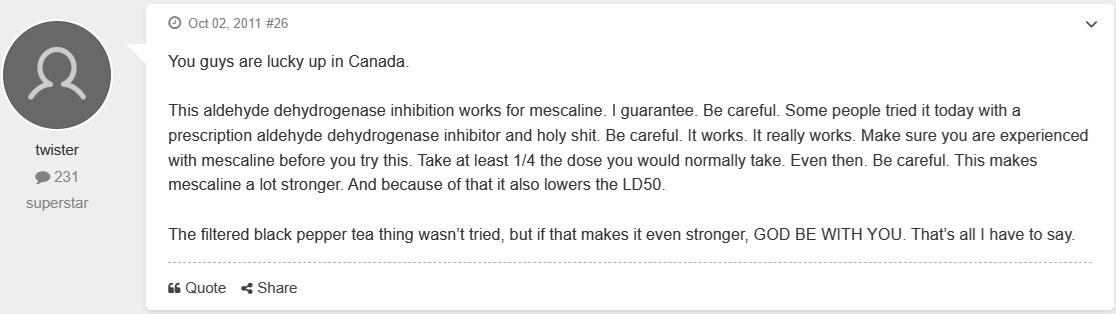
I personally think that mescaline is a weakly active prodrug. This post is from an old forum I used to participate:

image.png


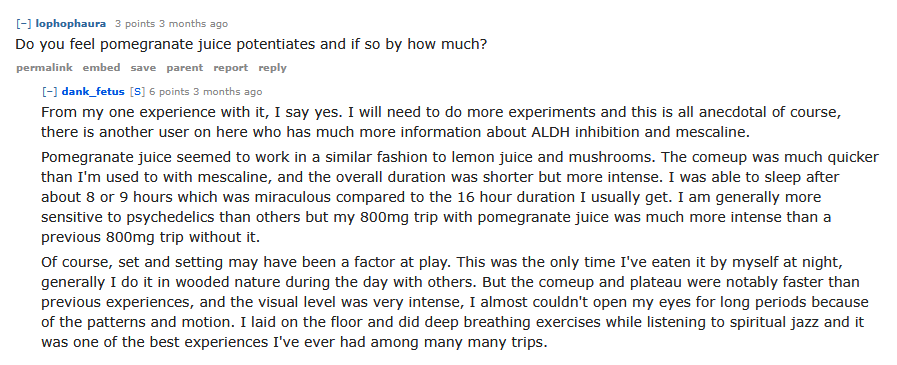
More recently:

image.png


Then again it could also just be slow absorption, prolonged distribution and many other things.
I think the 3,4,5-trimethoxy PEA format has peculiarities which lend to this unusual so-called bioactivation process. Modifications to either the tail (ฮฑ, รŸ, N) or aromatic ring all tend to create something much more potent. "Leave the prodrug alone". If you cyclize the N part then the aldehyde metabolite no longer forms, likewise with mescaline-NBOMe or dimethylmescaline.
 
Last edited:
Well, maybe there is indeed something missing and I wouldn't be surprised of active metabolites (moreso of metabolites not acting on 5-HT2AR though). So I don't want to discount it entirely. But I do think the main action is indeed the phenethylamine itself, and not some yet to be shown metabolite. My issue is mainly of how sure you seem to be, despite it going against current thinking/evidence. I do agree that not all things are set in stone, but some things are difficult and/or dangerous to prove/disprove in humans.

I agree mescaline has a slow come-up, but all long acting phenethylamines tend to be like that. I feel it building starting at T0:20h on empty stomach consumed orally, and it's already at pretty developed effects at T0:40 - T1:00h for me (similar to *most* other phenethylamines I tried, an exception perhaps being DOM). I do not agree with it having a biphasic nature for me.

My MAO-B comment came from what I know about 2C-B, where addition of selegiline makes it similar in potency, character and duration to DOB. I forgot about mescaline being primarily metabolised via DAO. Mea culpa.
 
My issue is mainly of how sure you seem to be, despite it going against current thinking/evidence.
This particular statement speaks volumes I think. Dogma remains as such until it's intentionally addressed.

I agree mescaline has a slow come-up, but all long acting phenethylamines tend to be like that.
This is partly implied by my earlier statement that "any clues are rationalised away under the presupposition that mescaline is the active drug".
 
Extraordinary claims require extraordinary evidence. You postulate a metabolite with MDA-like potency yet it can't be found? That's a bit convenient. Also *all* statements about bias etc can go right back at you too.
 
Well, maybe there is indeed something missing and I wouldn't be surprised of active metabolites (moreso of metabolites not acting on 5-HT2AR though).
Out of curiosity, what makes you exclude HT2a from the possible targets? I presume you didn't identify and screen any of these theorised metabolites...

Extraordinary claims require extraordinary evidence.
There are many clues - yet no academic (properly equipped) organisation with aptly minded people to carry out the necessary investigations.

You postulate a metabolite with MDA-like potency yet it can't be found?
Yes, with a dose range reminiscent of MDA, perhaps 100-300mg give or take. MDA is the closest verified example I'm aware of. If someone enacts the necessary enzymatic (and precursor) conditions then 100mg mescaline freebase should produce a strong experience. There's something which can be empirically tested by someone who is informed about the prerequisite in-vivo conditions.
 
I've heard he will be productive as long as the world does not run out of nicotine lol Which methoxyphenethylamine were you talking about, you've got my attention?
He is specifically referring to what he calls 2B which is 4-bromo-2-methoxyphenethylamine and also 3-B which is 4-bromo-3-methoxyphenethylamine. Imagine 2C-B with only a single methoxy group. I mistakenly called the 2nd one 5B, but if the 2-meo is taken out, the 5 position methoxy is now at the 3 position. He told me he believes the 2B will be active and he's not super hopeful about the 3B. I recommend following his IG page he is always crystallizing some new beta nitrostyrene. As long as you can ask a proper chemistry question he is very responsive and happy to talk shop. I am told to be on the lookout for a pHD dissertation by Dr. Tilka Fannana. Apparently she has done a lot of work on novel phenethylamines and related SAR.
 
He is specifically referring to what he calls 2B which is 4-bromo-2-methoxyphenethylamine and also 3-B which is 4-bromo-3-methoxyphenethylamine. Imagine 2C-B with only a single methoxy group. I mistakenly called the 2nd one 5B, but if the 2-meo is taken out, the 5 position methoxy is now at the 3 position. He told me he believes the 2B will be active and he's not super hopeful about the 3B. I recommend following his IG page he is always crystallizing some new beta nitrostyrene. As long as you can ask a proper chemistry question he is very responsive and happy to talk shop. I am told to be on the lookout for a pHD dissertation by Dr. Tilka Fannana. Apparently she has done a lot of work on novel phenethylamines and related SAR.
Interesting. It has been shown that 4-lipophilic-2-methoxyphenethylamine-NBOx are potent compounds in humans. I do not use Instagram ever, so will have to pass on the beautiful nitrostyrenes. But I have seen plenty of them through my own eyes instead of a screen :)
 
He is specifically referring to what he calls 2B which is 4-bromo-2-methoxyphenethylamine and also 3-B which is 4-bromo-3-methoxyphenethylamine. ... He told me he believes the 2B will be active and he's not super hopeful about the 3B.
2B is reminiscent of 5-MeO-7-TMT, so he's probably right in that it'll be active. The '3 is better suited to tetralin / chroman SAR tbh, so he's probably right in that it'll be mild or inactive.
 
I'd add also, this oversight of mescaline SAR impacts many areas, notably Shulgins "Mescaline Units" measurement; also SAR design for mescaline analogues eg people putting 2-ร— or 5-ร— on the 3,4,5-TMeO without a grander contextualised insight into mescalines nature.
5-x? There is nothing to be put there as it is blocked by methoxy already (unless you mean a modification of that), or do you mean 6-x? 2-Halomescalines and 2,6-dihalomescalines are all more potent than the parent compound.
 
I'm happy to consider that things may have been missed & overlooked; it wouldn't be the first time. I bet the active metabolite(s) are broken down into compounds which are unrecognisable as being anything special or unusual and thus become interpreted & contextualised within the current narrative.
If you could get your hands on any putative mescaline metabolite you are speculating on, which would you think is a hot candidate?
 
Top