• BASIC DRUG
    DISCUSSION
    Welcome to Bluelight!
    Posting Rules Bluelight Rules
    Benzo Chart Opioids Chart
    Drug Terms Need Help??
    Drugs 101 Brain & Addiction
    Tired of your habit? Struggling to cope?
    Want to regain control or get sober?
    Visit our Recovery Support Forums
  • BDD Moderators: Keif’ Richards

Poly drug use and cycling to minimize dependency & tolerance risk - In other words this idiot's addicted to being high

I use something almost daily, mainly as a way to reduce my alcohol problem, well thats good if using some other drugs helps you with your alcohol problem but if you think there is something wrong with taking pills everyday than u are wrong, let me clear this misconception by telling u that the average age of humans in ancient age was just 30-34 years this was mainly because their intake was much less, the most things we devour with our stomach the most mentally and physically strong we become.
 
I use something almost daily, mainly as a way to reduce my alcohol problem, well thats good if using some other drugs helps you with your alcohol problem but if you think there is something wrong with taking pills everyday than u are wrong, let me clear this misconception by telling u that the average age of humans in ancient age was just 30-34 years this was mainly because their intake was much less, the most things we devour with our stomach the most mentally and physically strong we become.


it's science, Neil said so
 
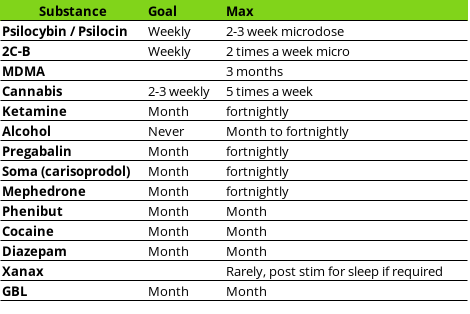
I'm on another mission, so a big update.

After more research I've used AI to create a protocol for poly drug use, the key goals are:-
  1. Avoid tolerance/dependency
  2. Avoid hitting receptors repeatedly with multiple drugs
  3. Give receptors time to recover between uses
  4. Stick to a usage frequency pattern that keeps dosage fixed and the effect the same
  5. Provide options to further reduce usage as a next step
  6. Dosage is assumed to be "normal" recreational amount - as per "threshold, common/normal, strong" general dosage amounts. YMMV etc.
As a result of the goals I've removed all Benzos from my list:- AI rationale "Diazepam was excluded because it shares the same calming receptor system as existing sedative drugs, has a long duration of action, creates cross-tolerance, and reduces recovery time between uses. Removing it simplifies the drug pattern and reduces overlapping dependence risk.”

I have ignored Cannabis, because in all honestly I'm fucking taking it every day regardless.

Version 0.1
Draft, comments, feedback, corrections, red flags are very welcome, I could use reviewers to feedback -
  • This is AI generated based on my steer given my own latest thinking and research
  • I've reviewed the basics and have tried to tackle formatting for readability
  • WARNING - No validation has been attempted in terms of tolerance or dependency, so do your own research on this 1st
  • I've not checked that receptor and cross-tolerance info is correct however AI is usually pretty good on these points - again check or even better confirm in that this is correct if it is
  • I need to also check the reference that AI provided to make sure they are real and not hallucinations!
To Do
  1. Add in Alcohol - it's not there now because I stopped drinking
  2. Update with GABA repair info earlier in this thread
It's taken me 3 months of research to get to this point, and a lot of effort, however please call out anything that's wrong and highlight any areas that need further work, research, or validation, then when I have time I'll try to look at them. Accuracy beats ego everytime for things like this.

How can you help?
  1. Review and comment for accuracy
  2. Please tag/DM any domain experts that might be able to review certain drugs/sections, it's always better when things get community validation
Now I'm going to go and take a couple of Soma as my reward

How to use this info
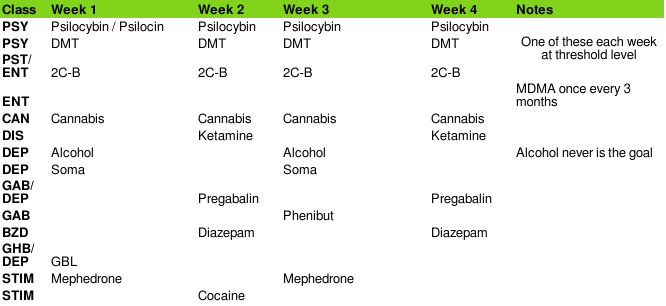
Just read either the "Poly drug use cycling harm reduction" or the simple version. Other spoilers contain deeper info on relevant subjects to explain why. The example 2 week rotation with pregablin is likely what I will try to implement myself as a next step on my journey, however note to self I need to start introducing regular weekly breaks each month from GABA drugs (GABA is my personal main issue!). I also plan to have 1 week off per month from stims, and the same for Ket/2C-B/MDMA (which I'll do occasionally).

I am not advocating that you start taking any of these drugs if you currently don't take them, in fact 1 big take out is to reduce the number and types of drugs you do take to something that is more managable, do not add more risk to yourself. Be aware that each of these drugs in their own right have dependency issues, individual abuse/addiction/withdrawal risks have not be covered, please make sure you understand the risks about every drug you take before using them.

This is meant more as a harm reduction framework, it's NOT a guide to maximising your drug intake safely, there are always risks taking drugs, and more risks taking multiple drugs. YMMV. Do your own research about things you're putting in your body. Do not trust AI or single sources on the internet for your safety

Reducing Harm From Multiple Substance Use​

Risk, tolerance, and dependence​


The main goal​

When someone is using several substances regularly, the first goal is not perfection.
The first goals are:
✅ Have planned days with no substances
✅ Reduce mixing different drug types together
✅ Avoid needing higher amounts to get the same effect
✅ Give your brain time to recover
✅ Gradually reduce the number of substances used


Step 1: Understand the “drug groups”​

Different drugs affect different systems in the brain.
Think of them like different “volume controls”:
Code:
                BRAIN SYSTEMS

     STIMULATION              CALMING

  Amphetamine              GBL
  Cocaine                  Carisoprodol
  Mephedrone

        ↑                       ↓


        ALTERED PERCEPTION / EXPERIENCE

        Ketamine
        2C-B
Using drugs from the same group repeatedly makes the brain adjust.
This can lead to:
  • Less effect from the same amount
  • Wanting higher amounts
  • Feeling worse without the drug
  • Difficulty taking breaks


Step 2: The first target — create recovery days​

If you currently use every day:

First goal:​

Reduce from:​

Code:
7 days per week
        ↓
5 days per week
        ↓
2 planned no-drug days
A realistic first target is to create a weekly structure where some days are focused on a single drug category rather than using multiple substances together.
Example:
DayGoal
MondayPlanned stimulant day (choose one stimulant only: amphetamine OR cocaine OR mephedrone). Ideally keep the same stimulant for the whole week rather than switching between stimulants day-to-day.
TuesdayPlanned GABA day (choose one: GBL OR carisoprodol; avoid combining both if possible). If using GABA drugs, keeping the same choice for the week can make it easier to monitor tolerance and effects.
Wednesday⭐ No drug day
ThursdayPlanned alternative day (ketamine OR 2C-B, rather than adding it on top of other drugs). These can be used as alternatives during breaks from other categories rather than as additional substances.
FridayPlanned stimulant or GABA day (choose one category; avoid using both together). If using a stimulant, continue with the same stimulant chosen earlier in the week where possible rather than switching between stimulant types.
SaturdayFlexible/social day (if using, try to keep to one drug class rather than mixing stimulant + GABA drugs). If changing substances, remember that switching within the same class does not necessarily reset tolerance because related drugs can affect overlapping brain systems.
Sunday⭐ No drug day

How this can change week to week​

The aim is not to create a strict schedule, but to introduce structure and avoid using the same drug patterns continuously.
A possible approach:

Week 1: Establish a baseline​

  • Choose one stimulant for the week (for example, amphetamine).
  • Choose one GABA medication if using that category (for example, GBL or carisoprodol).
  • Keep the two no-drug days.

Week 2: Change one variable​

  • If the person wants to rotate stimulants, they could choose a different stimulant for the next week (for example, cocaine instead of amphetamine).
  • Avoid changing stimulant type every day, as this can maintain tolerance across the stimulant group.
  • Switching between drugs within the same class usually does not provide a full tolerance reset because the brain systems affected overlap.
  • Potential benefits of switching between drug classes (rather than staying within the same class) may include:
    • Reducing continuous exposure to the same brain systems, which may allow more opportunity for recovery and lower tolerance over time.
    • Stimulants (amphetamine, cocaine, mephedrone): taking breaks from repeated dopamine/noradrenaline stimulation may help reduce stimulant tolerance and allow reward pathways to recover.
    • GABA-related drugs (GBL, carisoprodol): taking breaks from repeated GABA-related calming effects may help reduce tolerance risk and allow the brain’s calming systems to recover.
    • Ketamine/dissociatives: reducing frequency may allow recovery from adaptations in glutamate/NMDA-related pathways and reduce dissociative tolerance.
    • Psychedelics (such as 2C-B): spacing use allows serotonin receptor sensitivity to recover and reduces rapid psychedelic tolerance.
  • Keep the same overall structure of planned use days and recovery days.

Week 3: Focus on reducing one category​

Examples:
  • Reduce the number of GABA days.
  • Reduce stimulant days.
  • Increase alternative or no-drug days.

Week 4: Lower-intensity week​

Use this as a review period:
  • Keep the two no-drug days.
  • Avoid increasing amounts to compensate for tolerance.
  • Consider using fewer substances overall.
The general principle is:
Code:
One week = one main pattern

↓
Allow recovery

↓
Change gradually rather than changing everything at once
Switching between related drugs may change the experience, but it does not necessarily give the brain a full tolerance reset because similar drug classes can affect overlapping systems.
The first step is not choosing the “perfect” substance — it is creating separation between drug classes.
A useful starting rule:
✅ Stimulant days = amphetamine OR cocaine OR mephedrone
✅ GABA days = GBL OR carisoprodol
✅ Psychedelic/dissociative days = ketamine OR 2C-B
✅ No-drug days = no psychoactive substances
The aim is to move away from:
Code:
Multiple drugs every day
        ↓
One planned category per day
        ↓
More recovery days
The two no-drug days are important because they allow your brain and body to recover.
If you currently use every day:

First goal:​

Reduce from:​

Code:
7 days per week
        ↓
5 days per week
        ↓
2 planned no-drug days
A realistic first target:
DayGoal
MondayPlanned use
TuesdayPlanned use
Wednesday⭐ No drug day
ThursdayPlanned use
FridayPlanned use
SaturdayPlanned use/social day
Sunday⭐ No drug day
The two no-drug days are important because they allow your brain and body to recover.


Step 3: Avoid mixing drug groups​

The biggest risk often comes from combining different types of drugs.
Example:
Code:
STIMULANT
     ↓
Amphetamine / Cocaine / Mephedrone

        +
 
DEPRESSANT
     ↓
GBL / Carisoprodol

        =
"UP → DOWN" cycle
This pattern can increase:
  • Sleep disruption
  • Mood swings
  • Cravings
  • Difficulty controlling use


Step 4: Understanding tolerance​

Tolerance means:
“The same amount no longer feels as strong, so the person feels tempted to take more.”
Example:
Code:
First use:
10 mg → strong effect

After repeated use:
10 mg → weaker effect

Risk:
10 mg → 20 mg → higher tolerance
The safer response to tolerance is usually:
Take a break, rather than increase the amount.


Cross-tolerance: why switching drugs may not reset tolerance​

Some drugs affect similar brain systems.
This means:
Using one drug can reduce the effect of another related drug.

Stimulant group​

DrugMain brain system affected
AmphetamineDopamine + noradrenaline
CocaineDopamine + noradrenaline + serotonin
MephedroneDopamine + noradrenaline + serotonin
These drugs overlap.
Example:
Code:
Amphetamine use
        ↓
Brain adapts
        ↓
Cocaine may feel weaker
Switching between stimulants does not always give your brain a full break.


Calming / GABA-related drugs​

DrugMain system affected
GBLGABA-related calming system
CarisoprodolGABA-related calming system
These drugs can create tolerance because the brain adapts to repeated calming signals.
Important:
  • Avoid making them a daily routine
  • Avoid using them automatically after stimulant use
  • Allow breaks


Ketamine and 2C-B​

These are often grouped together because they are both considered “non-stimulant/non-GABA” substances, but they actually work on different brain systems and should generally be treated separately when thinking about tolerance and recovery.
DrugMain system affectedMain tolerance consideration
KetamineGlutamate/NMDA systemFrequent use can lead to reduced effects and increased risk of psychological dependence
2C-BSerotonin systemFrequent use can lead to rapid psychedelic tolerance
They generally do not have the same cross-tolerance as stimulants or GABA drugs.

Should they be grouped together?​

They can be grouped together as “alternative substances” when the goal is to avoid returning to stimulant or GABA drug use.
However, they should not be considered interchangeable:
  • Ketamine and 2C-B affect different brain systems
  • Tolerance to one does not necessarily mean tolerance to the other
  • The risks and reasons for taking breaks are different

How their protocols differ​

Ketamine​

Focus on:
  • Avoiding frequent or routine use
  • Watching for increasing amounts or frequency
  • Avoiding using it as a replacement for daily GABA or stimulant use

2C-B​

Focus on:
  • Allowing time between experiences to reduce tolerance
  • Avoiding frequent repetition because effects can diminish quickly
  • Keeping use occasional rather than making it a regular coping strategy
However:
  • Frequent use of either substance can still create tolerance
  • Either substance can become a habit
  • They should not replace one problem with another
  • Planned breaks are still important even when substances come from different categories


A simple monthly reduction example​

Month 1 goal:​

Reduce daily use and create structure.
Code:
Week 1:
★★★★★
Use less often
Create 1–2 no-drug days

Week 2:
★★★★☆
Avoid mixing drug groups

Week 3:
★★★☆☆
Reduce one drug category

Week 4:
★★☆☆☆
Increase recovery days


A simple rule system​

Try to follow:​

✅ Keep two no-drug days each week
✅ Keep doses the same rather than increasing
✅ Avoid using multiple drug types together
✅ Avoid using one drug to fix another drug’s effects
✅ Track what you take and when
✅ Build breaks into your routine


Warning signs that use is becoming harder to control​

Speak to a healthcare professional if:
⚠ You need more to get the same effect
⚠ You cannot take planned breaks
⚠ You use drugs to feel “normal”
⚠ You wake up thinking about using
⚠ You feel withdrawal symptoms
⚠ Your use is affecting sleep, work, relationships, or mood


The aim​

The goal is not to judge yourself or suddenly change everything overnight.
The goal is:
Code:
Many drugs every day

        ↓

Fewer drugs

        ↓

More recovery days

        ↓

Lower risk and more control
Small consistent changes are usually more sustainable than sudden large changes.


This is meant more as a harm reduction framework, it's NOT a guide to maximising your drug intake safely, there are always risks taking drugs, and more risks taking multiple drugs. YMMV. Do your own research about things you're putting in your body. Do not trust AI or single sources on the internet for your safety

🧠 REDUCING HARM FROM MULTIPLE SUBSTANCE USE​

A practical guide to reducing risk and regaining control​

Small changes can make a big difference.
If you currently use several substances, the first goal is not necessarily to stop everything immediately.
The first goals are:
🟢 Create recovery days
🟢 Reduce mixing substances
🟢 Avoid needing more to get the same effect
🟢 Give your brain time to recover
🟢 Move toward fewer substances over time


🧩 Understanding drug groups​

Different substances affect different systems in the brain.

⚡ STIMULANTS​

Examples:
  • Amphetamine
  • Cocaine
  • Mephedrone
Common effects:
  • More energy
  • Increased confidence
  • Increased alertness
Main risks:
  • Tolerance
  • Sleep disruption
  • Crashes
  • Increased cravings


🌙 CALMING / GABA-RELATED DRUGS​

Examples:
  • GBL
  • Carisoprodol
Common effects:
  • Relaxation
  • Reduced anxiety
  • Sedation
Main risks:
  • Tolerance
  • Dependence
  • Difficulty stopping


🌈 EXPERIENCE-ALTERING DRUGS​

Examples:
  • Ketamine
  • 2C-B
Common effects:
  • Changes in perception
  • Altered thinking and sensations
Main risks:
  • Tolerance if used frequently
  • Psychological reliance


🔄 Why breaks matter​

Your brain adapts to repeated exposure.
This is called tolerance.
Code:
Same amount used repeatedly

          ↓

Brain adjusts

          ↓

Same amount feels weaker

          ↓

Risk of taking more increases
The safest response to tolerance is usually:

Take a break — not a bigger dose​


📅 First goal: create recovery days​

If you currently use every day:

Step 1​

Code:
7 days using

      ↓

5 days using
+
2 recovery days
A recovery day means:
✅ No recreational drugs
✅ Normal sleep routine
✅ Food and hydration
✅ Exercise or normal activities


Example weekly structure​

DayGoal
MondayPlanned use
TuesdayPlanned use
Wednesday🟢 Recovery day
ThursdayPlanned use
FridayPlanned use
SaturdayPlanned use/social day
Sunday🟢 Recovery day


PAGE 2​

🔀 Understanding cross-tolerance​

Some drugs affect similar brain systems.
This means:
Using one drug can reduce the effect of another related drug.


⚡ Stimulant overlap​

DrugMain effect
AmphetamineDopamine + noradrenaline
CocaineDopamine + noradrenaline + serotonin
MephedroneDopamine + noradrenaline + serotonin
Example:
Code:
Amphetamine use

       ↓

Brain adapts

       ↓

Cocaine may feel weaker
Switching stimulants does not always give your brain a full break.


🧠 Drug groups at a glance​

SubstanceMain brain systemMain concern
AmphetamineDopamine/noradrenalineTolerance, sleep
CocaineDopamine/noradrenaline/serotoninRedosing
MephedroneDopamine/noradrenaline/serotoninRapid tolerance
GBLGABA calming systemDependence risk
CarisoprodolGABA calming systemSedation/dependence
KetamineGlutamate systemTolerance
2C-BSerotonin systemFrequent-use tolerance


🚦 Harm-reduction traffic light​

🟢 Lower-risk choices​

✔ Keep 2 recovery days each week
✔ Keep doses stable
✔ Plan use in advance
✔ Reduce mixing substances
✔ Track your pattern


🟡 Watch for warning signs​

⚠ Using more often
⚠ Needing more for the same effect
⚠ Using to feel normal
⚠ Difficulty taking breaks
⚠ Adding more substances


🔴 Get support if:​

⚠ You cannot reduce despite wanting to
⚠ You experience withdrawal symptoms
⚠ You need substances to sleep or function
⚠ Use is affecting your health or relationships


🎯 The reduction pathway​

Code:
CURRENT PATTERN

Multiple substances every day

          ↓

FIRST TARGET

2 recovery days per week

          ↓

NEXT TARGET

Fewer combinations

          ↓

LONG TERM GOAL

Fewer substances + more control


Remember​

The aim is progress, not perfection.
The biggest improvements usually come from:
1️⃣ Creating gaps between use
2️⃣ Reducing mixing
3️⃣ Avoiding dose increases
4️⃣ Giving your brain recovery time
Small consistent changes are more sustainable than trying to change everything at once.


Talk to your healthcare professional before reducing drugs that can cause physical dependence, especially GBL or other sedative drugs.

For a patient currently using multiple drugs daily, a sudden move to occasional use can be unrealistic and may lead to failure, concealment, or rebound use. A more practical harm-reduction approach is often stepwise reduction: first create structure, introduce non-use days, reduce mixing, then gradually reduce frequency and reliance on higher-risk substances.
The framework below is a goal-based reduction plan, not a rigid rule. The aim is:
  1. Establish 2 non-use days per week
  2. Reduce daily multi-drug exposure
  3. Avoid using the same drug class continuously
  4. Create planned “lower-risk weeks”
  5. Gradually reduce the number of substances involved


Stage 2: Transitional harm-reduction model​

Current pattern​

Daily use of:
  • GBL
  • Carisoprodol
  • Ketamine
  • Mephedrone
  • Amphetamine
  • 2C-B

Target pattern (first goal)​

AreaCurrentInitial target
Drug-free days0/week2/week
Multiple drugs in one dayFrequentReduce mixing
GABA drugsFrequentLimit to selected days
StimulantsFrequentRotate rather than stack
Number of substances6Gradually reduce


Weekly structure (first 1–3 months)​

Example weekly template​

DayGoal
MondayStimulant-focused day (choose one: amphetamine / cocaine / mephedrone)
TuesdayGABA-focused day (GBL OR carisoprodol, not both if possible)
WednesdayNo drug day
ThursdayKetamine or 2C-B OR stimulant day
FridayGABA-focused day
SaturdayFlexible/social day (avoid combining multiple classes where possible)
SundayNo drug day


Why this structure works​

1. Two fixed no-use days​

The most important early change is:
Daily use → 5 days/week
Even this creates meaningful improvement because the brain is no longer exposed continuously.
The two no-use days should ideally:
  • stay fixed each week
  • not become “catch-up” days
  • not be followed by very large doses


Monthly rotation approach​

Rather than trying to remove everything immediately, use “focus weeks”.

Week 1 — Stimulant reduction week​

Focus:
  • Keep stimulant use predictable
  • Avoid combining stimulants
Example:
DayCategory
MonAmphetamine/cocaine/mephedrone
TueNo stimulant
WedNo drugs
ThuStimulant
FriGABA
SatOptional stimulant/social day
SunNo drugs


Week 2 — GABA reduction week​

Focus:
  • Reduce GBL/carisoprodol frequency
Example:
DayCategory
MonGABA
TueNon-GABA
WedNo drugs
ThuKetamine/2C-B
FriGABA
SatNon-GABA
SunNo drugs


Week 3 — Dissociative/psychedelic substitution week​

Focus:
  • Use alternatives rather than increasing GABA or stimulant use
Example:
DayCategory
MonNo drugs
TueKetamine/2C-B
WedNo drugs
ThuStimulant
FriGABA
SatSocial/non-drug activity
SunNo drugs


Week 4 — Reset week​

Goal:
  • Lowest overall exposure
Example:
DayCategory
MonNo drugs
TueOne planned substance
WedNo drugs
ThuOne planned substance
FriNo drugs
SatOptional
SunNo drugs


Drug-class management rules​

GABA drugs (GBL/carisoprodol)​

Initial target:
  • Reduce from daily → 2–3 days/week
  • Avoid consecutive days where possible
Longer-term target:
  • 1–2 days/week or less
Important:
  • Do not use GABA drugs automatically after stimulant use.
  • Avoid making them the “solution” for sleep, anxiety, or crashes.


Stimulants (amphetamine/cocaine/mephedrone)​

Initial target:
  • Reduce from daily → 2–3 days/week
Rules:
  • Switching stimulant type is allowed initially.
  • Avoid stimulant days becoming consecutive.
  • Avoid using one stimulant because another “stopped working.”
Longer-term:
  • Choose one preferred stimulant rather than rotating all three.


Ketamine/2C-B​

Initial target:
  • Use as alternatives rather than additions.
Rules:
  • Do not add them on top of existing stimulant/GABA use.
  • Avoid increasing frequency because tolerance develops.


Progression targets​

Time periodGoal
Month 1Achieve 2 no-drug days/week
Month 2Reduce mixing multiple classes on the same day
Month 3Reduce GABA/stimulant days
Month 4+Move toward fewer substances overall


Signs the plan is working​

✅ Two planned no-use days happen consistently
✅ Same doses continue to work
✅ Less need to combine substances
✅ Less thinking about the next dose
✅ More normal sleep and mood between use days


Signs the plan needs adjustment​

⚠️ The patient cannot maintain even one no-use day
⚠️ Amounts increase to compensate
⚠️ GBL/carisoprodol become necessary to feel normal
⚠️ Stimulants and depressants become a repeating “up/down” cycle
⚠️ Planned use becomes unplanned use
For a patient starting from multiple daily substances, the biggest early success marker is not eliminating drugs — it is creating predictable gaps, reducing mixing, and breaking the daily-use pattern. Once that foundation exists, further reductions become much more achievable.

Below is an example harm-reduction conversation structure for a patient using multiple substances. It is designed around the goals of reducing complexity, reducing risk, and moving toward a more sustainable pattern. It is not a recommendation to use these substances; it is an example of how a clinician might discuss reducing harm with someone who is not currently ready or able to stop completely.
The key idea is simplification:
  1. Move from many drugs → fewer drugs
  2. Avoid mixing different drug families
  3. Move toward the lowest-risk pattern that still meets the patient’s goals


Stage 1 — Current situation: All drugs being used​

Current substances:
  • Gamma-Butyrolactone (GBL)
  • Carisoprodol
  • Ketamine
  • 4-Methylmethcathinone (Mephedrone)
  • Amphetamine
  • 2C-B

Main risks of this pattern​

IssueWhy it matters
Many different substancesHarder to predict effects and recognise problems
Stimulants + depressantsCan create cycles of “up” then “down”
Multiple dopamine/stimulant drugsGreater tolerance pressure
Multiple sedating drugsHigher risk of impaired judgement and dependence
Frequent switchingMakes it difficult to know which drug is causing problems

First goal:​

Do not add anything new. Reduce the number of moving parts.


Stage 2 — Reduce to one drug "family"​

Rather than choosing individual drugs, group them by purpose.

Option A: Keep the stimulant category​

Remove:
  • GBL
  • Carisoprodol
  • Ketamine
  • 2C-B
Keep only:
  • Amphetamine or
  • Mephedrone
BenefitResult
Removes sedative drugsLess dependence risk from depressants
Removes stimulant combinationsLess tolerance pressure
Easier to monitorClearer relationship between use and effects
Principle:
One stimulant is less complicated than rotating between several stimulants.


Option B: Keep the psychedelic/dissociative category​

Remove:
  • GBL
  • Carisoprodol
  • Amphetamine
  • Mephedrone
Keep:
  • Ketamine or
  • 2C-B
BenefitResult
Removes daily-use potential drugsLower dependence risk
Less receptor overlapLess tolerance pressure
More occasional patternEasier recovery
Principle:
Occasional experiences are generally lower risk than drugs that can become routine.


Stage 3 — More sustainable reduced combination​

A harm-reduction goal might be moving toward something like:

Example reduced pattern​

Remove:​

❌ GBL
❌ Carisoprodol
❌ Mephedrone
❌ Amphetamine

Retain:​

✅ Ketamine occasionally
✅ 2C-B occasionally
Why this may be considered a lower-risk direction:
ChangeReason
Remove GBLGABA-related dependence can develop quickly with frequent use
Remove carisoprodolDependence risk and sedation overlap
Remove multiple stimulantsReduces dopamine tolerance pressure
Avoid stimulant/depressant cyclingLess “up/down” reinforcement
Keep only occasional-use substancesLess likely to become a daily habit


Example progression table​

StageDrugs PresentMain Goal
Stage 1GBL + carisoprodol + ketamine + mephedrone + amphetamine + 2C-BStop escalation and understand pattern
Stage 2Amphetamine or mephedrone onlyRemove cross-tolerance and simplify
Stage 3Ketamine or 2C-B occasionallyMove toward lower-frequency use


Patient-friendly explanation​

“The biggest risk is not necessarily one specific substance—it is having many different substances available for different situations. The brain has less chance to recover when there is always another drug filling the gap. The first step is not perfection; it is reducing the number of substances until your pattern becomes predictable and easier to control.”


Clinical points worth assessing​

A clinician would usually want to explore:
  • Which substance is hardest to stop?
  • Which substance is used most frequently?
  • Is any substance being used to manage withdrawal or a crash from another?
  • Are there morning/daytime uses?
  • Are doses increasing?
  • Is use interfering with sleep, work, relationships, or mood?
In this particular combination, GBL and carisoprodol would usually receive the highest priority for review because of their dependence potential, while mephedrone and amphetamine would usually receive attention because of tolerance, binge patterns, and reinforcement risk.

For a patient currently using multiple drugs daily, a sudden move to occasional use can be unrealistic and may lead to failure, concealment, or rebound use. A more practical harm-reduction approach is often stepwise reduction: first create structure, introduce non-use days, reduce mixing, then gradually reduce frequency and reliance on higher-risk substances.
The framework below is a goal-based reduction plan, not a rigid rule. The aim is:
  1. Establish 2 non-use days per week
  2. Reduce daily multi-drug exposure
  3. Avoid using the same drug class continuously
  4. Create planned “lower-risk weeks”
  5. Gradually reduce the number of substances involved


Stage 2: Transitional harm-reduction model​

Current pattern​

Daily use of:
  • GBL
  • Carisoprodol
  • Ketamine
  • Mephedrone
  • Amphetamine
  • 2C-B

Target pattern (first goal)​

AreaCurrentInitial target
Drug-free days0/week2/week
Multiple drugs in one dayFrequentReduce mixing
GABA drugsFrequentLimit to selected days
StimulantsFrequentRotate rather than stack
Number of substances6Gradually reduce


Weekly structure (first 1–3 months)​

Example weekly template​

DayGoal
MondayStimulant-focused day (choose one: amphetamine / cocaine / mephedrone)
TuesdayGABA-focused day (GBL OR carisoprodol, not both if possible)
WednesdayNo drug day
ThursdayKetamine or 2C-B OR stimulant day
FridayGABA-focused day
SaturdayFlexible/social day (avoid combining multiple classes where possible)
SundayNo drug day


Why this structure works​

1. Two fixed no-use days​

The most important early change is:
Daily use → 5 days/week
Even this creates meaningful improvement because the brain is no longer exposed continuously.
The two no-use days should ideally:
  • stay fixed each week
  • not become “catch-up” days
  • not be followed by very large doses


Monthly rotation approach​

Rather than trying to remove everything immediately, use “focus weeks”.

Week 1 — Stimulant reduction week​

Focus:
  • Keep stimulant use predictable
  • Avoid combining stimulants
Example:
DayCategory
MonAmphetamine/cocaine/mephedrone
TueNo stimulant
WedNo drugs
ThuStimulant
FriGABA
SatOptional stimulant/social day
SunNo drugs


Week 2 — GABA reduction week​

Focus:
  • Reduce GBL/carisoprodol frequency
Example:
DayCategory
MonGABA
TueNon-GABA
WedNo drugs
ThuKetamine/2C-B
FriGABA
SatNon-GABA
SunNo drugs


Week 3 — Dissociative/psychedelic substitution week​

Focus:
  • Use alternatives rather than increasing GABA or stimulant use
Example:
DayCategory
MonNo drugs
TueKetamine/2C-B
WedNo drugs
ThuStimulant
FriGABA
SatSocial/non-drug activity
SunNo drugs


Week 4 — Reset week​

Goal:
  • Lowest overall exposure
Example:
DayCategory
MonNo drugs
TueOne planned substance
WedNo drugs
ThuOne planned substance
FriNo drugs
SatOptional
SunNo drugs


Drug-class management rules​

GABA drugs (GBL/carisoprodol)​

Initial target:
  • Reduce from daily → 2–3 days/week
  • Avoid consecutive days where possible
Longer-term target:
  • 1–2 days/week or less
Important:
  • Do not use GABA drugs automatically after stimulant use.
  • Avoid making them the “solution” for sleep, anxiety, or crashes.


Stimulants (amphetamine/cocaine/mephedrone)​

Initial target:
  • Reduce from daily → 2–3 days/week
Rules:
  • Switching stimulant type is allowed initially.
  • Avoid stimulant days becoming consecutive.
  • Avoid using one stimulant because another “stopped working.”
Longer-term:
  • Choose one preferred stimulant rather than rotating all three.


Ketamine/2C-B​

Initial target:
  • Use as alternatives rather than additions.
Rules:
  • Do not add them on top of existing stimulant/GABA use.
  • Avoid increasing frequency because tolerance develops.


Progression targets​

Time periodGoal
Month 1Achieve 2 no-drug days/week
Month 2Reduce mixing multiple classes on the same day
Month 3Reduce GABA/stimulant days
Month 4+Move toward fewer substances overall


Signs the plan is working​

✅ Two planned no-use days happen consistently
✅ Same doses continue to work
✅ Less need to combine substances
✅ Less thinking about the next dose
✅ More normal sleep and mood between use days


Signs the plan needs adjustment​

⚠️ The patient cannot maintain even one no-use day
⚠️ Amounts increase to compensate
⚠️ GBL/carisoprodol become necessary to feel normal
⚠️ Stimulants and depressants become a repeating “up/down” cycle
⚠️ Planned use becomes unplanned use
For a patient starting from multiple daily substances, the biggest early success marker is not eliminating drugs — it is creating predictable gaps, reducing mixing, and breaking the daily-use pattern. Once that foundation exists, further reductions become much more achievable.


This is a useful way to explain the concept to patients, but it's important not to present the percentages as measured scientific facts. We do not have studies showing, for example, that "dopamine receptors are 67% reset after 48 hours." Recovery differs by receptor, drug, dose, duration of use, and the individual.
Instead, you can present it as a conceptual recovery model that illustrates the direction of change rather than precise biology.
For example:
DayDrug classMain system affectedApproximate recovery status*
MondayStimulant (amphetamine or cocaine or mephedrone)Dopamine / Noradrenaline (± Serotonin)0% recovery – stimulant system is fully activated and begins adapting.
TuesdayGBL or CarisoprodolGABAergic systemStimulant system: ~30–40% recovered. GABA system: 0% recovery (new exposure).
Wednesday⭐ Drug-freeAll systemsStimulant: ~60–70% recovered. GABA: ~40–50% recovered.
ThursdayKetamine or 2C-BGlutamate (ketamine) or Serotonin 5-HT2A (2C-B)Stimulant: ~80–90% recovered. GABA: ~70–80% recovered. Minimal overlap with previous days.
FridayStimulant or GABADepends on choiceIf stimulant: dopamine system has had ~4 days since last stimulant, so much of the short-term adaptation has recovered. If GABA: GABA system has had ~3 days' recovery.
SaturdayFlexible (single class only)Depends on choiceIf repeating Friday's class, some new adaptation occurs. If using a different class, previously used systems continue recovering.
Sunday⭐ Drug-freeAll systemsRecovery continues across all systems before the next week begins.
*These percentages are illustrative only and are intended to help explain the concept of receptor/neurotransmitter system recovery. They are not measured biological values.

The key message for patients​

The protocol works because it spaces out repeated stimulation of the same brain systems, rather than because any particular receptor is "100% reset" after a fixed number of days.
Conceptually:
Code:
Repeated use of the same drug
        ↓
Brain adapts (tolerance develops)
        ↓
Breaks between uses allow adaptation to reverse
        ↓
Less tolerance
Less need to increase dose
Lower risk of dependence
So, rather than thinking of receptors as an on/off switch, it's better to think of them as gradually recovering towards baseline when they are given time without repeated stimulation. The exact recovery time varies by drug class—for example, stimulant-related adaptations often recover over days to weeks, whereas adaptations associated with long-term GABAergic drug use may take much longer if dependence has developed.

Below is an expanded version. Important caveat: the recovery percentages are not measured receptor reset values. They are a teaching model to show relative recovery trends after an isolated, typical/common dose with no established dependence. Real recovery can be much slower with daily use, high doses, sleep deprivation, or dependence.
Assumptions:
  • Starting point = person is not currently tolerant/dependent
  • Doses remain stable (no escalation)
  • Only one substance/class per day
  • “100% recovered” means “approaching previous baseline,” not that every receptor has returned exactly to normal
DayChoiceMain system affectedApproximate recovery status at end of day
MondayStimulant day (amphetamine OR cocaine OR mephedrone)Dopamine, noradrenaline (± serotonin)Stimulant system: ~0–10% recovery. Acute effects have ended, but compensatory changes begin (reduced sensitivity, neurotransmitter depletion). Other systems: ~100% baseline.
TuesdayGBLGABA-B system (plus downstream calming pathways)Stimulant system: ~30–40% recovered. GABA-B system: ~0–20% recovered (recently stimulated). Ketamine/2C-B systems: ~100%.
TuesdayCarisoprodolSedative system (mainly via meprobamate → GABA-A effects)Stimulant system: ~30–40% recovered. GABA-A/sedative system: ~0–20% recovered. GABA-B: relatively unaffected.
Wednesday⭐ No drug dayRecovery dayStimulant system: ~60–70% recovered. GBL-related GABA-B: ~40–60% recovered. Carisoprodol-related GABA-A: ~40–60% recovered. All other systems continue baseline recovery.
ThursdayKetamineNMDA/glutamate systemStimulant system: ~80–90% recovered. GABA systems: ~70–80% recovered. Glutamate system: ~0–20% recovery after use.
Thursday2C-BSerotonin receptors (especially 5-HT2A)Stimulant system: ~80–90% recovered. GABA systems: ~70–80% recovered. Serotonin system: ~0–20% recovery.
FridayStimulant day (same stimulant as Monday preferred)Dopamine/noradrenaline (± serotonin)If amphetamine: dopamine system has ~3–4 days recovery but may still have partial adaptation (~70–90%). If cocaine: similar recovery range but shorter acute depletion. If mephedrone: serotonin component may recover more slowly. A second stimulant exposure interrupts full recovery.
FridayGABA day – GBLGABA-BStimulant system: continues recovery (~80–95%). GABA-B: drops back toward lower recovery (~20–40%).
FridayGABA day – CarisoprodolGABA-A/sedative systemStimulant system: continues recovery (~80–95%). GABA-A: drops back toward lower recovery (~20–40%).
SaturdayFlexible stimulant (same stimulant preferred)Dopamine/noradrenalineRecovery from Monday/Friday stimulant use is interrupted. Stimulant system: may remain around ~50–70% rather than progressing toward baseline.
SaturdayFlexible GABA dayGABA systemRecovery from Tuesday/Friday GABA exposure is interrupted. GABA system: may remain ~40–60%.
SaturdayKetamineNMDA/glutamateDopamine and GABA systems continue recovering. Glutamate system: temporarily reduced recovery (~20–40%).
Saturday2C-BSerotoninSerotonin system recovery is slowed. If used close together, psychedelic tolerance can increase.
Sunday⭐ No drug dayFull recovery dayStimulant system: ~80–100% depending on Friday/Saturday choices. GABA system: ~70–90% depending on Tuesday/Friday/Saturday choices. Serotonin/glutamate: recovering.

What this schedule is trying to achieve​

The important pattern is not the exact percentages — it is the spacing:

Better pattern:​

Code:
Stimulant
↓
GABA
↓
OFF
↓
Different system
↓
Stimulant OR GABA
↓
Flexible
↓
OFF
This gives each system repeated opportunities to recover.

Higher-risk pattern:​

Code:
Amphetamine
↓
Mephedrone
↓
Cocaine
↓
Amphetamine
↓
Mephedrone
Even though the drugs are different, the same systems are repeatedly stimulated, so recovery is limited.


For a patient handout, I would simplify this further into “brain system recovery colours” rather than percentages, because the percentages can unintentionally imply a level of precision that does not exist. A clinician version can retain the approximate numbers as a conceptual model.

NB: I asked AI to create a 2 week rotation between GBL and Carisoprodol because they act on GABA-A and GABA-B, this provides a better improvement to GABA but it does not create a complete reset and should not be considered “avoiding GABA tolerance.”


GABA-A ↔ GABA-B switching is better than repeatedly hitting one receptor, but it is not equivalent to a true GABA break.


For the rotation model you were building, the hierarchy would be:​

ApproachRelative GABA recovery
No GABA drugs for several weeks⭐⭐⭐ Best
Occasional GABA use with long gaps⭐⭐ Good
Rotate GABA-A ↔ GABA-B weekly⭐ Better than repeating one
Rotate GABA-A ↔ GABA-B several times per week⚠️ Limited benefit
Daily mixed GABA-A + GABA-B use❌ Highest risk
So, in the context of your two-week example, GBL week 1 → carisoprodol week 2 is a more rational harm-reduction choice than GBL every week, but the biggest protective factor remains the number of GABA-free days, not simply switching receptor subtype.


Below is a two-week example showing how the same structure can work while rotating the GABA choice:
  • Week 1 GABA choice = GBL
  • Week 2 GABA choice = Carisoprodol
  • Thursday combines ketamine/2C-B as one “alternative class” choice
  • Friday combines stimulant vs GABA choices
  • Saturday is a single flexible day, with the preferred choice based on what was already used that week
Reminder: the recovery percentages are a teaching model, not measured receptor recovery values.


Example 2-week rotation​

Week 1: GBL week​

DayPlanned choiceMain system affectedApproximate recovery status at end of day
MondayStimulant day (choose ONE: amphetamine OR cocaine OR mephedrone; ideally keep the same stimulant throughout the week)Dopamine / noradrenaline (± serotonin)Stimulant system: ~0–10% recovered. Acute stimulation ends, but short-term adaptation begins. GABA, serotonin, glutamate systems: ~100% baseline.
TuesdayGBL dayGABA-B systemStimulant system: ~30–40% recovered. GABA-B system: ~0–20% recovered. Other systems remain close to baseline.
Wednesday⭐ No drug dayRecovery dayStimulant system: ~60–70% recovered. GABA-B: ~40–60% recovered. Brain begins reversing short-term adaptation.
ThursdayAlternative day: ketamine OR 2C-B (choose one, not both)Ketamine = glutamate/NMDA system. 2C-B = serotonin (5-HT2A) system.Stimulant system: ~80–90% recovered. GABA-B: ~70–80% recovered. Chosen alternative system temporarily drops (~0–20% recovery immediately after use).
FridayChoose ONE: stimulant OR GABA day (not both)

Preferred choice:
use the category that has had the longest break.

If Monday was stimulant → consider GABA instead.
If Tuesday was GBL → consider stimulant instead.
Depends on choiceIf stimulant: dopamine/noradrenaline recovery is interrupted (~60–80%).

If GBL: GABA-B recovery drops again (~20–40%).
SaturdayFlexible/social day: choose the class that has had the most recovery time. Avoid repeating Friday’s class if possible. Better is to have a no drug dayDepends on choiceIdeally choose the system least recently used. Repeating the same class (e.g., stimulant after stimulant) slows recovery.
Sunday⭐ No drug dayRecovery dayStimulant system: ~80–100% depending on Friday/Saturday choices. GABA-B: ~70–90% if no GBL since Tuesday. Other systems continue recovering.


Week 2: Carisoprodol week​

The structure stays the same, but the GABA drug changes.
DayPlanned choiceMain system affectedApproximate recovery status at end of day
MondayStimulant day (choose ONE stimulant and keep it consistent where possible)Dopamine / noradrenaline (± serotonin)Stimulant system: ~0–10% recovered. GABA-A/sedative system: ~100% baseline.
TuesdayCarisoprodol dayGABA-A/sedative system (via meprobamate)Stimulant system: ~30–40% recovered. GABA-A system: ~0–20% recovered.
Wednesday⭐ No drug dayRecovery dayStimulant system: ~60–70% recovered. GABA-A: ~40–60% recovered.
ThursdayAlternative day: ketamine OR 2C-B (choose one, not both)Ketamine = glutamate/NMDA. 2C-B = serotonin (5-HT2A).Stimulant system: ~80–90% recovered. GABA-A: ~70–80% recovered. Alternative system temporarily affected.
FridayChoose ONE: stimulant OR GABA day (not both)

Preferred choice:
choose the category least recently used.

If Monday stimulant → consider carisoprodol.
If Tuesday carisoprodol → consider stimulant.
Depends on choiceStimulant option: stimulant recovery interrupted (~60–80%).

Carisoprodol option: GABA-A recovery drops (~20–40%).
SaturdayFlexible/social day: choose the class with the longest break and avoid stacking the same system repeatedly. Better is to have a no drug dayDepends on choiceThe goal is to avoid three consecutive exposures to the same system.
Sunday⭐ No drug dayRecovery dayStimulant: ~80–100% depending on choices. GABA-A: ~70–90% if no carisoprodol since Tuesday.


Simple patient rule​

Instead of remembering receptors, use this:

🟢 Better pattern​

Stimulant → GABA → OFF → Alternative → Different category → Flexible → OFF

🔴 Higher-risk pattern​

Stimulant → Stimulant → Stimulant → GABA → GABA → GABA
The aim is not to find a “safe” combination of drugs; it is to:
  1. Avoid using the same brain system repeatedly.
  2. Avoid increasing doses.
  3. Build in recovery days.
  4. Gradually reduce the number of substances needed.

If the goal is harm reduction rather than abstinence, adding one planned pregabalin or gabapentin day per week is a reasonable modification provided it replaces another GABA drug rather than being added on top. Because pregabalin and gabapentin share essentially the same mechanism (binding to the α2δ subunit of voltage-gated calcium channels), they should be treated as one drug class in the schedule.
This approach:
  • avoids stacking multiple GABAergic-type drugs in the same week,
  • gives GABA-A (carisoprodol) and GABA-B (GBL) longer breaks,
  • spaces α2δ ligand exposure by about 7 days, reducing (but not eliminating) tolerance risk compared with more frequent use.


Example 2-week rotation (including weekly pregabalin OR gabapentin)​

Week 1 – GBL week​

DayPlanned choiceReasonApproximate system recovery status*
MondayStimulant (amphetamine OR cocaine OR mephedrone)Dopamine dayStimulant: ~0–10%. GABA-A/B & α2δ: ~100%
TuesdayGBLGABA-B dayStimulant: ~30–40%. GABA-B: ~0–20%
Wednesday⭐ No drug dayRecoveryStimulant: ~60–70%. GABA-B: ~40–60%
ThursdayKetamine OR 2C-BDifferent brain systemStimulant: ~80–90%. GABA-B: ~70–80%. Ketamine/serotonin system temporarily affected
FridayPregabalin OR Gabapentinα2δ calcium-channel day instead of another GABA-B exposureGABA-B: continues recovering (~80–90%). α2δ: ~0–20%
Saturday (preferred)⭐ No drug dayMaximum recoveryGABA-B: approaches baseline. α2δ: ~40–60%. Stimulant: recovering from Monday
Saturday (flexible)Stimulant (same as Monday)Better than another GBL or pregabalin/gabapentin day because it avoids repeating α2δ or GABA-B exposureStimulant: interrupted again. GABA-B and α2δ continue recovering
Sunday⭐ No drug dayRecoveryMost systems continue returning towards baseline


Week 2 – Carisoprodol week​

DayPlanned choiceReasonApproximate system recovery status*
MondayStimulant (same stimulant if possible)Dopamine dayStimulant: ~0–10%. GABA-A & α2δ: ~100%
TuesdayCarisoprodolGABA-A dayStimulant: ~30–40%. GABA-A: ~0–20%
Wednesday⭐ No drug dayRecoveryStimulant: ~60–70%. GABA-A: ~40–60%
ThursdayKetamine OR 2C-BDifferent brain systemStimulant: ~80–90%. GABA-A: ~70–80%
FridayPregabalin OR Gabapentinα2δ day instead of repeating carisoprodolGABA-A: continues recovering (~80–90%). α2δ: ~0–20%
Saturday (preferred)⭐ No drug dayMaximum recoveryGABA-A: approaches baseline. α2δ: ~40–60%
Saturday (flexible)Stimulant (same as Monday)Better than another carisoprodol or pregabalin/gabapentin dayStimulant: interrupted again. GABA-A and α2δ continue recovering
Sunday⭐ No drug dayRecoveryBroad recovery before next cycle


Why pregabalin/gabapentin replaces Friday​

This gives each inhibitory system its own "day":
DaySystem
MondayDopamine / noradrenaline
TuesdayGABA (GBL or carisoprodol)
WednesdayRecovery
ThursdayGlutamate (ketamine) or serotonin (2C-B)
Fridayα2δ calcium channels (pregabalin/gabapentin)
SaturdayRecovery (preferred) or stimulant
SundayRecovery
Compared with using GBL twice or carisoprodol twice in the same week, this spreads exposure across different primary pharmacological targets. That may reduce repeated adaptation of any one system, although pregabalin/gabapentin still produce CNS depressant effects and should not be viewed as a complete "GABA break."

Notes​

  • Pregabalin and gabapentin should not both be used in the same week. They have essentially the same mechanism and show substantial cross-tolerance.
  • If choosing between the two for this framework, gabapentin is generally the more conservative option because it has lower potency, slower absorption, and lower misuse potential, though either should ideally remain limited to one planned day per week within this model.
  • The recovery percentages remain illustrative rather than experimentally measured values. The core principle is to space repeated exposure to the same pharmacological system and include regular drug-free days, rather than relying on exact timelines for receptor recovery.

DrugPrimary Target / ReceptorMechanism of ActionApprox. Tolerance BuildApprox. Dependence DevelopmentCross-Tolerance
CocaineDAT, NET, SERTBlocks dopamine, noradrenaline and serotonin reuptakeHours–days (acute tolerance develops rapidly within a session)Days–weeks with frequent use (psychological dependence predominates)Strong with other dopamine reuptake inhibitors; partial with amphetamine
KetamineNMDA receptorNon-competitive NMDA receptor antagonistDays–weeksWeeks–months of regular useStrong with PCP and related dissociatives; partial with DXM
4-Methylmethcathinone (Mephedrone)DAT, NET, SERTMonoamine releasing agent and reuptake inhibitorSingle session to daysDays–weeks with repeated bingesStrong with MDMA and other cathinones; partial with amphetamine
AmphetamineDAT, NET (± SERT)Causes release of dopamine and noradrenaline via transporter reversalDays–weeksWeeks–months (psychological dependence most common)Strong with methamphetamine; partial with cocaine and cathinones
2C-B5-HT2A, 5-HT2CPartial serotonin receptor agonistVery little; builds slowlyVery low physical dependencePartial with classical psychedelics (LSD, psilocybin, mescaline)

Key differences​

DrugMain Neurotransmitter System
CocaineDopamine ↑, Noradrenaline ↑, Serotonin ↑ (reuptake blockade)
KetamineGlutamate ↓ (NMDA blockade)
MephedroneDopamine ↑, Noradrenaline ↑, Serotonin ↑ (release + reuptake inhibition)
AmphetamineDopamine ↑↑, Noradrenaline ↑↑ (transporter reversal)
2C-BSerotonin receptor agonism (primarily 5-HT2A/2C)
One interesting distinction is that cocaine and mephedrone develop acute tolerance very quickly within a single session, whereas 2C-B develops very little physical dependence and only modest tolerance compared with many other psychoactive drugs, particularly when used infrequently.


Dependence risk by pattern of use​

PatternCocaineKetamineMephedroneAmphetamine2C-B
Single useNoneNoneNoneNoneNone
WeeklyLowLowLowLowNegligible
Every 3–4 daysModerate psychologicalLowModerateModerateMinimal
Every other dayHighModerateHighHighLow
DailyVery high psychologicalHighVery highHighStill relatively low
Multiple doses/dayExtremely highHighExtremely highVery highNot typical

Relative speed of dependence​

RankDrugTypical Pattern
🥇CocaineDays to weeks (primarily psychological)
🥈MephedroneDays to weeks (strong binge/reinforcement pattern)
🥉AmphetamineWeeks to months
4KetamineWeeks to months
52C-BVery low dependence liability

Tolerance risk by pattern of use​

Here's a simplified tolerance risk by pattern of use table for the five substances. This is a broad, evidence-informed guide rather than a precise prediction—individual responses vary with dose, genetics, and duration of use.
Pattern of UseCocaineKetamineMephedrone (MCAT)Amphetamine2C-B
Single useNoneNoneNoneNoneNone
Once every 2–4 weeksNoneNoneNoneNoneNone
Once every 1–2 weeksVery lowVery lowVery lowVery lowVery low
Once weeklyLowLowLowLowLow
Every 3–4 daysModerateLow–ModerateModerateModerateLow
Every other dayHighModerateHighHighModerate
DailyVery HighHighVery HighHighHigh*
Multiple doses per dayExtremely HighHighExtremely HighVery HighNot practical*
*With 2C-B, daily use usually results in rapid loss of psychedelic effects because of serotonin receptor desensitization. Rather than becoming "more tolerant" in the same way as stimulants, many users find that repeated daily dosing produces little or no psychedelic effect after a short time.

Relative speed of tolerance​

RankDrugSpeed
🥇CocaineWithin hours (tachyphylaxis during a binge)
🥈MephedroneWithin a single session or a few days
🥉AmphetamineSeveral days to weeks
4KetamineDays to weeks
52C-BSlowest; often minimal with infrequent use

How quickly noticeable tolerance typically appears​

DrugNoticeable Tolerance
CocaineWithin the same session (acute tolerance)
4-Methylmethcathinone (Mephedrone)Same session to a few consecutive days
AmphetamineSeveral days to ~2 weeks of regular use
KetamineDays to a few weeks
2C-BOften after 2–3 consecutive days of use; tolerance usually fades over several days after stopping

Relative tolerance liability (lowest → highest)​

RankDrug
🟢 12C-B (if used intermittently)
🟡 2Ketamine
🟠 3Amphetamine
🔴 4Cocaine
🔴 5Mephedrone (MCAT)
A notable difference is the type of tolerance:
  • Cocaine and mephedrone tend to produce acute tolerance, where effects diminish even within a single binge.
  • Amphetamine tolerance usually builds more gradually over repeated use.
  • Ketamine tolerance often develops over days to weeks, especially with frequent use.
  • 2C-B produces rapid but largely reversible psychedelic tolerance, similar to other serotonergic psychedelics, rather than the progressive tolerance commonly seen with stimulants.

GABA
The dependence estimates are broad clinical patterns for regular therapeutic-dose use—there isn't a precise number of days after which dependence inevitably occurs, and risk varies with dose, frequency, and the individual.
DrugPrimary Target / ReceptorMechanism of ActionApprox. Tolerance BuildApprox. Dependence DevelopmentCross-Tolerance
DiazepamGABA-A (benzodiazepine site)Positive allosteric modulator2–8 weeks2–8 weeks of daily use; risk rises substantially after 2–3 monthsStrong with benzodiazepines; partial with alcohol, barbiturates and meprobamate
Pregabalinα2δ calcium channel subunitReduces excitatory neurotransmitter release1–4 weeks2–8 weeks of daily use; withdrawal more likely after prolonged continuous useStrong with gabapentin; partial with phenibut
Gabapentinα2δ calcium channel subunitSame as pregabalin2–6 weeks4–12 weeks of daily use (generally slower than pregabalin)Strong with pregabalin; partial with phenibut
PhenibutGABA-B + α2δGABA-B agonist plus gabapentinoid3–7 days7–14 days of daily use can produce clinically significant dependence in some peoplePartial with pregabalin/gabapentin; strong with baclofen; partial with GHB/GBL
CarisoprodolIndirect GABA-A (via meprobamate)Converted to meprobamate1–3 weeks2–4 weeks of daily useStrong with meprobamate; partial with benzodiazepines and barbiturates
MeprobamateGABA-A (barbiturate-like site)Direct GABA-A modulation1–3 weeks2–4 weeks of daily useStrong with carisoprodol; partial with benzodiazepines; strong with barbiturates
Gamma-Butyrolactone (GBL)GHB receptor + GABA-BConverted rapidly to GHB2–5 days (frequent use)5–14 days if used multiple times daily; much slower if used infrequentlyStrong with GHB; partial with phenibut and baclofen

Dependence risk by pattern of use​

PatternDiazepamPregabalinGabapentinPhenibutCarisoprodolMeprobamateGBL
Single useNoneNoneNoneNoneNoneNoneNone
WeeklyExtremely unlikelyExtremely unlikelyExtremely unlikelyExtremely unlikelyExtremely unlikelyExtremely unlikelyExtremely unlikely
Every 3–4 daysLowLowLowLow–moderate over timeLowLowLow
Every other dayModerate over monthsModerate over monthsLow–moderateModerate within weeksModerateModerateModerate
DailyHigh after weeks to monthsModerate–high after weeksModerate after monthsHigh within 1–2 weeksHigh within weeksHigh within weeksVery high if redosing throughout the day
Multiple doses/dayHighHighModerate–highVery highVery highVery highExtremely high

Relative speed of dependence (fastest → slowest)​

RankDrugTypical Dependence Speed
🥇Gamma-Butyrolactone (GBL)Days to ~2 weeks (with frequent daily redosing)
🥈Phenibut~1–2 weeks of daily use
🥉Carisoprodol / Meprobamate~2–4 weeks
4Pregabalin~2–8 weeks
5Diazepam~2–8 weeks (often longer in clinical use)
6Gabapentin~1–3 months (typically the slowest of this group)
One important distinction is that tolerance (needing more to get the same effect) and physical dependence (developing withdrawal symptoms if you stop) are related but not identical. Some drugs, such as phenibut and GBL, can produce dependence surprisingly quickly with continuous use, whereas others, such as diazepam, often produce dependence more gradually despite having a well-recognized withdrawal syndrome after long-term use.

NB: I'm personally applying this logic to all benzos and will stop taking them going forward in place of other GABA drugs

The relevant goal was:
Minimise receptor overlap, reduce cross-tolerance, maximise recovery time, and avoid creating dependence.
Under that framework, diazepam is a candidate for removal, especially if the person is already using other GABA-related drugs.

Why diazepam was correctly removed​

ReasonExplanation
Same receptor system as other calming drugsDiazepam acts on the GABA-A receptor. Other sedative drugs in the plan already affect calming pathways, meaning adding diazepam increases overlap rather than adding a new option.
Cross-tolerance with other sedativesRegular diazepam use can create tolerance that carries over to other GABA-related drugs, meaning the person may need more of them to achieve the same effect.
Very long half-lifeDiazepam and its active metabolites remain in the body for a long time. This means the brain may receive repeated GABA stimulation even on “non-use” days.
Reduces recovery windowsA short-acting drug may leave the system relatively quickly; diazepam can continue affecting the brain for days, reducing the opportunity for true receptor recovery.
High dependence potentialBenzodiazepines are among the substances where physical dependence can develop with regular use, and withdrawal can be medically significant.
Does not solve the core problemIf the goal is reducing reliance on calming drugs, adding another calming drug generally makes simplification harder.

In the context of this patient's original drug list:​

Original calming group:


Code:
GBL
 |
 |---- GABA calming system
 |
Carisoprodol
 |
Diazepam

Adding diazepam would create:


Code:
More GABA drugs
        ↓
More receptor overlap
        ↓
More cross-tolerance
        ↓
Less recovery time
        ↓
Higher dependence risk

So from a harm-reduction perspective, removing diazepam is consistent with the plan.

Why keep carisoprodol/GBL but remove diazepam?​

This is not because they are “safer” — they are not.
The logic would be:
  • If the patient already has a preference for GABA-type effects, the goal is to reduce the number of GABA drugs, not expand the category.
  • Diazepam adds another long-lasting GABA-A drug.
  • Removing it reduces the number of overlapping sedatives.
A more sustainable end state would generally aim toward:
CategoryKeep/Remove rationale
Multiple GABA drugs (GBL + carisoprodol + diazepam)❌ Too much overlap
One carefully managed sedative pathway⚠ Lower complexity
Regular GABA breaks✅ Allows recovery


The protocol we discussed is not a single evidence-based clinical protocol that has been tested as a complete package; it is a harm-reduction framework assembled from several established principles from addiction medicine, pharmacology, and behavioural science.

The evidence supports the individual principles, rather than this exact schedule.
The main evidence bases are:

Protocol principleEvidence basisSupporting evidence
Reduce frequency of use rather than only focusing on doseHarm reduction and managed-use approaches recognise that reducing exposure days can reduce harms even when abstinence is not immediately achievableHarm reduction frameworks focus on measurable reductions in harm and use patterns rather than only abstinence outcomes. (PubMed)
Create drug-free/recovery daysIntermittent exposure reduces continuous adaptation to repeated drug exposure and is a common principle in reducing tolerance riskSupported indirectly through dependence/tolerance research across sedatives, stimulants, and addictive substances
Avoid escalating doses to overcome toleranceDose escalation is a common pathway toward increasing risk and dependenceSupported strongly in benzodiazepine, stimulant, and sedative dependence literature
Avoid combining drugs with overlapping mechanismsPharmacological overlap increases additive effects and cross-tolerance riskSupported by receptor pharmacology and clinical interaction data
Reduce stimulant cycling (amphetamine ↔ cocaine ↔ mephedrone)These drugs share monoamine systems, particularly dopamine/noradrenaline pathwaysSupported by stimulant neurobiology literature
Reduce GABA-system stacking (GBL/carisoprodol/benzodiazepines)Repeated GABAergic exposure increases risk of tolerance and dependenceStrongly supported by benzodiazepine and sedative-hypnotic dependence literature
Simplify from many drugs → fewer drugsPoly-substance use is associated with greater complexity and risk; reducing the number of substances simplifies behaviour changeSupported by addiction treatment models addressing polysubstance use
Use structured goals rather than all-or-nothing changeBehavioural interventions often work better when goals are specific, measurable, and achievableSupported by behavioural therapy and contingency-management approaches (Wiley Online Library)


Key references that support the framework​

Evidence Base Behind This Harm Reduction Framework​

Note: This protocol is not taken from a single published study. It's based on combining several well-established principles from addiction medicine, neuropharmacology, and harm reduction.


1. Harm Reduction as a Treatment Philosophy​

Marlatt GA (Ed.). (1998). Harm Reduction: Pragmatic Strategies for Managing High-Risk Behaviors. Guilford Press.
Supports:
  • Meeting people where they are rather than insisting on immediate abstinence
  • Reducing harm even if substance use continues
  • Incremental, achievable behaviour change
Book (latest edition):
Guilford – Harm Reduction: Pragmatic Strategies for Managing High-Risk Behaviors
Sample chapter:
Sample Chapter (PDF)


2. Polysubstance Use and Simplifying Drug Patterns​

Connor JP, Gullo MJ, White A, Kelly AB. (2014). Polysubstance use: Diagnostic challenges, patterns of use and health. Current Opinion in Psychiatry, 27(4), 269–275.
Supports:
  • Multiple drug use creates additional risks beyond individual drugs
  • Different substances interact behaviourally and pharmacologically
  • Simplifying substance use patterns is a worthwhile treatment goal
Free preprint:
ResearchGate PDF – Polysubstance Use


3. Structured Reduction Strategies for Stimulants​

Rawson RA et al. (2006). A comparison of contingency management and cognitive-behavioral approaches for stimulant-dependent individuals. Addiction, 101(2), 267–274.
Supports:
  • Structured reduction plans
  • Behavioural reinforcement
  • Tracking measurable reductions in stimulant use rather than expecting immediate abstinence
DOI:


Khazanov GK et al. (2024). Should contingency management protocols and dissemination practices be modified to accommodate rising stimulant use and harm reduction frameworks? Addiction.
Supports:
  • Harm-reduction approaches for stimulant users
  • Adapting treatment to real-world patterns rather than idealised abstinence
PubMed:
https://pubmed.ncbi.nlm.nih.gov/38627885/


4. Benzodiazepine / GABA Dependence Principles​

Ashton CH. (2002). Benzodiazepines: How They Work and How to Withdraw (The Ashton Manual).
Supports:
  • Tolerance develops with repeated GABAergic exposure
  • Long-lasting neuroadaptation
  • Gradual reduction is generally preferable to abrupt cessation after dependence develops
Official manual:
The Ashton Manual


5. Benzodiazepine Withdrawal and Tapering​

Lader M, Tylee A, Donoghue J. (2009). Withdrawing benzodiazepines in primary care. CNS Drugs, 23(1), 19–34.
Supports:
  • Avoiding unnecessary long-term benzodiazepine exposure
  • Careful dose reduction rather than abrupt stopping
  • Individualised tapering plans
DOI:


6. Neuroadaptation and Recovery​

Nestler EJ. (2005). Is there a common molecular pathway for addiction? Nature Neuroscience, 8(11), 1445–1449.
Supports:
  • Repeated drug exposure causes neuroadaptation
  • Dopamine and reward pathways require recovery time
  • Recovery periods reduce cumulative adaptation
DOI:
https://doi.org/10.1038/nn1578


How These Papers Relate to the Protocol​

Protocol PrincipleEvidence Strength
Reduce overall frequency of use⭐⭐⭐⭐ Strong
Introduce planned drug-free days⭐⭐⭐ Moderate–Strong (indirect evidence)
Avoid dose escalation⭐⭐⭐⭐ Strong
Reduce polysubstance use⭐⭐⭐⭐ Strong
Minimise receptor overlap where possible⭐⭐⭐ Moderate (based on pharmacology)
Avoid cross-tolerance⭐⭐⭐ Moderate (based on pharmacology)
Rotate between unrelated drug classes rather than repeatedly using one class⭐⭐ Theoretical/Expert opinion
Keep doses stable and use tolerance breaks⭐⭐⭐ Moderate (supported by neuroadaptation research)


Mapping these references onto the specific protocol​

Stage 1: “All drugs → reduce frequency”​

Evidence basis:
  • Harm reduction
  • Behavioural change models
  • Contingency management principles
Supported.


Stage 2: “Keep drugs within fewer related categories”​

Evidence basis:
  • receptor overlap
  • cross-tolerance
  • interaction risk
Supported pharmacologically, although not usually tested as a standalone clinical intervention.
Example:


Code:
Amphetamine
     ↓
Dopamine system adaptation
     ↓
Cocaine may feel weaker


Stage 3: “Move toward a smaller, sustainable combination”​

Evidence basis:
  • reducing complexity improves behavioural control
  • fewer substances = fewer interaction risks
Supported conceptually, but the exact “best combination” is individual.


Important clinical caveat​

The protocol should be described as:
“A harm-reduction framework based on established principles of addiction medicine and neuropharmacology.”
It should not be described as:
“A validated treatment protocol.”
The strongest evidence is for:
  • reducing stimulant use through behavioural interventions
  • reducing benzodiazepine/sedative dependence through careful tapering
  • harm-reduction approaches that improve safety and engagement
The weaker evidence area is the exact optimisation of recreational polysubstance schedules — this is an area where clinical judgement and individual assessment are required.

For a clinician document, I would add a final section called “Evidence strength by recommendation” (Strong / Moderate / Theoretical) so patients and clinicians can distinguish established practice from pharmacological reasoning.

Moving from pregabalin to gabapentin may be a harm-reduction step because gabapentin generally has a lower intensity of effect and lower misuse potential, while acting on the same target system.
ReasonExplanation
Same mechanism, less disruptionBoth pregabalin and gabapentin act on the α2δ subunit of voltage-gated calcium channels, so switching does not create a completely new drug effect or eliminate tolerance, but it can reduce overall intensity.
Lower recreational appealGabapentin typically produces weaker and less predictable subjective effects than pregabalin, which may reduce reinforcement and compulsive redosing.
Lower risk of escalationPregabalin’s stronger and faster effects can make dose increases more tempting; gabapentin may be easier to maintain at a stable dose.
Better fit with reducing dependenceIf the long-term goal is to reduce reliance on calming substances, moving toward the less reinforcing option can make gradual reduction easier.
May reduce “stacking” behaviourA weaker substitute may reduce the tendency to combine with other sedating substances to enhance effects.

Limitations​

  • It is not a tolerance reset: Pregabalin and gabapentin have cross-tolerance, so the brain has still adapted to the same drug class.
  • Gabapentin can still cause dependence: Regular daily use can still lead to withdrawal symptoms if stopped abruptly.
  • Some people may compensate: If the effect feels weaker, there is a risk of increasing gabapentin doses or combining it with other substances.

Within the original protocol:​

A logical progression would be:
Code:
Pregabalin (higher intensity, higher misuse potential)
              ↓
Gabapentin (lower intensity, easier to stabilise)
              ↓
Gradual reduction / planned breaks where appropriate
So, compared with continuing pregabalin, gabapentin is generally the more conservative choice for someone whose aim is to reduce psychoactive intensity and move away from stronger reinforcing substances.

Why gabapentin may fit the protocol better​

The goal is not just “find something that works”; it is:
Find something that reduces chaos without creating another high-reinforcement substance.
Gabapentin may be preferable because:

1. Lower reward/recreational pull​

Pregabalin can produce:
  • noticeable relaxation
  • anxiolysis
  • euphoria in some users
  • stronger subjective effects
Gabapentin tends to be:
  • smoother
  • less reinforcing
  • less likely to encourage dose chasing
This matters because the protocol is trying to avoid:
Code:
Drug A becomes less effective
        ↓
Switch to stronger Drug B
        ↓
New tolerance/dependence develops


2. Easier to keep doses stable​

A major goal was:
"Keep doses constant without needing increases."
Pregabalin's stronger effects can make escalation more tempting.
Gabapentin's flatter effect profile may make it easier for some people to maintain a consistent dose.


3. Lower risk of becoming the “replacement drug”​

A common problem in substance substitution is:
Code:
Problem drug removed
        ↓
Replacement drug becomes the new daily dependency
Pregabalin has a higher chance of becoming that replacement for some users because it has a more noticeable subjective effect.


Where pregabalin may actually be preferable​

Pregabalin may be the better choice when the goal is medical stabilisation, for example:
  • severe anxiety symptoms
  • neuropathic pain
  • epilepsy
  • someone who repeatedly fails with gabapentin because the effect is too inconsistent
Advantages:
  • predictable absorption
  • fewer doses per day
  • clearer dose-response relationship


In the specific patient scenario you described​

Current/relevant drugs:
  • GBL
  • carisoprodol
  • stimulants
  • ketamine
  • 2C-B
The main issue is likely too many competing psychoactive effects, not lack of another calming medication.
A hierarchy consistent with your protocol would likely be:

Better option:​

Code:
Reduce GBL/carisoprodol reliance
        ↓
If a stabilising medication is required:
        ↓
Gabapentin preferred over pregabalin
        ↓
Create non-use/recovery days

Less ideal:​

Code:
Reduce GBL/carisoprodol
        ↓
Add pregabalin
        ↓
Maintain daily calming-substance dependence


Bottom line​

For this specific harm-reduction objective:
Gabapentin is generally the preferable substitution for pregabalin because it has:
  • lower recreational appeal
  • lower reinforcement potential
  • less likelihood of encouraging escalation
  • a better fit with reducing overall drug intensity
Pregabalin may be better for symptom control in a medical context, but gabapentin is usually the more conservative choice when the goal is reducing a pattern of recreational poly-substance use.
The important caveat: switching between them does not create a tolerance reset — they are cross-tolerant because they act on the same target. The benefit comes from reducing the overall pattern of use, not from the molecule change alone.
 
Last edited:
Poly drug use is annoying because I never know what I'm wding from.
yes key risk that's been discussed, and that's 1 of the things that this is trying to avoid....use drugs but don't get dependent on anything....even if that means using drugs less, at lower dose, and reducing the number of drugs you take
 
Top