Allylbenzene
Bluelighter
- Joined
- Jul 25, 2025
- Messages
- 1,433
In question are the original 1929 & 1930 Burr & Burr studies which "proved" the essentiality of so-called essential fatty acids (EFA). Anyone supportive of this idea will cite these studies:
Based on the experiment done by the Burrs, some polyunsaturated fats (linoleic & linolenic acids) became known as essential fatty acids. EFA appeared to cure a scaly skin condition (“rat dermatitis”) observed in rats. The introduction of EFA into the rats’ fat-deficient diet cured the dermatitis and what was coined an essential fatty acid deficiency.
'Deconstructing' the studies
In the late 1920s, most of the B vitamins and trace mineral had not yet been identified. As a result, citing a study from 1929/1930 to prove the existence of an essential nutrient seems odd.
The years following the Burrs' discovery, more knowledge had been attained regarding the B vitamins and other nutrients. Studies post-dating the Burrs' experiment indicated that what was previously thought to be a skin abnormality induced by a lack of EFA was a vitamin B6 & B5 deficiency (ref 1-5). The rats skin condition the Burrs' witnessed were produced by deficiencies of nutrients that had yet to be discovered. Even 50 years ago, the essentiality of EFA was called into question.
Further context:
Induced EFA "deficiency"
Attempts to intentionally induce an EFA deficiency in humans provided interesting results.(6) To test the effects of a very low fat diet on a human, biochemist William Brown volunteered to go six months in Burr’s laboratory eating such a diet. Chris Masterjohn discusses the results of this experiment in his article “Precious Yet Perilous: Understanding the Essential Fatty Acids.”:
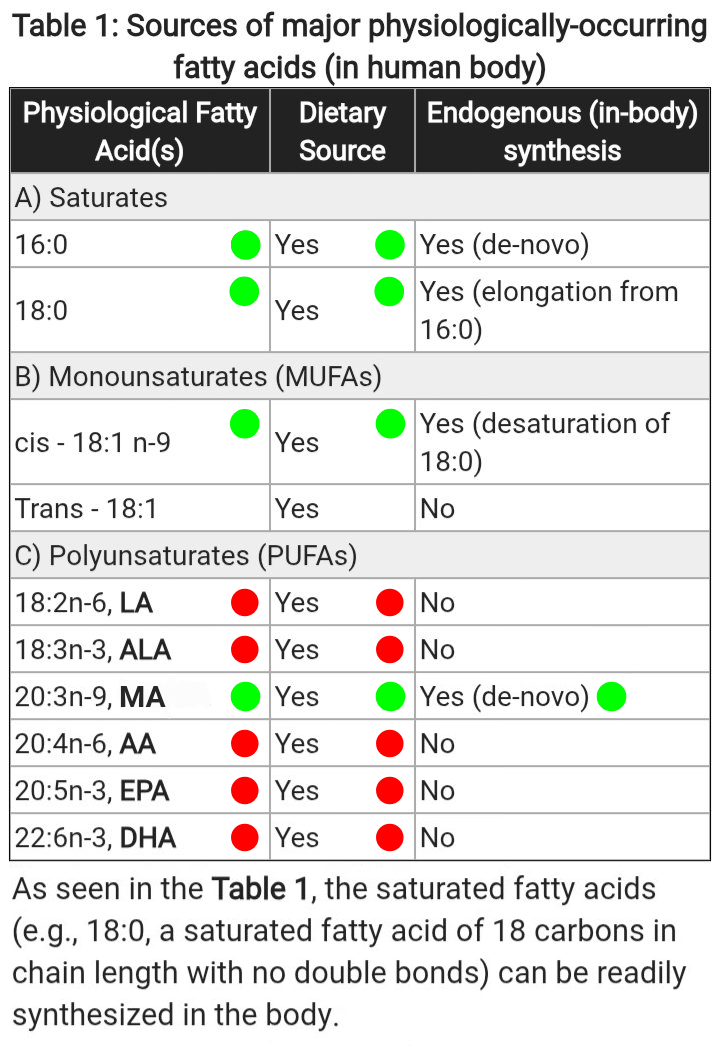
In EFA deficiency, mead acid (omega-9) is de novo synthesized from other carbon sources, such as acetate and sugars. Mead acid is considered an endogenous PUFA synthesized from oleic acid in the n-9 series via the same enzyme system as for the n-6 and n-3 series.
The amounts of mead acid and other n-9 PUFAs present in the body are small whereas arachidonic acid and EPA are abundant. Δ6-Desaturase, the rate-limiting enzyme in PUFA synthesis, has a much higher affinity for α-linolenic acid (ALA) and linoleic acid (LA) than for oleic acid. Therefore, Δ6-desaturation of oleic acid is highly suppressed in the presence of LA and ALA. Mead acid formation requires a marked decrease in both linoleic acid and α-linolenic acid.(8)
Mead acid is now recognized to also be converted to various lipid mediators similar to those of ARA.(8)
Burr G. O., Burr M. M. 1929. A new deficiency disease produced by the rigid exclusion of fat from the diet. J. Biol. Chem. 82: 345–367.
Burr G. O., Burr M. M. 1930. On the nature and role of the fatty acids essential in nutrition. J. Biol. Chem. 86: 587–621.
Based on the experiment done by the Burrs, some polyunsaturated fats (linoleic & linolenic acids) became known as essential fatty acids. EFA appeared to cure a scaly skin condition (“rat dermatitis”) observed in rats. The introduction of EFA into the rats’ fat-deficient diet cured the dermatitis and what was coined an essential fatty acid deficiency.
'Deconstructing' the studies
In the late 1920s, most of the B vitamins and trace mineral had not yet been identified. As a result, citing a study from 1929/1930 to prove the existence of an essential nutrient seems odd.
The years following the Burrs' discovery, more knowledge had been attained regarding the B vitamins and other nutrients. Studies post-dating the Burrs' experiment indicated that what was previously thought to be a skin abnormality induced by a lack of EFA was a vitamin B6 & B5 deficiency (ref 1-5). The rats skin condition the Burrs' witnessed were produced by deficiencies of nutrients that had yet to be discovered. Even 50 years ago, the essentiality of EFA was called into question.
Further context:
Several publications between 1936 and 1944 made it very clear that Burr’s basic animal diet was deficient in various nutrients, especially vitamin B6. The disease that appeared in Burr’s animals could be cured by fat free B-vitamin preparations, or by purified vitamin B6 when it became available. A zinc deficiency produces similar symptoms, and at the time Burr did his experiments, there was no information on the effects of fats on mineral absorption.
Induced EFA "deficiency"
Attempts to intentionally induce an EFA deficiency in humans provided interesting results.(6) To test the effects of a very low fat diet on a human, biochemist William Brown volunteered to go six months in Burr’s laboratory eating such a diet. Chris Masterjohn discusses the results of this experiment in his article “Precious Yet Perilous: Understanding the Essential Fatty Acids.”:
“Inducing an essential fatty acid deficiency in an adult human proved much more difficult than curing one…Each day, he consumed three quarts of defatted milk, a quart of cottage cheese made from it, sucrose, potato starch, orange juice and some vitamin and mineral supplements. His blood lipids became more saturated and their concentrations of linoleic and arachidonic acids were cut in half. He experienced a marked absence of fatigue, his high blood pressure returned to normal, and the migraines he had suffered from since childhood completely disappeared.”(7)
In EFA deficiency, mead acid (omega-9) is de novo synthesized from other carbon sources, such as acetate and sugars. Mead acid is considered an endogenous PUFA synthesized from oleic acid in the n-9 series via the same enzyme system as for the n-6 and n-3 series.
The amounts of mead acid and other n-9 PUFAs present in the body are small whereas arachidonic acid and EPA are abundant. Δ6-Desaturase, the rate-limiting enzyme in PUFA synthesis, has a much higher affinity for α-linolenic acid (ALA) and linoleic acid (LA) than for oleic acid. Therefore, Δ6-desaturation of oleic acid is highly suppressed in the presence of LA and ALA. Mead acid formation requires a marked decrease in both linoleic acid and α-linolenic acid.(8)
Mead acid is now recognized to also be converted to various lipid mediators similar to those of ARA.(8)
(1) WILLIAMS MA, HINCENBERGS I. Methyl arachidonate supplementation of vitamin B6-deficient rats. Arch Biochem Biophys. 1959 Aug;83:564-5.
(2) Gyôrgy, P., Poling, C. E., and Subbarow, Y.: Experiments on the anti-dermatitis component of the filtrate factor in rats. Proc. Soc. Exper. Biol.&Med., 42: 738(Dec.)1939.
(3) U.S. Department of Agriculture. Agricultural Research Administration. Office of Experiment Stations.. Experiment Station Record, Volume 87, July-December, 1942. Washington. UNT Digital Library. http://digital.library.unt.edu/ark:/67531/metadc5069/.
(4) F. W. QUACKENBUSH, H. STEENBOCK, F. A. KUMMEROW AND B. E. PLATZ. Linoleic acid, Pyroxidine, and Panthothenic Acid in Rat Dermatitis. J. Nutr. September 1, 1942 vol. 24 no. 3.
(5) H. Schneider, H. Steenbock, and Blanche R. Platz ESSENTIAL FATTY ACIDS, VITAMIN B6, AND OTHER FACTORS IN THE CURE OF RAT ACRODYNIA. J. Biol. Chem. 1940 132: 539-551
(6) Brown WR, Hansen AE, Burr GO, McQuarrie I. EFFECTS OF PROLONGED USE OF EXTREMELY LOW-FAT DIET ON AN ADULT HUMAN SUBJECT. J. Nutr. December 1, 1938 vol. 16 no. 6 511-524
(7) “Precious Yet Perilous: Understanding the Essential Fatty Acids” by Chris Masterjohn, PhD
(8) Kawashima H, Yoshizawa K. The physiological and pathological properties of Mead acid, an endogenous multifunctional n-9 polyunsaturated fatty acid. Lipids Health Dis. 2023 Oct 14;22(1):172. doi: 10.1186/s12944-023-01937-6.
(2) Gyôrgy, P., Poling, C. E., and Subbarow, Y.: Experiments on the anti-dermatitis component of the filtrate factor in rats. Proc. Soc. Exper. Biol.&Med., 42: 738(Dec.)1939.
(3) U.S. Department of Agriculture. Agricultural Research Administration. Office of Experiment Stations.. Experiment Station Record, Volume 87, July-December, 1942. Washington. UNT Digital Library. http://digital.library.unt.edu/ark:/67531/metadc5069/.
(4) F. W. QUACKENBUSH, H. STEENBOCK, F. A. KUMMEROW AND B. E. PLATZ. Linoleic acid, Pyroxidine, and Panthothenic Acid in Rat Dermatitis. J. Nutr. September 1, 1942 vol. 24 no. 3.
(5) H. Schneider, H. Steenbock, and Blanche R. Platz ESSENTIAL FATTY ACIDS, VITAMIN B6, AND OTHER FACTORS IN THE CURE OF RAT ACRODYNIA. J. Biol. Chem. 1940 132: 539-551
(6) Brown WR, Hansen AE, Burr GO, McQuarrie I. EFFECTS OF PROLONGED USE OF EXTREMELY LOW-FAT DIET ON AN ADULT HUMAN SUBJECT. J. Nutr. December 1, 1938 vol. 16 no. 6 511-524
(7) “Precious Yet Perilous: Understanding the Essential Fatty Acids” by Chris Masterjohn, PhD
(8) Kawashima H, Yoshizawa K. The physiological and pathological properties of Mead acid, an endogenous multifunctional n-9 polyunsaturated fatty acid. Lipids Health Dis. 2023 Oct 14;22(1):172. doi: 10.1186/s12944-023-01937-6.
Last edited: