Allylbenzene
Bluelighter
- Joined
- Jul 25, 2025
- Messages
- 1,433
A WADA-safe doping guide: no experimental peptides/drugs/steroids. It's an assortment of items which most people might understandably dismiss as weak, but imo are underrated performance enhancing items when used in combination. They happen to be OTC and inexpensive.
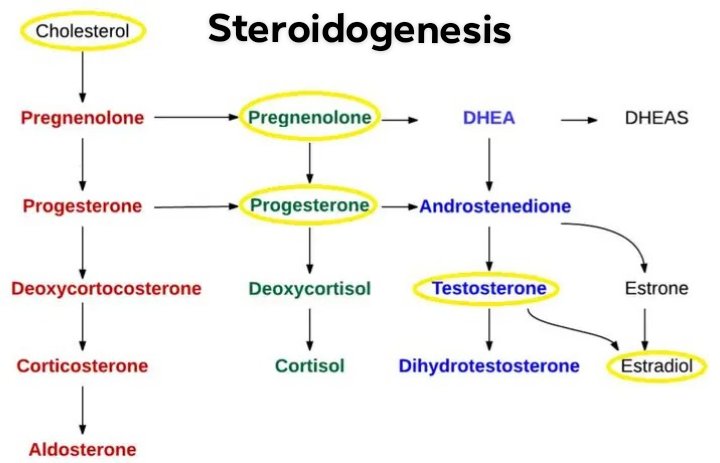
The general goal is metabolic enhancement via the boosting of ... mitochondrial & thyroid function (T3 synthesis, ATP production: OXPHOS, hormone production: steroidogenesis), dopamine synthesis (via tyrosine hydroxylase) and minimising disruptive stress activity (cortisol, ACTH, CRH) and aromatase activity.
- pidolic acid (ATP)
- succinic acid (ATP)
- stearic acid (ATP, mitochondrial support)
- palmitic acid (ATP, mitochondrial support)
- inosine (ATP, mitochondrial support)
- ribose (ATP)
- low-dose thiamine (B1, metabolic support, 10-100mg)
- low-dose pregnenolone (metabolic support, precursor for all other neurosteroids, 1-10mg)
- low-dose riboflavin (B2, FAD - OXPHOS, recycles NADH to NAD+, 5-10mg)
- low-dose niacinamide (B3, metabolic support, NAD, 50-100mg)
- low-dose biotin (B7, metabolic support, 1-5mg)
- very low-dose aspirin/salicylic acid (metabolic support, directly stimulates dopamine synthesis, aromatase inhibitor, 10-50mg)
- sodium ascorbate (increases dopamine synthesis)
- vitamin E (d-alpha tocopherol, aromatase inhibitor)
The doses are purposefully on the low end since I wrote this with harm reduction in mind... more isn't necessarily better for some of these items. The only "golden" metabolic booster I didn't mention was caffeine which belongs in it's own drug class. It's more similar to T3 (triiodothyronine) than classical stimulants (eg amphetamine, cocaine, methylphenidate).
The succinic and pidolic acid can be reacted with sodium or magnesium carbonate to make a more neutral salt. Likewise with salicylic acid to make sodium/magnesium salicylate (alternatively buy it as is).
Niacinamide also inhibits 11β-HSD type 1 and promotes 11β-HSD type 2, thus inhibiting cortisone conversion to cortisol and promotes cortisol conversion to cortisone.
Aspirin inhibits the enzyme 11β-HSD1 and blunts the release of cortisol during stress.
Aspirin as an aromatase inhibitor MOA #1:
So how to practically enact this "WADA-safe doping"?
The chosen items could be combined (+sucrose) in an enteric capsule (or 3) and stored under the tongue until necessary (sprint, swim, ski etc). Better add sucrose or make sure your glycogen storage is maximised:
The general goal is metabolic enhancement via the boosting of ... mitochondrial & thyroid function (T3 synthesis, ATP production: OXPHOS, hormone production: steroidogenesis), dopamine synthesis (via tyrosine hydroxylase) and minimising disruptive stress activity (cortisol, ACTH, CRH) and aromatase activity.
- pidolic acid (ATP)
- succinic acid (ATP)
- stearic acid (ATP, mitochondrial support)
- palmitic acid (ATP, mitochondrial support)
- inosine (ATP, mitochondrial support)
- ribose (ATP)
- low-dose thiamine (B1, metabolic support, 10-100mg)
- low-dose pregnenolone (metabolic support, precursor for all other neurosteroids, 1-10mg)
- low-dose riboflavin (B2, FAD - OXPHOS, recycles NADH to NAD+, 5-10mg)
- low-dose niacinamide (B3, metabolic support, NAD, 50-100mg)
- low-dose biotin (B7, metabolic support, 1-5mg)
- very low-dose aspirin/salicylic acid (metabolic support, directly stimulates dopamine synthesis, aromatase inhibitor, 10-50mg)
- sodium ascorbate (increases dopamine synthesis)
- vitamin E (d-alpha tocopherol, aromatase inhibitor)
The doses are purposefully on the low end since I wrote this with harm reduction in mind... more isn't necessarily better for some of these items. The only "golden" metabolic booster I didn't mention was caffeine which belongs in it's own drug class. It's more similar to T3 (triiodothyronine) than classical stimulants (eg amphetamine, cocaine, methylphenidate).
The succinic and pidolic acid can be reacted with sodium or magnesium carbonate to make a more neutral salt. Likewise with salicylic acid to make sodium/magnesium salicylate (alternatively buy it as is).
Niacinamide also inhibits 11β-HSD type 1 and promotes 11β-HSD type 2, thus inhibiting cortisone conversion to cortisol and promotes cortisol conversion to cortisone.
Aspirin inhibits the enzyme 11β-HSD1 and blunts the release of cortisol during stress.
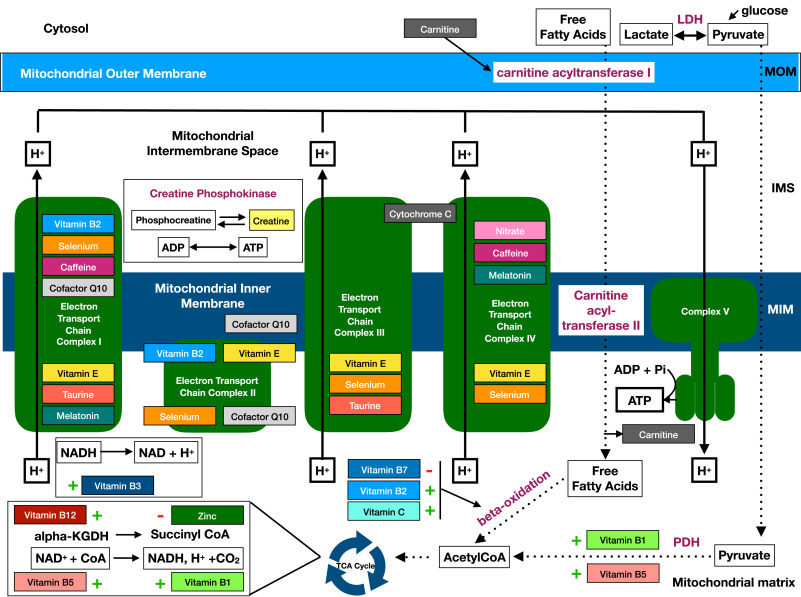
Adequate nutrient levels are essential for mitochondrial function as several specific micronutrients play crucial roles in energy metabolism and ATP-production. We have addressed the role of B vitamins, ascorbic acid, α-tocopherol, selenium, zinc, coenzyme Q10, caffeine, melatonin, carnitine, nitrate, lipoic acid and taurine in mitochondrial function.
— https://doi.org/10.1016/j.clnu.2018.08.032
Vitamin E, however, significantly reduced aromatase expression, suggesting reduced estrogen synthesis.
— https://doi.org/10.1096/fj.03-1116fje
A dietary saturated fatty acid, stearic acid, increases mitochondrial membrane potential. The membrane potential is an important component of the proton motive force required for ATP production and a partial indicator of OXPHOS capacity.
— https://doi.org/10.1093/gerona/glv044
Since mitochondria require oxygen to carry out oxidative phosphorylation, increased oxygen consumption is a direct measure of increased mitochondrial metabolism. Palmitate-treated cells exhibited a 2-fold increase in oxygen consumption rate and in most mitochondrial fluxes prior to ROS accumulation.
— https://doi.org/10.1016/j.metabol.2013.10.009
Aspirin as an aromatase inhibitor MOA #1:
Consequently, aspirin effectively inhibited the activity of AC in vitro and reduced estrogen biosynthesis by inhibiting the expression of aromatase in human granulosa cells, a key enzyme that catalyzes the conversion of androgens into estrogens. Aspirin irreversibly inhibited the activity of AC subtypes...
...
Mechanistically, aspirin inhibited cAMP response element-binding protein-mediated aromatase expression by the AKT/mammalian target of rapamycin (mTOR) signaling pathway.
— https://doi.org/10.1096/fj.202403152R
There is a closely-related family of transporters known as the cation organic transport protein (OCTN/OCTP), which are responsible for transporting/controlling carnitine inside the cell, and I have written about them in the past in regards to substances such as Meldnium/Mildronate, aspirin, quinine, etc. Anyways, back to E1S and OATP. It turns out that a number of molecules is capable of inhibiting this protein as well. The study below demonstrates that the PUFA metabolites known as prostaglandins strongly increased E1S cellular uptake. Conversely, the abundant endogenous steroid pregnenolone-sulfate (PS) (and to a much smaller degree, DHEA-S) was capable of inhibiting E1S update into the cell and thus depriving the cell of its major estrogen precursor used to synthesize the active estrogens. Importantly, at concentrations of 50 uM/L PS inhibited E1S uptake by about 80%. Now, every cell can synthesize estrogen de-novo, without using E1S as a precursor. However, studies have shown that the de-novo pathway is energetically very expensive and as long as the cell has access to pre-formed precursors such as E1S it prefers to use them instead of synthesizing E1 and E2 from scratch using cholesterol as a precursor. Overall, about 90% of the active estrogens inside the cell are derived from E1S and only 10% are synthesized de-novo from cholesterol and other precursors. Thus, if one inhibits significantly the E1S uptake into the cell, this has the effect of drastically reducing the estrogenic tone of a cell/organism. That means that the cheap and widely available aspirin and PS are functional anti-estrogens and can be used similarly to known anti-estrogenic drugs such as the SERM class or aromatase inhibitors (AI). The study corroborates this hypothesis by demonstrating that OATP expression in breast cancer cells is more than 100-fold higher than in healthy cells, ensuring a major role for E1S (and its uptake inhibitors) in breast cancer.
So how to practically enact this "WADA-safe doping"?
The chosen items could be combined (+sucrose) in an enteric capsule (or 3) and stored under the tongue until necessary (sprint, swim, ski etc). Better add sucrose or make sure your glycogen storage is maximised:
In addition taurine may improve carbohydrate metabolism and favor glycogen resynthesis.
— https://doi.org/10.3389/fphys.2017.00710
The possible mechanism of the decreasing biotin blood sugar in diabetic rats may by promoting the synthesis of glycogen and reducing gluconeogenesis.
— https://pubmed.ncbi.nlm.nih.gov/25997216/
Last edited: