See if they will do all 4. Thyroid doesn't explain it all, Hypothyroid would explain all of it other than imsomnia though. But if it's just Hypothyroid & Imsomnia then you're in luck.
And just because you have hypothyroidism doesn't rule out other issues, so check all bases and rule out as much as you can.
Let’s break this carefully into testing, specialists, and care setting.
1. Tests to consider after thyroid evaluation
Once thyroid labs are done (TSH, Free T4/T3, antibodies), next steps depend on the results and your remaining symptoms: If thyroid is normal or corrected but symptoms persist:
Test / Evaluation
Purpose
Vitamin B12, folate, vitamin D
Detect deficiencies causing fatigue, cognitive decline, sexual dysfunction, neuropathy
Sex hormones + prolactin
Evaluate sexual dysfunction, possible dopamine/prolactin imbalance
If thyroid, sex hormones, or prolactin are abnormal, or if multiple endocrine issues are suspected
Neurologist
For cognitive decline, altered perception, tinnitus, or abnormal stimulant response
ENT (audiologist/otolaryngologist)
For persistent tinnitus
Primary care / internal medicine
For coordination of labs and monitoring overall health
Psychiatrist
If mood, attention, or behavior issues persist; also to guide safe use of stimulants, MAOIs, or other CNS-active medications
Important: In your case, many of your core symptoms (memory loss, altered consciousness, tinnitus, lack of stimulant response) are neurological/metabolic rather than purely psychiatric.
3. Staying in a psych ward
Pros: Safe environment, 24-hour monitoring, access to psychiatric medications if acute agitation, risk of self-harm, or severe mood disturbance is present.
Cons in your scenario:
If psychiatrist has not seen you for a week, treatment planning is stalled.
Your symptoms (cognitive decline, altered perception, tinnitus, fatigue, abnormal stimulant response) may not be psychiatric in origin, so staying in a psychiatric ward may not address the underlying causes.
Extended stay without active evaluation can delay proper medical care (endocrine or neurological).
Bottom line:
A psychiatric ward is not necessarily the right setting for your main symptoms if you are medically stable and there is no acute psychiatric risk.
The priority should be medical evaluation: thyroid, vitamins, hormones, neurological assessment.
A primary care doctor or hospital admission for medical workup might be more appropriate if access to specialists is needed.
Recommendation
Get thyroid labs (TSH, Free T4/T3, antibodies).
If abnormal → endocrinologist. If normal, proceed to:
Vitamin panel (B12, folate, D)
Sex hormones/prolactin
Neurological workup (MRI, EEG, ENT for tinnitus)
Coordinate with primary care for referrals; psychiatric support only if mood/behavior symptoms are present.
Consider moving out of psych ward if medically stable and acute psychiatric care is not required, so you can access the appropriate specialists.
The fun fact is that outside the psych ward, in these lasts 17 months, every doctor Who i spoke with, tought i was delusional and i had psychiatric issues, and they always refered me to a psychiatrist, they don’t belive me.
Inside this psych ward, ironically, i found the only doctor who belived me and want to figure out what the hell happened to my SNC after risperidone injections, and this doctor told me i have no mental diagnosis and i’am completely normal, and my sympthoms are linked to something neurological and not psychiatric.
So I have to stay in this psych ward to keep in touch with the only doctor who belived me and want to help me, even if I don’t have any mental illness diagnosis..
Vyvanse and similar drugs may be helpful to some people. It really depends on what you are trying to treat. Neither of you guys have any idea what you are trying to treat so you have no reason to use stimulant type medication so let's just rule this one out.
Any doctor giving you a dopamine agonist would be doing you harm. Likely they would be giving you it as a placebo. It doesn't make any sense especially given you don't know what you are trying to treat with it.
You want dopamine system working as normal. An agonist is not working as normal. It will downregulate dopamine receptors, won't restore normal signalling & will cause harm. Binding is also more complex than just affinity. RisperdalConsta had 2 shots of risperidone 17 months ago & his receptors are no longer antagonized. Regardless if his receptors were still antagonized an agonist would not be the way to counteract this & would only cause harm. What are you trying to treat and what is your theory behind suggesting a dopamine agonist?
The doctor herself suggested dopamine agonists and they want to use it for him after the PET exam,the national library of medicine also states it can be used to treat the effects of antipsychotics. We're trying to damage caused by the antipsychotics
It's saying that you want to see these guys not dickhead psychiatrists. Real doctors who are going to try to rule out physical causes for illness.
Neurologist for cognitive and sensory changes
Endocrinologist for hormonal/metabolic issues (thyroid, adrenal, sex hormones) (The blood tests may rule this one out)
General check-up including bloodwork, brain imaging (MRI), and possibly EEG
Essentially while you are in the ward the 1st course of action is to get bloodwork done. In order of importance
1. Thyroid panel – most likely treatable contributor 2. Vitamin B12, folate, vitamin D – deficiency can explain multiple neurological symptoms 3. Sex hormones and prolactin – especially if sexual dysfunction persists 4. Basic metabolic and kidney/liver function – ensures safe medication use and rules out metabolic contributors
But just get all done. Hopefully it's only thyroid, that's treatable and easy.
1. Thyroid function
Check for both hypo- and hyperthyroidism, including autoimmune causes:
TSH (thyroid-stimulating hormone) – primary screening test
Free T4 – active thyroid hormone
Free T3 – especially if T4/TSH are borderline
Thyroid antibodies (TPO-Ab, Tg-Ab) – for autoimmune thyroid disease
2. Vitamins and minerals
Deficiencies can cause cognitive decline, fatigue, and neurological issues:
Vitamin B12 – deficiency can cause memory loss, neuropathy, and tinnitus
Folate (B9) – supports cognitive function
Vitamin D – deficiency can worsen fatigue and mood
Magnesium – important for nerve function
3. Metabolic & endocrine panels
Blood glucose / HbA1c – rule out diabetes or hypoglycemia contributing to fatigue/cognition
Electrolytes – sodium, potassium, calcium, etc., for CNS function
Liver function tests – metabolic and drug clearance check
Kidney function (BUN, creatinine) – affects toxin clearance and CNS health
Sex hormones (if sexual dysfunction is significant) – testosterone, estradiol, LH, FSH, prolactin
4. Inflammatory / autoimmune markers
C-reactive protein (CRP) – general inflammation
ESR – another inflammation marker
ANA / autoimmune panel – if autoimmune causes are suspected
5. Optional / targeted tests
Homocysteine – can indicate B12 or folate metabolism issues
Iron, ferritin – iron deficiency can affect cognition and fatigue
Cortisol / adrenal function – if unusual fatigue, sleep, or stress responses
It sounds like you’re describing a cluster of neurological and physiological symptoms that are quite serious. Let’s break them down carefully:
Altered state of consciousness & perception changes → Could indicate effects on the brain’s neurotransmitter systems, possibly due to drug use, neurotoxic exposure, or neurological disease.
Cognitive decline & memory loss → Suggests possible damage or dysfunction in areas like the hippocampus or frontal lobes.
Sexual dysfunction → Can be related to hormonal imbalances, neurological issues, or chronic substance effects.
No response to typical stimulants (nicotine, caffeine) → Suggests altered receptor sensitivity in the brain; the usual excitatory pathways aren’t working as expected.
Inability to feel tiredness → Indicates dysregulation of the sleep-wake cycle or neurotransmitters like melatonin, orexin, or adenosine.
Tinnitus → Often linked to auditory nerve or central nervous system dysfunction.
When these symptoms occur together, they may indicate:
Chronic substance-induced neurological changes (from drugs, medications, or toxins).
Neurodegenerative or autoimmune disorders affecting the central nervous system.
Severe metabolic, endocrine, or hormonal imbalances.
Chronic brain inflammation or infection.
This is not normal and could be dangerous. Even though it might be tempting to self-diagnose, only a neurologist or other qualified physician can properly evaluate this. They may run:
Blood tests (hormones, toxins, vitamins)
Neuroimaging (MRI, CT)
EEG or other neurological assessments
Given that these symptoms include altered consciousness, cognitive decline, and inability to respond to stimuli, it is urgent to seek professional medical attention as soon as possible.
Key points about Risperdal Consta:
It’s a long-acting injectable antipsychotic (risperidone).
Each injection slowly releases the drug over about 2 weeks.
It is metabolized and cleared from the body over a few weeks; after 17 months, the drug itself should be completely gone.
Common side effects while active include sedation, sexual dysfunction, metabolic changes, movement disorders, and sometimes tinnitus.
What this means for your current symptoms:
It is extremely unlikely that the risperidone injections are directly causing these symptoms now, because they were only two injections 17 months ago.
Persistent symptoms like altered perception, cognitive decline, inability to feel tiredness, lack of response to caffeine/nicotine, sexual dysfunction, tinnitusare not typical long-term effects after such a short course so long ago.
This suggests another underlying neurological, endocrine, or psychiatric cause might be at play.
Urgency and next steps:
Some of the symptoms you listed (altered consciousness, cognitive decline, abnormal response to stimuli) can be serious and need urgent evaluation.
Recommended medical evaluation:
Neurologist for cognitive and sensory changes
Endocrinologist for hormonal/metabolic issues (thyroid, adrenal, sex hormones)
General check-up including bloodwork, brain imaging (MRI), and possibly EEG
Bottom line: The Risperdal injections from 17 months ago are almost certainly not the direct cause. These symptoms are concerning and need urgent professional assessment.
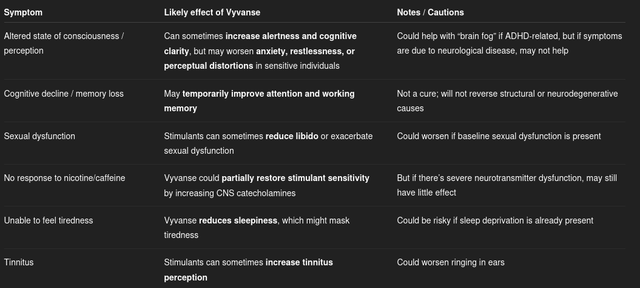
Thoughts on vyvanse
Vyvanse addresses some ADHD-like cognitive and attentional symptoms, but it does not treat underlying neurological damage, metabolic disorders, or chronic post-medication effects.
Given your history of altered perception, cognitive decline, lack of response to stimulants, and other serious neurological symptoms, starting Vyvanse without a full evaluation could mask dangerous symptoms or worsen them.
Interaction caution: If any residual effects from Risperdal Consta or other medications exist, stimulants can sometimes worsen tension, anxiety, or heart issues.
Bottom line
Vyvanse might improve alertness, attention, and some cognitive functions if your symptoms are related to ADHD-like deficits.
It is very unlikely to fix or reverse memory loss, altered consciousness, sexual dysfunction, or tinnitus caused by serious neurological or metabolic issues.
Medical supervision is essential—especially given your unusual response to other stimulants (nicotine, caffeine) and persistent serious symptoms.
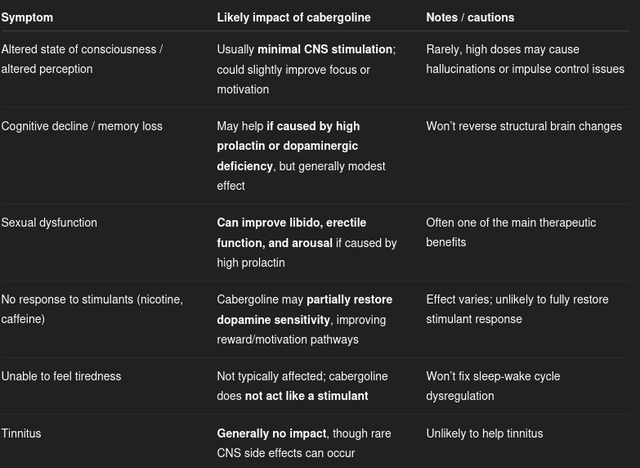
Thoughts on dopamine agonist:
Cabergoline mainly affects prolactin and dopamine pathways. So symptoms caused by high prolactin (e.g., sexual dysfunction, low motivation) may improve.
Symptoms like persistent cognitive decline, altered perception, or abnormal stimulant response may only partially improve if they are dopamine-related; otherwise, they need further neurological evaluation.
Side effects: nausea, dizziness, hypotension, heart valve issues (rare at standard doses), and rarely impulse-control changes.
Bottom line
Cabergoline is most likely to help sexual dysfunction and possibly motivation if prolactin was previously elevated.
It is unlikely to resolve tinnitus, severe cognitive decline, or abnormal stimulant responses.
Given your complex symptom profile, cabergoline could be considered only under careful medical supervision after lab tests (especially prolactin, dopamine-related hormones, and cardiac evaluation).
Tl;dr it's saying you want to see a Neurologist, Endocrinologist and have a general check up including bloodwork, brain imaging (MRI), and possibly EEG.
I asked it a few other things and one thing it said about the tinnitus was "Thyroid, vitamin B12, or other imbalances can contribute to tinnitus." got me thinking, Has this guy had his thyroid checked?
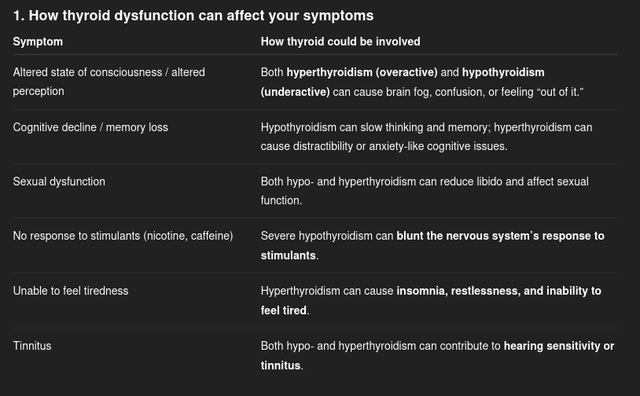
So i asked it "could it be a thyroid issue" 1. How thyroid dysfunction can affect your symptoms
2. Why thyroid could be relevant for you
You have a combination of cognitive, metabolic, sexual, and sensory issues.
Thyroid hormones affect almost every organ system, including the brain, cardiovascular system, and auditory pathways.
Some symptoms — like inability to feel tired, altered perception, and tinnitus — could be explained by hyperthyroidism, but cognitive slowing and memory loss could point to hypothyroidism.
3. How to check
A simple blood test can check thyroid function:
TSH (thyroid-stimulating hormone) – most sensitive for overall thyroid function
Free T4 and Free T3 – active thyroid hormones
Sometimes thyroid antibodies if autoimmune thyroid disease is suspected
4. Key points
Thyroid issues are treatable and reversible, unlike some structural brain causes.
Given your complex symptom profile, checking thyroid function is a low-risk, high-value step before pursuing more invasive or risky treatments.
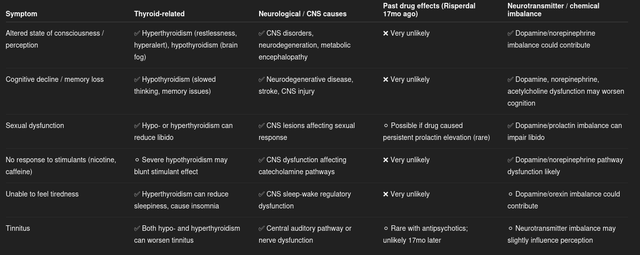
At this point it offered "If you want, I can make a table mapping all your symptoms to possible causes — thyroid, neurological, drug effects, and neurotransmitter issues. This would make it very clear which symptoms might improve with thyroid treatment vs which need other interventions."
Legend / Notes
Likely contributor
Possible contributor, less likely
Very unlikely contributor
Key Takeaways
Thyroid dysfunction could plausibly contribute to almost all your symptoms, especially fatigue, cognition, sexual function, and tinnitus.
Neurological or CNS causes are a major concern, given persistent altered consciousness, cognitive decline, and abnormal stimulant responses.
Past Risperdal injections are unlikely to be causing ongoing issues 17 months later.
Neurotransmitter imbalances (dopamine/norepinephrine) may contribute to sexual dysfunction, cognition, alertness, and stimulant insensitivity.
This table can serve as a roadmap for a doctor, showing which areas to test first: thyroid labs, neurological imaging, and neurotransmitter/hormonal evaluation.
But yeah fingers crossed on Thyroid problem with vitamin B12 deficiency instead of Neurological or CNS.
The doctor wants to give him a PET exam, she's not a dickhead, she actually believes him and chatgpt is not right all the time. It even didn't mention use of dopamine agonists to treat the effect of antipsychotics from the library of medicine site
The fun fact is that outside the psych ward, in these lasts 17 months, every doctor Who i spoke with, tought i was delusional and i had psychiatric issues, and they always refered me to a psychiatrist, they don’t belive me.
Inside this psych ward, ironically, i found the only doctor who belived me and want to figure out what the hell happened to my SNC after risperidone injections, and this doctor told me i have no mental diagnosis and i’am completely normal, and my sympthoms are linked to something neurological and not psychiatric.
So I have to stay in this psych ward to keep in touch with the only doctor who belived me and want to help me, even if I don’t have any mental illness diagnosis..
Not all time, even risperdalconsta had problems with it. It only tells you want to hear,he was asking him the date to recover and the ai kept lying to me. He said hasn't recovered in 5 months and the ai would 12 months. He would later say he hasn't recovered in 12 months and ai said 2 years. He kept expanding it until the ai kept expanding it
ChatGPT told me that i will recover in the 9-12 months mark, but it never told me i would develop tinnitus at 13 months mark, then, crossed 12’months without recovery it told me that I will recover in 15 months mark, but this don’t happened, then at 15 months told me i will full recover at 18 months, but i’am almost there without recovery.
Then i try to told him that i’am 18 months without recovery and it told me it take 24 months, then i told him i’am 2 years without recovery and it told me it take 3 years, and goes on like that until it told me it can take 5 years to recover.
ChatGPT it’s a Mossad israeli spy app that collect data about people, every social or app you use and you have it’s tracking you, even if you just have your phone in your poket and talk about something then magically when you use your phone you will see content about what you have previous talked about (like on tiktok or insta)
The whole phone it’s a device designed to track your profile, best thing it’s to avoid smartphone, let alone share sensitive data and info with ChatGPT
i never said 6 months. if you read my posts i mentioned feeling much better by 7-8 months. i am at month 14 and feel pre-invega. the only benefit i got from this was that i will never trust psychiatry again.
I will find a way to slap your ghost if you commit suicide under two years with side effects. You're going to be ok. Most people recover from this, I just met someone who also had the loading dose in real life and he's ok now. That's like the third person I knew who recovered from this medication. He never looked at these forums, he just got better over time and now he's just chillin, depressed and unmedicated, but chillin. How old are you? Four months ain't shit to me, I'm 31.
Why is everyone obsessed with killing themselves with edited? Can the mods delete any mention of it? It's a bad way to go and it has killed two people here. This community needs to curb copycat suicides.
Brokenself didn’t copy anyone. He complained daily for months until he finally did it, @rawbanana attempted once and failed so he tried again and was successful. Both were pretty independent actions from one another
A Moving song, remembering loved ones or dead parents used to bring tears to my eyes. That is no longer the case. Does anyone else feel the same same right now? Does feeling emotions deeply ever come back? One girl who was off invega told me that one of her family members died and she felt sad but no tears or any strong emotional response which she used to have before invega. This is after being 5 years off invega. Is this for everyone?
A Moving song, remembering loved ones or dead parents used to bring tears to my eyes. That is no longer the case. Does anyone else feel the same same right now? Does feeling emotions deeply ever come back? One girl who was off invega told me that one of her family members died and she felt sad but no tears or any strong emotional response which she used to have before invega. This is after being 5 years off invega. Is this for everyone?
A Moving song, remembering loved ones or dead parents used to bring tears to my eyes. That is no longer the case. Does anyone else feel the same same right now? Does feeling emotions deeply ever come back? One girl who was off invega told me that one of her family members died and she felt sad but no tears or any strong emotional response which she used to have before invega. This is after being 5 years off invega. Is this for everyone?
I can see/ feel an understanding of the slow progression that’s been happening to me over this time. I also didn’t have it as bad as a lot of other people, the only things that I really had was cognitive dulling, restlessness, and physical health impairment, and lastly weight gain. Everything else has been minute enough to the point I could overcome it for the most part.
I’ve gained 70 pounds, lost my job, gained a concussion and many more things because of psychosis and Invega. But regardless of how much I may all I can do is wait at this time. I find it incredibly important during this time I’m doing things of importance or at the very least enjoyable.
I don’t think complaining doesn’t have its level of validity or isn’t important but I have to remember and stay conscious that the situation could always get worse. Additionally I’ve done a good amount of research on ways to remove Invega, how long it’s expected to take, and what are signs that you’ll recover. I’ve utilized methods to remove Invega, I know how long it’ll take and have seen results of betterment, and I have passed the tests that indicate recovery.






 Likely contributor
 Possible contributor, less likely
 Very unlikely contributor
