• N&PD Moderators: Skorpio

Sihextramine

Smyth2

Bluelighter
Joined
Jul 26, 2011
Messages
712
1-[(1-Phenylcyclohexyl)methyl]piperidine
[88780-94-3]
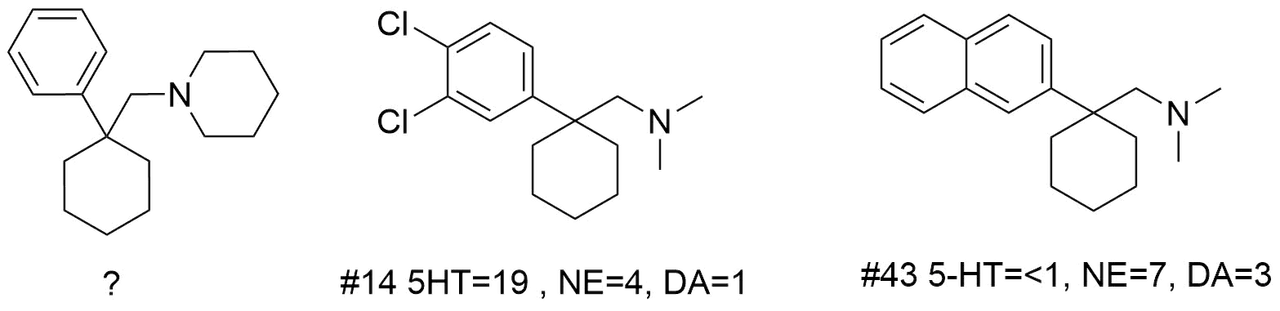
Can’t find Lit. synthesis might be from the reduction of the amide. Another interesting theoretical alternative would be the direct reduction of the nitrile to the primary amine. Alkylation with 1,5-dibromopentane would yield the piperidine ring. It is known that this reaction is facile by direct analogy with diphenidine.

(1-Phenylcyclohexyl)-1-piperidinylmethanone [102207-06-7]

See also: DiMe: [101355-47-9]

Could be compared to Sliming’s drugs.

Hence synthesis is likely going to be benzylnitrile and 1,5-dibromopentane starting materials and double alkylation in the presence of a strong base. FGI of the nitrile to the acid followed by amide formation with piperidine. Sibutramine is the model compound from which all these analogs are derived. Because of the similarity of the title compound to pcp and it’s reference, it is possible to suggest that it may have been explored as a military incapacitating agent in a psychochemical warfare testing programme. However it may also have medicinal properties. It would be interesting to know what it’s pharmacological mode of activity is since in the case of Sliming’s compounds dimethylamines and 3’,4’-disubstitution (dichloro or beta-naphthyl) into the phenyl ring gave potent SNDRI’s.

U.S. Army Armament Research & Development Command, Chemical Systems Laboratory, NIOSH Exchange Chemicals., NX#07476

My question is not regarding the chemical synthesis. I would like to know what pharmacology they think the drug marked with a question mark is likely to have.
 
Last edited:

Also read this if you want to learn about the synthesis of diphenidine:

Wallach, Jason; Kavanagh, Pierce V.; McLaughlin, Gavin; Morris, Noreen; Power, John D.; Elliott, Simon P.; Mercier, Marion S.; Lodge, David; Morris, Hamilton; Dempster, Nicola M.; Brandt, Simon D. (2015). "Preparation and characterization of the ‘research chemical’ diphenidine, its pyrrolidine analogue, and their 2,2-diphenylethyl isomers". Drug Testing and Analysis. 7 (5): 358–367. doi:10.1002/dta.1689

But I accept there is more than one synthetic pathway I just don't want to get too bogged down in synthesis discussions on bluelight. It might fit in better on another platform.
 
Sure - but I can say with some degree of certainy about that one compound.

Talk about serendipity. The idiots made the pyrrolidine homologue by mistake first attempt and it's a DRI. It evolved into pyrophenidone.
 
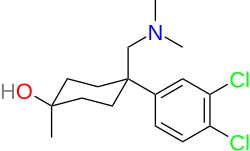
In the SNDRI section on wikipedia there is a compound called SEP-432.
250px-SEP-432.svg.png

Sramek, J. J., Hardy, L. W., Bieck, P., Zamora, C., Versavel, M., Kharidia, J., Grinnell, T., Chen, Y., Sullivan, M., Ding, H., Cutler, N. R. (May 2016). "Exploratory Biomarker Study of the Triple Reuptake Inhibitor SEP‐432 Compared to the Dual Reuptake Inhibitor Duloxetine in Healthy Normal Subjects". CNS Neuroscience & Therapeutics. 22 (5): 404–412. doi:10.1111/cns.12513.
 
In the SNDRI section on wikipedia there is a compound called SEP-432.
250px-SEP-432.svg.png

Sramek, J. J., Hardy, L. W., Bieck, P., Zamora, C., Versavel, M., Kharidia, J., Grinnell, T., Chen, Y., Sullivan, M., Ding, H., Cutler, N. R. (May 2016). "Exploratory Biomarker Study of the Triple Reuptake Inhibitor SEP‐432 Compared to the Dual Reuptake Inhibitor Duloxetine in Healthy Normal Subjects". CNS Neuroscience & Therapeutics. 22 (5): 404–412. doi:10.1111/cns.12513.
It seems to act more like an antidepressant rather than a recreational SNDRI
 

A stage 2 trial where out of a cohort of twenty six, eight dropped out for somewhat vague reasons is a concern. I find it hard to believe that at least after the trial they could at least of checked how many of them had been randomly assigned the candidate. Clearly afterwards the COULD identify those given the candidate.

It would appear Sunovion threw quite a few candidates at the wall to see what would stick.

I have mentioned this before but the vast majority of candidates fail in stage 3 trials (over 90%). There are many possible reasons but because there is no legal requirement to publish human trials, I have no way of knowing if this candidate was dropped here (and the 2016 study is the latest I can find) or if further trials didn't look too promising so weren't published.

But I suggest that safety and effacacy have to be demonstrated and in either case, with nothing demonstrates that, one must assume the worst.

I keep on saying that www.alltrials.net was at least partly set up as a result of the Super-MAB scandal. A case where earlier data showed the risks but that data wasn't publshed. It's only when harm cannot be hidden that we hear about it. Troven, Theralizumab, BIA 10-2474,CAR-T were only forced into the spotlight because they couldn't be hidden, Each case is different but I feel still gives an insight into how unethical it can be.

I would argue first-into-man should be the development team. Go back far enough and it was (at least in some cases).

BTW I am in no way associated with Alltrials and do not benefit in any way either directly or indirectly from providing the link or for any other actions a do or do not take.
 

Diphenidine was an equipotent inhibitor of the norepinephrine and dopamine transporters in the low micromolar range and a very weak inhibitor of the serotonin transporter. Besides binding to transporters, diphenidine bound to adrenergic α1A and α2A receptors and 5-HT1A and 5-HT2A receptors in the range of 4-11μM.
https://doi.org/10.1016/j.ejphar.2017.12.012
 
In the SNDRI section on wikipedia there is a compound called SEP-432.
250px-SEP-432.svg.png
Reminds me of Diclofensine
960px-Diclofensine.svg.png


A cyclized N-methyl-ß-(3,4-dichlorophenyl)-4-methoxy-phenethylamine.

Diclofensine potently bound to the monoamine transporters in the submicromolar range and had similar inhibition potential for all three transporters in the range of 2.5-4.8μM. Moreover, diclofensine bound to adrenergic, dopamine, serotonin, and trace amine-associated receptors.
 
Last edited:
The thing is, the scientific establishment is within flux on the topic of clinical depression. I think for too long stimulants were used to treat depression and one assumes after decades of research, the stimulants got dropped.

I wonder. Do the same ring-substitution patterns seen in each perform approximate the same adjustments?

I hope I'm at the top of the list in underlining the fact that affinity isn't the same as effacacy. But when some examples have triple reuptake inhibition <1nm/kg
 
The thing is, the scientific establishment is within flux on the topic of clinical depression. I think for too long stimulants were used to treat depression and one assumes after decades of research, the stimulants got dropped.
I don't think it's genuinely understood. SSRIs are still candy...
They're liberally handing out methylphenidate & amphetamine for so-called ADHD and patients are exclaiming that they feel SO much better. Personally I interpret ADHD as a catch-all term for real symptoms of diverse origin. In this context the adoption of amphetamine & methylphenidate would mask nearly anything for a brief period of time.
 
Last edited:
Tips if you press Ctl + Alt + copy it's possible to copy the CD picture into smiles code for use on pubchem/spider website.
 
Top