




red22
Bluelighter
- Joined
- Nov 23, 2009
- Messages
- 2,178
Two people argued with me on this site and The Shroomery about lysergic acid amide. Below I'm posting the relevant posts and I'd like someone who likes to analyze things to give his or her opinons.
First, the one that's on this site:
My argument:
Other person's argument:
I also made posts arguing against the idea that clavines are desirable: post-16323815
From The Shroomery:
My argument:
Other person's argument:
First, the one that's on this site:
My argument:
Blocked by shulginfoundation for posting this on one of their posts:
"Over 200 compounds synthesized and tested."
One compound he didn't synthesize or test is lysergic acid amide. He actually published one of the stupidest things that has ever been published in psychedelic literature about this compound. He says lysergic acid amide does not contribute to the psychedelic effects of morning glory seeds. He actually read a description of the effect of LAA that was published by Albert Hofmann and included a butchered paraphrasing of Hofmann's description in TiHKAL, which is much more popular than any of the few publications that contain descriptions of pure LAA.
"This is an active compound and has been established as a major component in morning glory seeds. […] The epimer, inverted at C-8, is isoergine or d-isolysergamide, and is also a component of morning glory seeds. […] Both compounds are probably correctly dismissed as not being a contributor to the action of these seeds."
Some quotes from Hofmann, for the record:
"… tiredness, apathy, a feeling of mental emptiness and of the unreality and complete meaninglessness of the outside world."[1]
"Already at that stage we had, in experiments on ourselves, ascertained a psychotomimetic activity with a marked narcotic component with dosages of 0.5 to 1 mg."[1]
"The experience had some strong narcotic effect, but at the same time there was a very strange sense of voidness. In this void, everything loses its meaning. It is a very mystical experience."[2]
"Not a contributor to the action of these seeds."
Thanks a lot, Shulgin. As if LAA didn't have a bad enough reputation to begin with. You have discouraged an untold number of people from experimenting with something that is readily available…unlike those 200 compounds.
"Im actually pretty suprised LSA doesnt get more attention as it is a truely great substance. I can actually admitt I like it evenly with LSD. All you hear about is people eating Hawaiian Baby Woodrose Seeds or Morning glories or sometimes Ololiuhqui. Some people even make crude alcohol extractions. I made a purified extract, with staggering results." (Kash, 2012-03-05, DMT-Nexus: Pure LSA Extraction (324044))
References
1. The Active Principles of the Seeds of Rivea corymbosa and Ipomoea violacea [sic]. Albert Hofmann. 1963-11-22. Cambridge, MA: Botanical Museum, Harvard University. doi: 10.5962/p.168542. Pharmacological and clinical activity of the isolated alkaloids
2. Stanislav Grof Interviews Dr. Albert Hofmann. 1984. MAPS Bulletin 9.2, Fall 2001: 22–35.
Other person's argument:
This is from TiHKAL entry #26 on LSA causing a tired, dreamy state with an inability to maintain clear thoughts. The implication is that psychedelic effects are due to other alkaloids in MG/HBWR seeds including LSH and the clavine-type alkaloids.
LA-111 Ergine, d-Lysergamide (LSA).
This is an active compound and has been established as a major component in morning glory seeds. It was assayed for human activity, by Albert Hofmann in self-trials back in 1947, well before this was known to be a natural compound. An i.m. administration of a 500 microgram dose led to a tired, dreamy state with an inability to maintain clear thoughts. After a short period of sleep, the effects were gone and normal baseline was recovered within five hours. Other observers have confirmed this clouding of consciousness leading to sleep. The epimer, inverted at C-8, is isoergine or d-isolysergamide, and is also a component of morning glory seeds. Hofmann tried a 2 milligram dose of this amide, and as with ergine, he experienced nothing but tiredness, apathy, and a feeling of emptiness. Both compounds are probably correctly dismissed as not being a contributor to the action of these seeds.
A related quote:
Alkaloid extracts should not be referred to as LSA, unless one has purified LSA and eliminated all other alkaloids found in the seeds etc. Shulgin and many others who researched this stated they did not think that LSA was the active alkaloid in these seeds, but that other alkaloids were. LSA is the majority alkaloid, but there are others present that are much more likely candidates for psychedelic effects.
Who has been able to obtain pure LSA from a chemical supply house and taken it?
The only accounts I know of using pure LSA are not psychedelic accounts.
I also made posts arguing against the idea that clavines are desirable: post-16323815
From The Shroomery:
My argument:
unholy said:LSA is sedative and non-hallucinogenic.
Are you sure about that? The only people who are qualified to speak about the effects of pure LSA are people who have tried pure LSA. Albert Hofmann and his colleagues tried LSA and so did a few other people in the context of two studies performed decades ago. Let's take a look at the comments that were made about pure LSA:
Hofmann's quotes
"Already at that stage we had, in experiments on ourselves, ascertained a psychotomimetic activity with a marked narcotic component with dosages of 0.5 to 1 mg."[1]
Grof: Have you actually tried the [ololiuhqui] yourself?
Hofmann: Yes, I did. But, of course, it is about ten times less active; to get a good effect, you need one to two milligrams.
Grof: And what was that experience like?
Hofmann: The experience had some strong narcotic effect, but at the same time there was a very strange sense of voidness. In this [void], everything loses its meaning. It is a very mystical experience.[2]
"The effective dose of lysergic acid amide is 1 to 2 mg by oral application."[3]
"A substance very closely related to LSD, the monoethylamide of lysergic acid (LAE-32), in which an ethyl group is replaced by a hydrogen atom on the diethylamide residue of LSD, proved to be some ten times less psychoactive than LSD. The hallucinogenic effect is also qualitatively different: it is characterized by a narcotic component. This narcotic effect is yet more pronounced in lysergic acid amide (LA-111), in which both ethyl groups of LSD are displaced by hydrogen atoms. These effects, which I established in comparative self-experiments with LA-111 and LAE-32, were corroborated by subsequent clinical investigations."[4]
"The slight difference in chemical structure between the [ololiuhqui] constituents and LSD is very significant with regard to hallucinogenic acitivity. The effective oral dose in man of LSD is 0.05 mg; this compound is thus about 50 to 100 times more active than lysergic acid amide, which is active in doses of 2 to 5 mg. Furthermore there is not only a quantitative difference between the principles of [Ipomoea tricolor] and Turbina corymbosa and LSD; there is likewise a qualitative one, LSD being a very specific hallucinogen, whereas the psychic effects of lysergic acid amide and the total alkaloids of these two plants are characterized by a pronounced narcotic component (Hofmann, 1968)."[5]
[Hofmann, A.]: Psychotomimetic agents. In Burger, A. (Ed.): Chemical Constitution and Pharmacodynamic Action, 2nd ed., New York, M. Dekker, 1968, 169–235.
"Jonathan Ott lives in México on a ranch in the mountains of the state of Veracruz. His ranch bears the name “Ololiuhqui.” This name has its special significance. That is, Ololiuhqui is the Aztec name for one of the ancient Mexican magic drugs, the seeds of plants from the morning glory family (Convolvulaceae). Ololiuhqui has a connection to my friendship with Jonathan. My chemical investigations of Ololiuhqui seeds led to the unexpected discovery that the entheogenic principles of Ololiuhqui are alkaloids, especially lysergic acid amide, which exhibits a very close relationship to lysergic acid diethylamide (=ʟsᴅ). It follows therefrom that ʟsᴅ, which hitherto had been considered to be a synthetic product of the laboratory, actually belongs to the group of sacred Mexican drugs."[6]
Comments from others
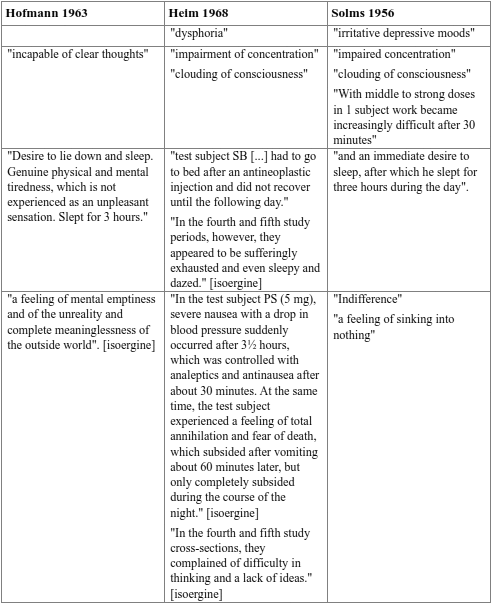
I'm presenting select quotes from the two studies in this table, which shows that they parallel some of Hofmann's comments. Note that ergine is a synonym for LSA.
Hofmann 1963: reference #1, below.
Heim E, Heimann H, Lukács G. 1968. Die psychische Wirkung der mexikanischen Droge „Ololiuqui“ am Menschen. Psychopharmacologia 13 (1): 35–48. doi:10.1007/BF00401617.
The quotes on this page were translated using Google Translate.
Solms H. 1956. Relationships between chemical structure and psychoses with the use of psychotoxic substances; comparative pharmacopsychiatric analysis: a new research method. Journal of Clinical and Experimental Psychopathology 17 (4): 429–433. PMID 13406032. https://www.erowid.org/references/refs_view.php?ID=4195
Heim 1968 also recorded the following effects: "after a relatively short phase of dozing, all test subjects felt relaxed and comfortable, sometimes even a little euphoric. They seemed to overestimate their performance capabilities. Paraesthesia and individual synesthesia were noted, as well as an overestimation of the time that had passed." b) ᴅ-isolysergic acid amide, p. 39
1. Albert Hofmann. The Active Principles of the Seeds of Rivea corymbosa and Ipomoea violacea. 1963-11-22. Cambridge, MA: Botanical Museum, Harvard University. doi: 10.5962/p.168542. Pharmacological and clinical activity of the isolated alkaloids, pages 208–209
Rivea corymbosa has been updated to Turbina corymbosa and later, Ipomoea corymbosa. Ipomoea violacea was determined to be a different plant altogether; the I. violacea Hofmann is referring to is I. tricolor (more info).
2. Stanislav Grof Interviews Dr. Albert Hofmann (1984). MAPS Bulletin 9.2 (Fall 2001): 22–35.
3. Albert Hofmann. The Road to Eleusis: Unveiling the Secret of the Mysteries. 1978, 2008. R. G. Wasson, Albert Hofmann, Carl A. P. Ruck, Peter Webster. 2. A Challenging Question and My Answer, p. 40.
https://books.google.com/books?id=7JC7EAAAQBAJ&pg=PA40
4. Albert Hofmann. LSD: My Problem Child (1979). 3. Chemical Modifications of LSD
More info about LAE-32, for those interested.
5. Albert Hofmann. The Botany and Chemistry of Hallucinogens. Schultes, R.E., Hofmann, A. 1973. Chas. Thomas, Springfield, IL. p. 252
6. Albert Hofmann, Burg i.L., Switzerland, November 1992.
This note is the foreword to Jonathan Ott's "Pharmacotheon". Copied from the 2nd edition (1996, Natural Products Co., p. 13, ISBN: 9780961423490). The first edition was published in 1993.
Other person's argument:
"Shulgin AT (2003). "Basic Pharmacology and Effects". In Laing RR (ed.). Hallucinogens: A Forensic Drug Handbook. Forensic Drug Handbook Series. Elsevier Science. pp. 67–137. ISBN 978-0-12-433951-4. Retrieved 1 February 2025. "Table 3.23 Amide analogues and pyrrole derivatives of LSD [...] Code: LA-111. Potency (mg): 0.5–1. Potency (x-LSD): 0.1a. [...] a sedative action or autonomic changes in humans; not hallucinogenic"
https://en.wikipedia.org/wiki/Ergine
"Lysergic acid amide is a DEA Schedule III controlled substance. Substances in the DEA Schedule III have a potential for abuse less than substances in Schedules I or II and abuse may lead to moderate or low physical dependence or high psychological dependence. It is a Depressants substance."
https://pubchem.ncbi.nlm.nih.gov/compound/lysergic acid amide
"U.S. FEDERAL LEGAL SUMMARY
LSA
REGULATED Yes
STATUS Scheduled
SCHEDULE Schedule III
CLASSIFICATION Depressant"
https://www.erowid.org/chemicals/ls...://www.erowid.org/chemicals/lsa/lsa_law.shtml
Last edited:

