Allylbenzene
Bluelighter
- Joined
- Jul 25, 2025
- Messages
- 1,287
Whilst MAO inhibition is a well-known method of potentiation, the use of aldehyde dehydrogenase (ALDH) inhibition is more obscure. Aldehyde dehydrogenase catalyzes the oxidation of aldehydes to carboxylic acids (eg acetaldehyde -> acetic acid).
The main sources of endogenous aldehydes are MAO and SSAO which metabolise amines into aldehydes, eg:
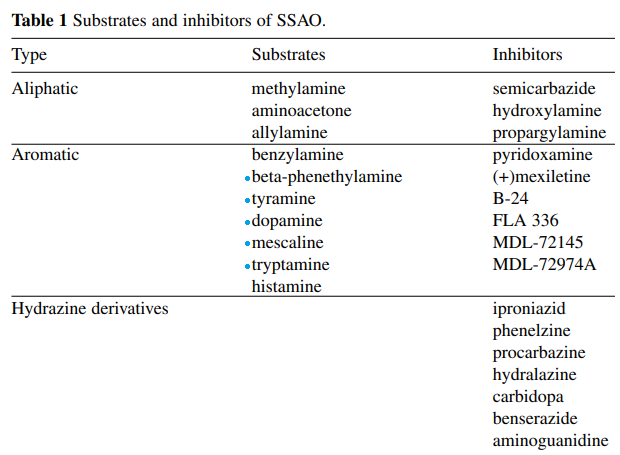
- https://doi.org/10.1351/pac200173091393
It's often assumed that MAO is responsible for deaminating mescaline but SSAO seems to play a more prominent role.
Taking the example of phenethylamine (PEA), MAOB inhibitors are commonly used to potentiate PEA (often using excessive 1g+ doses) but ALDH inhibitors have also been explored. These produced novel results worthy of further investigation. With proper ALDH inhibition the active PEA dose is much more reasonable (200-500mg) and the psychoactive effects are of a completly different nature, longer lasting with a gradual reduction in potency. Usually PEAs effects last for 5 mins to a few hours if there are any effects at all; this is also the case for tryptamine which Shulgin reports little if any effects.
Of course I'm not implying that PEAs aldehyde metabolite is active but that it acts as a prodrug of some sort.
The influence of ALDH inhibition on mescaline has been investigated, albeit a while ago. This is documented in Trouts notes: The Cactus Alkaloids
These are the only reports i've found on the combo of mescaline + ALDH inhibitor.
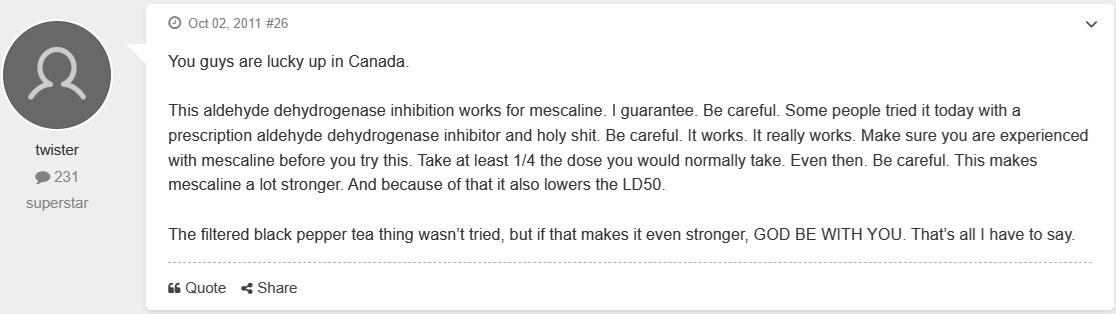
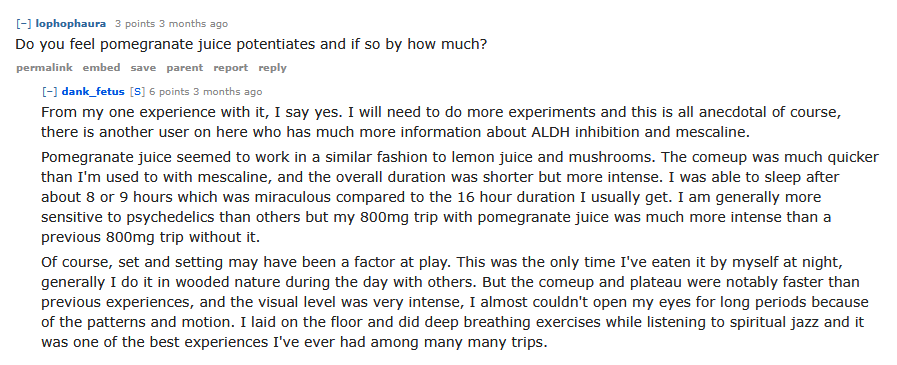
If mescalines aldehyde metabolite is somehow necessary in it's effects then the ideal potentiation strategy would facilitate it's formation (by SSAO) and minimise it's removal by ALDH. The only inducer of ALDH i've found is sulforaphane (common supplement) which would theoretically weaken mescalines effects. A true SSAO inhibitor would also theoretically weaken mescalines effects.
There are a few suitable food-based ALDH inhibitors:
Predosing the ALDHI works best.
Pomegranate juice works best, pre-dose with 500ml then drink some periodically throughout the experience. If using garlic as the ALDH inhibitor look for garlic supplements with the highest allicin content.
Predosing with the common supplement L-lysine for a day or more (the longer the better) can further amplify things. It helps to minimise choline-rich foods (eg eggs, dairy, meat) since choline contributes significantly towards the production of dimethylamine via gut bacteria transformation.
Here's the technical bit:
The main sources of endogenous aldehydes are MAO and SSAO which metabolise amines into aldehydes, eg:
- serotonin → 5-hydroxyindole-3-acetaldehyde
- tryptamine → indole-3-acetaldehyde
- phenethylamine → phenylacetaldehyde
- tyramine → 4-hydroxyphenylacetaldehyde
- dopamine → 3,4-dihydroxyphenylacetaldehyde
- mescaline → 3,4,5-trimethoxyphenylacetaldehyde
- https://doi.org/10.1351/pac200173091393
It's often assumed that MAO is responsible for deaminating mescaline but SSAO seems to play a more prominent role.
Semicarbazide is an SSAO inhibitor, and Diamine oxidase (DAO) is part of the SSAO family.The enzyme responsible for the deamination of mescaline to the aldehyde derivative is still a controversial issue among the scientific community. This reaction may be carried out by a monoamine oxidase (MAO) or a diamine oxidase (DAO). Studies with mice have shown that this route is inhibited by TPN, nicotinamide, iproniazid, semicarbazid, and other inhibitor compounds of mono or diamine oxidase [43, 78].
- https://doi.org/10.2174/1874467211666181010154139
Taking the example of phenethylamine (PEA), MAOB inhibitors are commonly used to potentiate PEA (often using excessive 1g+ doses) but ALDH inhibitors have also been explored. These produced novel results worthy of further investigation. With proper ALDH inhibition the active PEA dose is much more reasonable (200-500mg) and the psychoactive effects are of a completly different nature, longer lasting with a gradual reduction in potency. Usually PEAs effects last for 5 mins to a few hours if there are any effects at all; this is also the case for tryptamine which Shulgin reports little if any effects.
Of course I'm not implying that PEAs aldehyde metabolite is active but that it acts as a prodrug of some sort.
The influence of ALDH inhibition on mescaline has been investigated, albeit a while ago. This is documented in Trouts notes: The Cactus Alkaloids
Inhibition of aldehyde dehydrogenase by calcium carbimide "severely" enhances the pharmacological effects of mescaline in rabbits. Neff & Rossi 1963 cite Friedhoff & Goldstein 1962.
...
In rabbits, which show no symptoms from mescaline, pretreatment with calcium carbimide causes some effect whereas calcium carbimide by itself does not. Since there is no way to know how a rabbit would respond to mescaline if they could respond to mescaline, it is not entirely clear what this means. It certainly is interesting and implies there may be need of follow up research.
...
Rabbits, which are estimated to be about 70 times more tolerant to mescaline than humans, developed "severe" reactions when given very small doses of mescaline after pretreatment with calcium carbimide implying that aldehyde dehydrogenase inhibition enhances the pharmacological activity of mescaline
These are the only reports i've found on the combo of mescaline + ALDH inhibitor.
If mescalines aldehyde metabolite is somehow necessary in it's effects then the ideal potentiation strategy would facilitate it's formation (by SSAO) and minimise it's removal by ALDH. The only inducer of ALDH i've found is sulforaphane (common supplement) which would theoretically weaken mescalines effects. A true SSAO inhibitor would also theoretically weaken mescalines effects.
There are a few suitable food-based ALDH inhibitors:
- starfruit
- diallyl trisulfide from garlic
- diethyl disulfide from durian (ref1, ref2)
- pomegranate
- menthol
Predosing the ALDHI works best.
Pomegranate juice works best, pre-dose with 500ml then drink some periodically throughout the experience. If using garlic as the ALDH inhibitor look for garlic supplements with the highest allicin content.
ALDH activity was inhibited in the kidney after DATS administration.
...
Diallyl trisulfide (DATS) is one of several compounds produced by hydrolysis of allicin.
Allicin is an organosulfur compound obtained from garlic and leeks. When fresh garlic is chopped or crushed, the enzyme alliinase converts alliin into allicin, which is responsible for the aroma of fresh garlic.
Predosing with the common supplement L-lysine for a day or more (the longer the better) can further amplify things. It helps to minimise choline-rich foods (eg eggs, dairy, meat) since choline contributes significantly towards the production of dimethylamine via gut bacteria transformation.
Here's the technical bit:
If we assume that the whole process of alkaloid production is taking place in the intestines then probably enzymes beyond human enzymatic capabilities might be involved. The process is probably mainly carried out in the jejunum, where the pH is around 8, between 7-9.
...
The transformation process of L-lysine to 1-piperideine is though. It's a natural defense mechanizm of intestinal flora against pathogens, 1-piperideine is toxic to bacteria like salmonella or shigella. I think that the condensation reaction would rather begin with 1-piperideine than the piperidine, because of the double bond, and because it's a natural product of intestinal flora. The enzyme essential to this reaction is primary-amine oxidase, it's a copper containing enzyme like SSAO, it can also be inhibited by semicarbazide. Probably it's inhibited by the same or almost the same compounds which can inhibit SSAO. It's essential because of aldehyde being an intermediate.
There is also a corresponding reaction for 1-pyrrolidine
- L-lysine -> cadaverine -> 5-aminopentanal -> 1-piperideine
- ^lysine decarboxylase -> primary-amine oxidase -> spontaneous conversion
- L-ornithine (or L-arginine) -> putrescine -> 4-aminobutanal -> 1-pyrroline
- ^[Putrescine can be made by various pathways] -> putrescine oxidase -> spontaneous conversion
Last edited: