• N&PD Moderators: Skorpio

🌟🌟 Social 🌟🌟 Rectify's molecular poetry thread

Sure, I was just pointing out commom dietary sources of concentrated allylbenzenes. This paper does a risk assessment for dutch pesto. No word of on the Italians.

I don't plan on using these oils. I'm mainly interested in the active metabolite(s) and how they might be formed.

Cool - if you seek knowledge so the sake of it, that is a laudable action.

But I'm old enough to have been taught at school that the neutrino was a massless particle and when I asked how it was detected, the answer was that 'occassionally a neutrino strikes the nucleus of an atom cusing fision;. Which didn't make sense to me. Now, not only do we know that neutrinos have not one but THREE different masses depending on their flavour (physicists used dumb terms back then and we are stuck with them for now) but that even without mass, photons still possess momentum. Although, given that both are subject to gravity, it does make me wonder what experiments being carried out today will show us.

But there is an inexhausable supply of papers available on-line, the majority at no cost.

If I were in any way talented in the sphere of hortaculture, I'm sure I would be looking into selective growing of herbal medicines such as kratom. It's not that it's so difficult, but it is time-consuming. Like all of science, it's so easy to just zoom in on the bit that interests you but so easy to omit those who you imagine not to be of interest.

I stumbled on an absolutley beautiful reaction while reading patents on the antidepressant sertraline. I remember it was the 109th paper I read. But there it was, two paragraphs of absolute gold. You have to mine a lot of rock to find the gold.

 
I edited my post btw.
I tried the pubchem 3D molecule viewer but I think a more recent program would be better. I'm looking for a free alternative to Chemdraw.
 
I edited my post btw.
I tried the pubchem 3D molecule viewer but I think a more recent program would be better. I'm looking for a free alternative to Chemdraw.

OK - there are older versions of ChemOffice that turn up on E-bay from time to time. Now I contacted a vendor to ask if it was a new, sealed copy were one entered a password and got not reply. So I strongly suggest given the prices offered £100-£120 per disk, they are 'cracked' but work,

Also there are various of those dubious file-sharing services but to be honest, I'm not sure I trust them but the truth is, I just don't know how they work.

It should NOT cost £25000 for someone to have the tools to understand chemistry and they just increased the price again.

So while I do not condone the above, they do exist.

One tip - get an older version. 9, 10 and 11 are fine, after that they 'improved things worse' if you see what I mean. They also tied in the software to the publishers so you can buy academic papers via later versions of Chemoffice. Buy without even knowing, I've heard. But I use 9 - it works for me.

It's the fact that not only does it show a molecule in 3D but it performs minimum-energy calculations which I mentioned on that kratom thread. Of all the opioids, 7-OH most closly mimics BDPC of all things. Overlays the A aromatic, the HBA and PIL very well indeed. But look at the two on paper... totally different.
 
Yeah I thought about the file-sharing (torrent) option but don't want to install potentially tampered programs. What they'll be is a disk image file of a probably cracked copy.

From my earlier post -
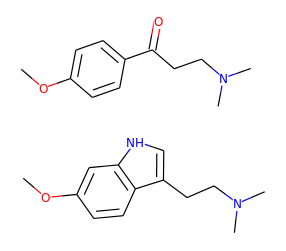
...here's an estragole metabolite (as per Oswald) compared to 6-methoxy-DMT.
Can you check out the 3D overlay in Chemoffice?

image.png


1'-oxoestragole-dimethylamine = CN(C)CCC(=O)C1=CC=C(C=C1)OC
6-meo-DMT = CN(C)CCC1=CNC2=C1C=CC(=C2)OC
 
OK - I might be wrong but Isn't 6 hydroxy tryptamine is used scientifically to selectively kill brain cells. So once again, if you have a genetic grouping of people who will deprotect that methoxy, it could prove to be toxic.

BTW Pubchem is free and shows all of the near-minimum energy conformations of chemicals but I'm uncertain if it performs the minimum energy conformation as it takes ChemOffice minutes to do so although I suppose newer and faster processors would speed it all up but it would take a finite time to do so. The fact it will cycle through all ten instantly sort of suggests not.

Also, you may wish to look into the newer software that used quantum calculations (no idea) but they are precalculated, so who knows how long they would take even on a faster computer.

There we go, a long, long list of things I don't know. Often one has to work out an experiment to prove a hypothesis and as Karl Popper notes, no experiment can prove something to be true. Only that it adds to the weight of evidence. So in fact failure should be embraced as it's just as valuable.

BTW what Chemoffice singularly fails to do is to calculate hydrogen-bonding. So with psilocin, it gets it wrong. The reason psilocin is orally active is because that bare hydroxyl forms a hydrogen-bond with the amine so it curves back on itself and, evidently, that conformation isn't a substrate for the various liver enzymes. Get used to the idea that you can spend a lifetime learning... and relearning... and relearning... and then knowing that in the event, you will never truly KNOW.
 
Last edited:
Perhaps, it was there soley as a comparison for 1'-oxoestragole-dimethylamine which was anecdotally reported to be quite something. Someone noted it resembled 6-meo-dmt and theorised it was behaving more as a tryptamine than a PEA. Hence my curiosity on the 3D overlay of both molecules.
 
Perhaps, it was there soley as a comparison for 1'-oxoestragole-dimethylamine which was anecdotally reported to be quite something. Someone noted it resembled 6-meo-dmt and theorised it was behaving more as a tryptamine than a PEA. Hence my curiosity on the 3D overlay of both molecules.

Well I spent a significant amount of time in producing various ring-substituted tryptamines and elsewhere I have shown how tryptamines overlay PEAs. That N in the indole acting like the 2-methoxy of a PEA and the 5-MeO well, IS the same 5-MeO of and indole so I strongly suspect that 5-MeO 7-methyl AMT is very likely to be similar to DOM. But will it produce the same side effects, I don't know. Obviously I would begin with 5-MeO 7-methyl DMT on the basis that the duration and toxicity are likely to be much lower.

But I find it odd that people sort of get that there are two enantiomers of methamphetamine and manufacturers now produce chiral product (fractional crystalization and raecemization of unwanted enantiomer), nobody is doing the same with the tryptamines where exactly the chemistry will isolate the sought enantiomer and allow the unwanted enantiomer to be raecemized.

Certainly one enantiomer of AMT is WAY more powerful as a hallucinogen while the other is a serotonin modulator so more like MDMA. So no waste! Add a 7 methyl and wooohh... even the racemate has a wonderful window between nothing and 'tripping ballz'. I really liked it but we couldn't possibly find a large enough cohort and at the scales we were dealing with, to costly, but if the Chinese are produing 'moonrock' at huge scales using modern techniques, I suspect exactly the same techniques could make substituted tryptamines.

So yeah - forget PEAs, in a decade I think we will witness an explosion of novel tryptamines that are either the same as or better than their PEA counterparts. Someone has attempted to patent tens of thousands of trypramines but there is a rule-of-thumb that the more compounds a patent seeks to control, the weaker the contol on each compound. I do NOT believe they would win a legal battle but the cost of keeping a medicine off the market using lawfare means others will pay for a licence.

The pharmacutical industry isn't ethical. It's always about the money. But it would be interesting to see them trying to sue a Chinese vendor (given that China's patent laws are not strong and China does not accept foreign patents...
 
Well I spent a significant amount of time in producing various ring-substituted tryptamines and elsewhere I have shown how tryptamines overlay PEAs. That N in the indole acting like the 2-methoxy of a PEA and the 5-MeO well, IS the same 5-MeO of and indole so I strongly suspect that 5-MeO 7-methyl AMT is very likely to be similar to DOM. But will it produce the same side effects, I don't know. Obviously I would begin with 5-MeO 7-methyl DMT on the basis that the duration and toxicity are likely to be much lower.

Yes I recall reading your posts on the relationship between indole's N/5-MeO and 2C-x / FLY. I hadn't considered that! I made a few comparisons of allylbenzene metabolites and associated indole substitutions here (see end of post) https://www.bluelight.org/community/threads/various-β-aminoketones-phenylpropylamines.948278/
 
Yes I recall reading your posts on the relationship between indole's N/5-MeO and 2C-x / FLY. I hadn't considered that! I made a few comparisons of allylbenzene metabolites and associated indole substitutions here (see end of post) https://www.bluelight.org/community/threads/various-β-aminoketones-phenylpropylamines.948278/

All I can add is that while it's lovely to guess the QSAR, it doesn't work the majority of the time when it comes to subjective human experience... as I have repeatedly discovered to my own cost. But I feel it's MORE dangerous when people trust animal models. If YOU design a compound then ethics dictate that you are the first human subject. Pharma did this until the 1970s when losing a team member was shown to be too costly. So look where we are now:


People who cannot POSSIBLY give informed consent (not being medicinal chemists) who are reduced to allowing their own bodies to be reduced to vehicles for drug development. Most of the time it's OK, sometimes people die. Mostly when they die, it gets covered up but look at Super-MAB, look at the Trovan trials on Nigerian kids and novel HIV medications in Zimbabwe.

When did we get so evil?
 
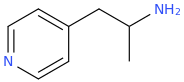
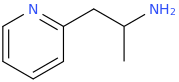
1-(4-azaphenyl)-2-aminopropane.png


GARRETT
1-(4-azaphenyl)-2-aminopropane

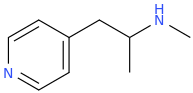
1-(4-azaphenyl)-2-methylaminopropane.png


BROOKS
1-(4-azaphenyl)-2-methylaminopropane

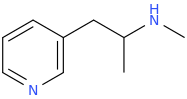
1-(3-azaphenyl)-2-methylaminopropane.png


PROMETHEUS
1-(3-azaphenyl)-2-methylaminopropane

1-(2-azaphenyl)-2-aminopropane.png


HENRY
1-(2-azaphenyl)-2-aminopropane

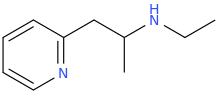
1-(2-azaphenyl)-2-ethylaminopropane.png


HARRIET
1-(2-azaphenyl)-2-ethylaminopropane
 
Last edited:
FYI the O in the NBOMes overlays the O= of the amide function of LSD...
240px-LSD_skeletal_formula.svg.png
160px-Ergolin_num_ABCD.svg.png

Looking at LSD it contains both phenethylamine and tryptamine. But what about phenylpropylamine? Doesn’t that give a basis for new developments?
[edit]
Seems PPA is used for phenylpropanolamine. PPrA for phenylpropylamine?

This is the closest image I have depicting this, 2 derivatives of LSD. Left focuses on the DMT (et al) whilst the right focuses on phenylpropylamine (et al) - just ignore the keto group.

image.png
 
Last edited:
Looking at LSD it contains both phenethylamine and tryptamine. But what about phenylpropylamine? Doesn’t that give a basis for new development?
I've actually played around with this, I suspect there may be a relationship also between phenidates and cathinones based on similar projections but I'm not quite positive. Trying to figure out the synthesis of a modified lysergic acid which could produce these lysergamides seems like a significant pain in the ass, finding the properly substituted nicotinic acid precursor is honestly the biggest hurdle iirc.

Edit: This is the source of the synth I was talking about: doi: 10.1021/acs.joc.2c02564
I spent a few long nights on acid and ephedrine trying to figure out how to produce a variant of lysergic acid that I could Finkelstein to put substitutions in new places, but I suspect other routes will be needed. The variety of exposed nitrogens makes even the creation of 1-substituted lysergic acids kind of a pain in the ass as far as the workup goes, so I'm trying to avoid nitrogenous subs and focus on ones shown in other SARs to be interesting. Replicating mescaline off of the bottom benzene heterocycle would be neat, but I bet allylescaline's substituions would be even more effective.

This is the closest image I have depicting this, 2 derivatives of LSD. Left focuses on the DMT (et al) whilst the right focuses on phenylpropylamine (et al) - just ignore the keto group.
You should check out Nervewing's writings on Hans somethingoranother's work with Phenethylamine-N-Diethylamines, aka PEA-NDEPAs.
 
Last edited:
You should check out Nervewing's writings on Hans somethingoranother's work with Phenethylamine-N-Diethylamines, aka PEA-NDEPAs.

I've read it. Good stuff.
On that theme, looking solely at indole V ß-aminoketone below, note the keto group location.

image.png


Alternatively, applying a 2-methoxy instead of the keto (based on phenylpropylamine)
That N in the indole acting like the 2-methoxy of a PEA and the 5-MeO well, IS the same 5-MeO of an indole

For 5-MeO-DMT
download-1.png


For 5-MeO-7-methyl-DMT
download-5.png


For 4-OH-DMT
download-4.png


For 7-methyl-AMT
download-3.png
 
Last edited:
We used to use Lipinski's Rule of 5 (RO5) to decide if a compound was likely to be 'druglike' but I've noted that Veper's Rule can be more useful.

One key element is the number of rotatable bonds because the more you have, the more local minimum-energy conformations can exist. I know some vendor in Turkey (?) offered a non-rigid LSD analogue and reports were that subjectively it was very much like LSD, but it was orders of magnitude less potent. I assume because even if the compound can escape those local energy minima, it will only bind when the appropriate conformation exists.

Don't fall into the trap of just drawing a structure in 2D and thinking that if it overlays in 2D it will overlay in 3D, especially after those important minimum-energy conformations are calculated. Even then, if you have a hydrogen-bond doner and a hydrogen-bond acceptor in the same molecule, the two may well interact. I gave psilocin as an example.

Also don't forget that the compound may exist as multiple species at pysiological pH.

I promise I'm not trying to make it sound hard because I don't think it is. But you really do need to use software that will answer ALL of the above questions before embarking on a design.

Now the dull, complicated and time-consuming part is finding or adapting a facile synthesis OF a candidate. No software I know of will ever point out that no route to a given compound is known, You have to use something like Reaxys or at least retrosynthetic stratergy to figure out what's possible. I think my first experience of that was when I idley wondered if the ketone moiety found in the cathinones could be replaced with either a sulfinyl or sulfonyl moiety since both are bioisosteres of ketones in many classes of compound. But how to produce an alpha sulfinyl or alpha sulfonyl amine moiety... yeah, tricky.
 
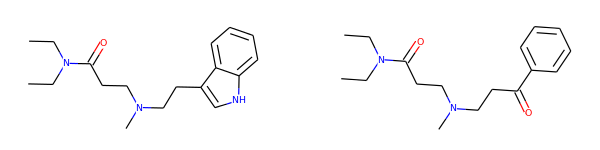
If you're interested i made a draft here:
This compound is called IDDC and is related to dizocilpine and is made from the same precursor as was used in the synthesis of diphenidine.

At the end of the day, the two aromatics are joined by a single methylene spacer so it cannot adopt the active conformattion of the 1,2-diarylethylamine class of compound,

That bridged seven-member ring of which the aromatics and methylene spacer are all part of is ALL optimized for NMDA affinity,

I think MK-801 did appear as an RC briefly but the trip reports do not sound too good and it's killed a few people. The mechanism of toxicity I do not know, But note that in both compounds, the spacial position of the nitrogen relative to the B aromatic is the same and the lone-pair is 107.5 degrees* FROM that B aromatic.

Look at pyrophenidine and zylofuramine to see how the class I described can be optimized for DRI activity because when people say they love K or they love MXE, it's actually because thoose compound both seem to have the optimal NMDA/DRI activity. Subjective human experience is hard enough to preedict fron animal models, let alone in vitro studies.

*I noted that 'magic angle' decades ago so it may be 109.5 degrees, but it was extremely precice so SOMEONE worked it all out. Unclear what the medical use-cases were meant to be. But it'a not juat that such RCs have to produce both activities, the ratio is also important, Which is why we see the law of diminishing returns as people make random guesses at the QSAR,
 
Last edited:
Whats your take on amantadine? It's an NMDA & alpha-7 nAchR antagonist, D2 & sigma-1 agonist with some adrenergic activity. It also increases tyrosine hydroxylase activity. It was pretty stimulating with dissasociative & subtle psychedelic qualities. VERY different to memantine.
250px-Amantadine.svg.png
 
Last edited:
Well I assume that the adamantine cage is just space-filling a lipophilic pocket. You can seen the same adamantine in some of the later, less selective CB1/CB2 ligands when the earlier scaffolds came under legal control. Scaffolds that had previously used an aromatic ring.

I would expect it to be extremely promiscuous and I'm uncertain how the body would metabolize it. It cannot oxidize that amine to a ketone but I guess it might be able to oxidize it to the hydroxylamine but I assume hydroxylation those methylene spacers (which would introduce chrality) plays a key role so I suspect that if it displays a range of activities, that could be a simple case of WHICH methylene(s) get oxidized, where the oxidation takes place and the chirality of those oxidations.

I would imagine the LogP to be reasonably high and for that amine not to be very basic, so not very soluble in polar solvents.

The cage is sort of interesting because other cages have been made that are referred to as 'proton traps' i.e. if you pop a unmasked proton inside the cage, it just sits there. This cage is slightly larger so maybe it can act as an 'ion trap? But I couldn't be sure without trying to track down sufficient data to assert it as a fact.

The lone pair may interconvene between three identical orientations so, again, metabolism could change that.

Probably smells a bit fishy.

I would look at the chemistry of tert butyl amine as that may well provide clues,
 
Top