klfiend
Bluelighter
Steric hindrance a problem with this? Just received word it is available now. Curious to try it. I would wager less potent and more importantly shorter acting than PCP.


N&PD Moderators: Skorpio
You are using an out of date browser. It may not display this or other websites correctly.
You should upgrade or use an alternative browser.
O-PCP
klfiend
Bluelighter
Steric hindrance a problem with this? Just received word it is available now. Curious to try it. I would wager less potent and more importantly shorter acting than PCP.

klfiend
Bluelighter
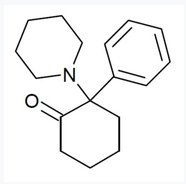
Picture didn't load

Psychestim
Bluelighter
Steric hinderance shouldn't be an issue, since the carbonyl would be in a plane in a 90° angle to the plane in which the piperidine ring would roughly be. My suspicion tho is that they are selling O-PCPr and are either purposefully or mistakenly labeling it as O-PCP. Did they attach this picture on their website?
klfiend
Bluelighter
The picture was from the vendors website. Listing was for "O-PCP" with the above picture.

dydst
Greenlighter
You’re not the first person that I’ve heard suggest that this is mislabeled O-PCPr. Why is that being suggested?
Steric hinderance shouldn't be an issue, since the carbonyl would be in a plane in a 90° angle to the plane in which the piperidine ring would roughly be. My suspicion tho is that they are selling O-PCPr and are either purposefully or mistakenly labeling it as O-PCP. Did they attach this picture on their website?

4DQSAR
Bluelighter
It's worth reading about Dizocilpine (MK-801) and how the researchers found a 'magic angle' between aryl and amine moieties. If memory serves 109 °or even 109.2°. I forget.
French researchers replaced the ketone moiety with chiral methyl side-chains to further elucidate the receptor cleft.
Fiinaly, replacing the cycloheamine with a 4-thiane increased affinity. They seemed to detail two seperate sites and some had higher affinity for one, some for the other. But since I don't know if we understand what those two subtypes mean as far as subjective activity, it's still interesting (to me) how subtle the QSAR of the ACAs really is.
I keep pointing out that after reading 165 Parke-Davis patents, I noted that the 2-chloro-5-methoxy homologue (overlay of K and MXE) was patented in the UK but not the US. The patent only covered a handful of compounds and as a rule-of-thumb, the more compounds you attempt to protect in a single patent, the weaker the protection given to each one. So at the time it seems they wanted to at once make damned sure THEY held the patent while trying to hide the fact (i.e. no US patent).
I have posted the patend and discussed it with @fastandbulbous who seemed to agree that likely CMXE would be the next step.... but even if it's more potent than MXE, it's unlikely to be as potent as 3-MeO PCE and saldy profit comes before quality or safety.

pcplease
Bluelighter
All i know/speculate about O-PCP possibly being something else is that for months a big CN source has had "O-PCE substitute - no CAS yet" listed. But, more reputable chinese sources have listings for O-PCP now. along w/ ald52 lol, so not all hope is lost
I'd think something close to MXE could still gain traction to be profitable. It was novel and seemingly unanimously popular. I'd think that the greatest profit was in 2F-O-PCM, as popular and prevalent as ketamine is. i assume 2BrOPCM was lackluster or would be around. i liked MXM myself, but for many of these there would need to be an MXE resurgence like happened with 2C-B.
4DQSAR
Bluelighter
Well, CMXE overlays both ketamine and methoxetamine.

SMILES COc1ccc(Cl)c(c1)C1(CCCCC1=O)NCC
GB Patent 1202834 'NOVEL CYCLOHEXANONE COMPOUNDS AND PROCESS MEANS FOR THE PRODUCTION THEREOF' by Parke Davis (no name of chemist given)
The KEY insight is that the ortho chloro of ketamine increases NMDA affinity while the meta methoxy of MXE increases DRI activity. The two ring substituents are para rather than ortho i.e. the 2-chloro-3-methoxy most likely won't work. Sadly nobody knows where @fastandbulbous has got to but I suggest the reason why the N-ethyl was chosen for MXE was because it also acts to increase NMDA affinity. It balances the two activities.
Most people seem to miss two things. That K/MXE and this stuff are all chiral with one enantiomer being the NMDA antagonist, the other monkeys around with DRI. So I SUSPECT that they might have tested the N-methyl homologue of MXE but the 'balance' between the two different activities meant it lacked the 'magic' of MXE itself. So here, the N-methyl may be better than the N-ethyl, someone would need to taste them both.
It's the way Parke-Davis, a US company, only obtained a British patent. I suggest the reasons may have been that they had found a successor to K but by the time they discovered this disubstitution, K was already accepted by clinicians. No competing product ever turned up so there was no reason to make use of it - they would just be competing with themselves. The GB patent wouldn't be spotted by competitors BUT would most likely be accepted in a US court as proof that they had indeed discovered it.
Does that make sense? They wanted to keep it a secret BUT ensure they held the legal control. It's complex, I know.
But while I would wager it to be at least as potent as MXE, I wouldn't wager it being vastly more potent. So while customers are prepared to accept the cruddy K homologues (best case) or the incredibly hazardous but hugely potent 3-MeO PCE, no supplier is going to investigate the stuff.
You can go down crazy side-quests like swapping the cyclohexane/cyclohexanone for the 4-thiane and swap the ketone for a methyl group (adding another chiral centre) as a French team did a couple of decades ago. But that way madness lies. The only really interesting detail in the French work was that they identified two distinct sites on the NMDA receptor where the things bind and almost nobody seems to know what that would mean to the subjective effects.
I will conclude with the standard disclaimer - to the best of my knowledge CMXE has only ever undergone testing in vitro thus predictions of effacacy are entirely my conjecture and in spite of the fact that it's almost identical to two well characterized compounds, CMXE is a novel compound with absolutely no data concerning safety or activity. Even IF someone offers CMXE, unless you apply instrumental analysis, there is no way to be certain what you have.

Smyth2
Bluelighter
If you are interested in novel ketamine analogues there is one in development that is called Blixeprodil.
4DQSAR
Bluelighter
Interresting and I'm certain an absolue stack of research is going into seperating the antidepressant activity of ketamine with it's more err... acute effects.
It's going to be VERY interesting because if I were working on a new arylcyclohexylamine, I would ASSUME others who have patents still active covering the class would employ lawfare.
Simply swapping the cyclohexane for a 4 thiane works and would likely get around that issue.
pcplease
Bluelighter
it is listed as available (as OPCPr) by at least one Chinese source
You’re not the first person that I’ve heard suggest that this is mislabeled O-PCPr. Why is that being suggested?
pcplease
Bluelighter
those two things often go hand in hand, lol. the chem is probably not going anywhere, and its cheap.
i am still skeptical about the fact that more reputable CN sources are offering O-PCP, while the sketchier source who released "new bromazolam/ethylbromazolam" finally changed "O-PCE substitute (still no name yet)" to "O-PCPr" after what seems like a year of it remaining unnamed/no CAS given.
..MAYBE they are both available right now, but that would be a hell of a coincidence.
4DQSAR
Bluelighter
It's kind of interesting that CMXE was patented by Parke-Davis and overlays both K and MXE but AFAIK isn't expressly controlled anywhere... but I'm told the precursor is costly and while I would exect it to be as active as MXE, I have no idea if it would be more active.
Then you know that out of the many dozens of arylcyclohexylamine ligands, only a handful have a reasonable NMDA antagonist to DRI ratio and I don't think there is any way except for tasting that would tell us either way. It's novel and hasn't undergone human trials although the fact that Parke-Davis got a patent on this specific compound suggests animal models were used. Either way, it's still an unknown... but then so are all the others.

higherconciousness
Bluelighter
I have a gram of O-PCP coming from a buddy who verified it’s the real deal. From the few reports I’ve seen and his own experience, it sounds like a solid compound. Hopefully it’ll be delivered tomorrow and I’ll provide a positive report. He also through in a g of high quality DMT. May combine both compounds and blast off.
4DQSAR
Bluelighter
I have a gram of O-PCP coming from a buddy who verified it’s the real deal. From the few reports I’ve seen and his own experience, it sounds like a solid compound. Hopefully it’ll be delivered tomorrow and I’ll provide a positive report. He also through in a g of high quality DMT. May combine both compounds and blast off.
I woud expect it to be much the same as deschloro ketamine.
I have mentioned this before but Parke Davis had over a hundred patents issued covering the atylcyclohexylamine class of agent. But what interests me is that the ONLY aryl substituents the patents covered were those containing a chloro moiety and or and ankoxy moiety.
Obviousy without www.alltrials.net we don't know why that is, but I would suggest Parke Davis were based placed to know what worked and what didn't and who knows,, what is subject to metabolism and what is not. Because lets not forget that ketamine appears to be excreted unchanged - which is one way of avoiding the need to test for toxic metabolites, I suppose.
In the UK ALL arylcyclohexaylamines were banned using BUT what they didn't notice was a team of French researchers who patented and wrote academic papers on compounds in which that cyclohexyl moiety was swapped for a 4-thiane ring. I don't say this substitution makes for safer compouinds BUT it would allow someone to essentially make something that is a bioisostere of ketamine, a bioisostere of MXE or indeed a bioisostere of CMXE.
BTW U did ask the discoverer of MXE about CMXE so the name isn';t something I just plucked out of the air. I DID ask the one person who I felt could make a reasonable case for being THE expert on the class.

dopamimetic
Bluelighter
How potent is O-PCP? Seen it being available and have to decide whether I should order or not. I love dissociatives, they help me enormously to cope and my last order were 2g DMXE but my high tolerance makes them very expensive. So I'd love to hear if O-PCP was more potent. How does it compare to e.g. DMXE or HXE - is it warm/serotonergic or more cold?
4DQSAR
Bluelighter
The problem is we are drifting further and futher away from that which has been researched.
I don't know why Parke Davis ONLY patented compounds with an ortho chloro or a 2-chloro-5-alkoxy aromatic, but that's what they did.
Long ago I did read a little about tiletamine but quickly realized that they had accidentially discovered that their are in fact two NMDA receptors and that the balance between the two can alter the subjective effects a LOT.
But for human usage, I submit the thought that by design they sought ligands that were both NMDA antagonists AND DRIs. I presume for clinical reasons. People forget that ketamine is still (widely) used medically all the way from general anesthesia in chidren (due to safery profile which I suggest is a good idea) right to novel antidepressants... a role I am less convinced by.

Allylbenzene
Bluelighter
What is it that makes you doubt ketamines antidepressant potential?
People forget that ketamine is still (widely) used medically all the way from general anesthesia in chidren (due to safery profile which I suggest is a good idea) right to novel antidepressants... a role I am less convinced by.
4DQSAR
Bluelighter
What is it that makes you doubt ketamines antidepressant potential?
Because long experience has taught me to doubt the potential of all antidepressants.
But a compound KNOWN to be a DRI stands out as a truly terrible option. May as well go back 130 years to when Freud discovered that cocaine was an 'effective antidepressant'. Or just 90 years when amphetamines were discovered to be 'effective antidepressants' or indeed all of the various amphetamine derivatives from nomifensine to the newer compounds such as McN5652 and JNJ-7925476.
I hope we can agree that the point of an antidepressant is to improve mood over a prolonged period of time. Not to produce euphoria which ends in a crash.