




dexedrone
Greenlighter
- Joined
- Nov 24, 2019
- Messages
- 5
I recently read a study suggesting that a great many opioids are, as it turns out, also NMDAR antagonists, but at a level too low to be qualitatively obvious. Further, NMDAR antagonists, nonselective or otherwise, appear to do a decent job of blocking tolerance development in certain classes of opioids. There's also a huge amount of literature on adjunct therapy involving NMDAR antagonists and opioid analgesics. In short, there's probably significant use for a dual-action opioid/NMDAR analgesic.
I'm interested in this from a primarily medicinal standpoint. Frankly "opioids you can take for ages at consistently low-ish doses" sound kinda scary to me. Nonetheless, I thought you all might find the topic of interest.
Notable relevant compounds, from left: 2-OXO-PCE (eticyclidone, anesthetic disso), Bromadol (potent opioid), Tramadol (low-potency opioid).
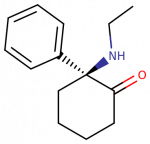
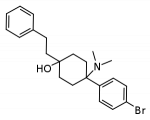
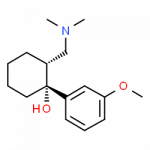
It's clear that an aryclyclohexylamine backbone is capable of opioid activity. It's worth noting that alternate 3/meta placement of the bromine (or chlorine) does not negate opioidergic effects of Bromadol analogs. Tacking a methoxyl moiety on R3 of 2-OXO-PCE should produce an active NMDAR compound (MXE). It appears, based on a piddly sample of 2 arycyclohexylamine-ish opioids, that having some steric bulk off the 3/4 positions may be important to opioid activity.
MXE was hypothesized by its designer to hit the MOR (mu opioid receptor). It was later discovered that it does not have any appreciable activity at that site. Looking at the two compounds above, there may be a good reason for this; steric bulk on the ortho position of the cyclohexane ring, or in that general vicinity. The Bromadol has an N,N-Dimethyl group, and the Tramadol has a hydroxyl group, plus an N,N-DImethyl group that would probably spend a bit of time in that general vicinity (but not most of the time).
Perhaps N-methylating MXE would produce the long-sought-after (non-PCP-mania-inducing) MOR/NMDAR activity combo?
I'm interested in this from a primarily medicinal standpoint. Frankly "opioids you can take for ages at consistently low-ish doses" sound kinda scary to me. Nonetheless, I thought you all might find the topic of interest.
Notable relevant compounds, from left: 2-OXO-PCE (eticyclidone, anesthetic disso), Bromadol (potent opioid), Tramadol (low-potency opioid).
It's clear that an aryclyclohexylamine backbone is capable of opioid activity. It's worth noting that alternate 3/meta placement of the bromine (or chlorine) does not negate opioidergic effects of Bromadol analogs. Tacking a methoxyl moiety on R3 of 2-OXO-PCE should produce an active NMDAR compound (MXE). It appears, based on a piddly sample of 2 arycyclohexylamine-ish opioids, that having some steric bulk off the 3/4 positions may be important to opioid activity.
MXE was hypothesized by its designer to hit the MOR (mu opioid receptor). It was later discovered that it does not have any appreciable activity at that site. Looking at the two compounds above, there may be a good reason for this; steric bulk on the ortho position of the cyclohexane ring, or in that general vicinity. The Bromadol has an N,N-Dimethyl group, and the Tramadol has a hydroxyl group, plus an N,N-DImethyl group that would probably spend a bit of time in that general vicinity (but not most of the time).
Perhaps N-methylating MXE would produce the long-sought-after (non-PCP-mania-inducing) MOR/NMDAR activity combo?
Last edited:



