• N&PD Moderators: Skorpio

Closeness of DRIs (dopamine/monoamine reuptake inhibitors) and synthetic opioids (Mu)

Nagelfar

Bluelight Crew
Joined
Nov 23, 2007
Messages
2,527
Location
Vancouver, Washington USA
I know there are some substances that are both. Could someone elucidate the structures of some that are, and theories on the closeness of others, what would need be changed to make certain drugs have both methods of action, et cetera?

I was just realizing how close methylphenidate was to fentanyl:

MPH:
sp4A4.jpg


Fent:
9or0Y.jpg
 
I was just realizing how close methylphenidate was to fentanyl:

Can you elaborate? To me they don't appear very similar at all. Aside from both containing some rings, some nitrogens, etc. they have quite different connectivity.
 
Chemists don't, as a rule of thumb, overlay line drawings in that manner. They don't accurately reflect the 3d positioning of the atoms in space.
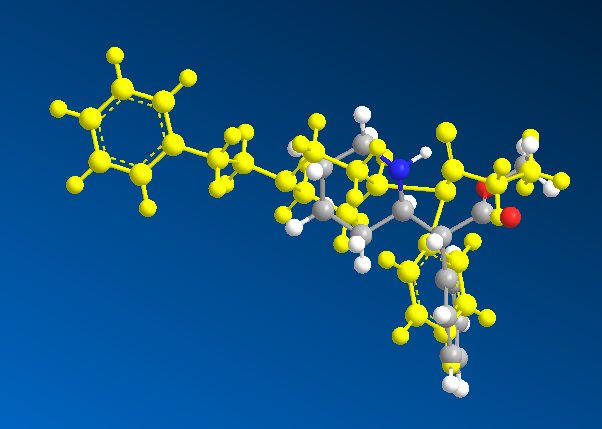
As you can see below when you overlay energy-minimized structures of dexmethylphenidate and fentanyl (highlighted in yellow) they don't quite match up. It's a bit of a fudge fest and the electronics are a bit wierd (e.g. there are nitrogens in one comound where there ain't in another)

(this is the best I can fudge it)
heJx9jS.png


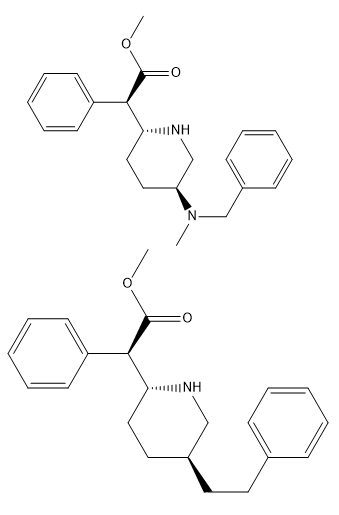
How about these? :P
OYgXOTv.png


Experimental evidence suggests that the phenethyl tail on fentanyl is required for opioid activity, so...
 
Last edited:
I know you asked about DAT/mu agonist combos, but I think its worth mentioning some NET/mu agonist combos:

Tapentadol
Tramadol


Maybe some analogues of those gain DAT activity?
 
(e.g. there are nitrogens in one comound where there ain't in another)

The nitrogen's *pretty close*, besides, there are cocaine analogs which have nitrogens in what would be the same area, having no problems with binding, e.g.:

3aErd.jpg


How about these? :P
OYgXOTv.png


Experimental evidence suggests that the phenethyl tail on fentanyl is required for opioid activity, so...

Nice, I'd knew you'd come 'round. ;-P ;-J
 
Also, you forgot about pethidine which is probably the closest to a DRI/mu agonist you can get (link), albeit it's certainly not DAT-selective.
 
Also, you forgot about pethidine which is probably the closest to a DRI/mu agonist you can get (link), albeit it's certainly not DAT-selective.

Pethidine! I knew it was familiar. I pretty much "re-made" it over at the random molecules thread trying to find an intermediate between troparil & methylphenidate. Which turns out to be an opioid. No surprises there. It's the one sekio said looked most viable. ;-P

Mine had the nitrogen a position over however (which is has to be, to be *truly* between the position of phenyltropanes and MPH analogs). I wonder if that'd increase the dopaminergic qualities and what it would do to the opioid function?
 
Often in ligand binding close isn't good enough. They have tried making fentanyl analogs where the piperidine nitrogen is rotated to the 2 or 3 position and they aren't active. The piperidine nitrogen plays an important role in the binding of fentanyl to the mu receptor (it is analogous to the nitrogen in morphine), and you can't reorient the nitrogen in relation to the phenethyl group and retain high affinity. I suspect that even with carfentanil you wouldn't be able to move the nitrogen around.

Designing hybrid ligands is difficult not only because you are dealing with two different pharmacophores but also because you have to engineer the ligand so it is active at both targets with similar potencies. Otherwise it will only hit one target in vivo.
 
^Well of course, in my instance I was saying the nitrogen at it's exact position for fentanyl like drugs didn't diverge from monoamine reuptake binding necessarily as shown in other analogues of them. Of course, if one constituent is necessary for one, that would have to be done, if it was neutral in the other respect.

I was looking at Ifenprodil, a NMDAR antagonist:

JzJ64.jpg


It is similar to fentanyl, seemingly, in how reverse-rotatory isomers of morphine like skeletons can be NMDA receptor antagonist (e.g. DXM)


& thank you, endotropic. The great thing about Tapentadol, is that it is a NE reuptake inhibitor, and NE increase in firing during opioid withdrawal is one of the main mechanisms by which opioid cessation is dysphoric. So similarly "draining" NE when coming off of it, together with ceasing its opioid function upon disuse (both method of actions stopping at once) might be part of the reason by which tapentadol has a lower incidence than oxycodone in terms of adverse side effects.
 
Last edited:
wow, the pethidine molecule surely remembers me of cocaine, and apparently even binds to the same site at DAT... probably being a transporter 'inverse agonist' like cocaine and mph if it is capable of inducing cocaine-like behaviour even, wow, now i wanna try it

how does the DA activity changes the subjective effects of pethidine? i'd love to know... i've heard some people say it has a different and very euphoric rush when IVed. i instantly thought of a cocaine and pethidine speedball but considering they bind to the same site you'd just have the opioid and cocaine rush anyway

interesting compound
 
wow, the pethidine molecule surely remembers me of cocaine, and apparently even binds to the same site at DAT... probably being a transporter 'inverse agonist' like cocaine and mph if it is capable of inducing cocaine-like behaviour even, wow, now i wanna try it

how does the DA activity changes the subjective effects of pethidine? i'd love to know... i've heard some people say it has a different and very euphoric rush when IVed. i instantly thought of a cocaine and pethidine speedball but considering they bind to the same site you'd just have the opioid and cocaine rush anyway

interesting compound


EDIT: (For the impatient: Minute/second mark 1:35)
 
Last edited:
So in the 'i like to draw random molecules thread' the morphine rule was mentioned... but a lot of opioids don't actually seem to adhere to those criteria.

Meaning that compounds posted in #4 may wel be opioidergic?

Is the tertiary amine in fent the replacement of the quaternary carbon? If we look at the AH-7921 and U-47700 type opioids, what functional groups do still seem to be needed - or maybe it is better to say what kind of receptor / transporter site moieties need to have complementary binding groups for it to be activated / inhibited?

And I guess that yes, the criteria / pharmacophores for not only DRIs and mu opioids but also some NMDA antagonists have potential overlap which allows both crossover multiple action drugs matching enough criteria of more than one drug category.... while of course it is always still possible to go the exact other way and go on the hunt for selective agonists...
 
And I guess that yes, the criteria / pharmacophores for not only DRIs and mu opioids but also some NMDA antagonists have potential overlap which allows both crossover multiple action drugs matching enough criteria of more than one drug category.... while of course it is always still possible to go the exact other way and go on the hunt for selective agonists...

It's even possible to have cross-over and be selective within the scope of either "sides of the fence", as it were, of what two different neurological systems the chemical crosses over into (DAT selective in contrast to SERT & NET with MAT, and at the same time being Kappa selective, in contrast to Mu & Delta) Now those would be the interesting ones, in my humble opinion.
 
I don't really see the value of a "hybrid action" drug in the scope of recreational/abusive usage: The reason being that tolerance to the effects will likely escalate at differing rates.

An example would be how Tramadol is considering by many to give a qualitatively excellent high the first time/first couple of times in an opiate naive individual, but quickly stops being worth it. The SNRI aspect adds a unique something else... but as your mu tolerance increases it stops being worth it.

If your goal is to hit both sites simultaneously it seems much more logical to use two highly selective ligands and adjusts dosages for each as necessary.

Of course stuff like tramadol might have some value in a pharmaceutical setting because it's easier/preferable to prescribe one drug than multiple, but I can't think of any compelling medical reason to add dopaminergic activity to an opioid painkiller.
 
personally, i find the idea interesting purely for the novelty of it. you are right, though, pharmacologically and pharmacokinetically the chances of such a drug working out is quite a longshot.
 
personally, i find the idea interesting purely for the novelty of it. you are right, though, pharmacologically and pharmacokinetically the chances of such a drug working out is quite a longshot.

I agree. I think of these substances in terms of the *first exposure* honeymoon period of the drug naive individual. Like that first shot of cocaine, etc. I can't get that from it ever again personally, since my body knows how to react and what counter-measures to use against dopamine indirect agonism or opioid receptor direct agonism from having their full scale affection.
 
Top