'Our purity is above 99%': the Chinese labs churning out legal highs for the west

S.J.B.

Bluelight Crew
Joined
Jan 22, 2011
Messages
6,922
Location
Canada
'Our purity is above 99%': the Chinese labs churning out legal highs for the west
Nicola Davison
The Guardian
May 1st, 2015

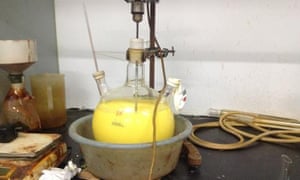
At midnight on a recent Friday, in a backroom at Chemsun Global pharmaceutical laboratory in Shanghai, a Chinese chemist who called himself Terry was eager to close a deal. Outside in the lab a bright yellow liquid whirred around a flask. The smell of fumes was so intense it left a bitter, chemical aftertaste.

The place was filthy: surfaces were strewn with discarded rubber gloves and in one corner a sack of white powder spilled onto the floor.

I was there to “inspect” the lab, to take stock of the wooden barrels full of drugs, but Terry wasn’t interested in small talk. “You just take the samples, right?” he said, near shouting. “Let’s just be quick. Tell me what you want, how much you want, then we can talk about price, we can talk about shipment.”

In the last decade, the global trade in drugs has changed in profound and unpredictable ways. The reality of drugs in the digital age is that on deep web markets any illegal drug, from marijuana to methamphetamine, is a click or two away.

Meanwhile the newly interconnected, globalised drugs scene has grown too complex and fractured for existing laws to control – a situation vividly illustrated by the rapid emergence of “legal highs”, or what official bodies call novel psychoactive substances (NPS).

Read the full story here.

 
The same chemist mentioned the drugs they distributed killed people because the synthesis was sloppy and incorrect. This picture is from the article.

500.jpg
 
The same chemist mentioned the drugs they distributed killed people because the synthesis was sloppy and incorrect.

I am pretty sure that the author misrepresented what the chemist was saying. I think she was saying that the structure of the molecule made it toxic, not the fact that it was synthesized incorrectly. This seems pretty obvious from the context if you read that section over.
 
"Photograph: Nicola Davison for the Guardian"

That sums up the authority of the photograph. China's Public Security Bureau (a.k.a. PSB) would *never* allow foreign media to take a picture of a local clandestine lab. This is a random picture of a "lab" somewhere outside of China... UK, perhaps?
 
Why do both of you gang up on the Guardian? I mean what is your motive? The Guardian is very respected. The Guardian has arguably released the most influential international news this entire decade.

If the Guardian published this I trust the article is as accurate as possible. The Guardian has more credibility than either of you.
 
Last edited:
Why do both of you gang up on the Guardian? I mean what is your motive? The Guardian is very respected. The Guardian has arguably released the most influential international news this entire decade.

If the Guardian published this I trust the article is as accurate as possible. The Guardian has more credibility than both of you.

I didn't mean to suggest that the author intentionally changed the facts. But she is not a chemist and I think she just misunderstood what the chemist was telling her.
 
Last edited:
Good read.. I liked the end part alot -

“Legal highs appear to have arisen because of success in the enforcement on the supply side for cocaine and ecstasy particularly,” Kushlick says. “The demand remains and the entrepreneurs, whether they be criminal or legit, move in to exploit that demand.”

Mike Power, author of Drugs 2.0, argues that the answer to the legal high dilemma does not lie in punitive controls and the annual spending of millions of taxpayers’ dollars. Drugs law should be progressively dismantled, he says, recommending the introduction of a controlled, regulated market of cannabis as seen in Colorado.

“The strength and potency of the drug would be limited by law, with accurate labelling and age requirements for prospective users demanded as we currently have with alcohol,” he says.

Kushlick, too, advocates legalising the more benign substances. “When prohibition goes and we have legally regulated markets for drugs that have been used, in the case of cannabis, for millennia, people will choose to use those,” he says. “Why would you want to use a random white powder?”
 
The Guardian has more credibility than either of you.

I can't speak for S.J.B., but those that know me, would beg to differ with you regarding my knowledge of the People's Republic of China, which happens to be very intimate and long-standing. And no, I'm not a drug producer or distributor, so don't go there. Fair warning. BTW, my comment had nothing to do with the authority of that publication, but rather, with the image that was used.
 
"Photograph: Nicola Davison for the Guardian"

That sums up the authority of the photograph. China's Public Security Bureau (a.k.a. PSB) would *never* allow foreign media to take a picture of a local clandestine lab. This is a random picture of a "lab" somewhere outside of China... UK, perhaps?

Why do both of you gang up on the Guardian? I mean what is your motive? The Guardian is very respected. The Guardian has arguably released the most influential international news this entire decade.

If the Guardian published this I trust the article is as accurate as possible. The Guardian has more credibility than either of you.

But does Nicola Davison?

A quick check on the Internet reveals she is a freelance journalist, not a Guardian staffer, though I'm not sure it would make much difference. While I give her points for quoting sense from Mike Power and Danny Kushlick I'm afraid she loses all these points when you look at other sensationalist stuff she has had published.

http://nicoladavison.co.uk/chemical-highs/

Try that one. Another sensational legal highs piece where she manages to mention "meth(amphetamine) is cheap heroin" in the second paragraph. And in the last paragraph refers to mephedrone as "meow-meow".

She does live in Shanghai so I do believe that photo is probably genuine. However, a lot of things about the article published here reek of drug sensationalism and the need to sell an article based on people's prejudices about drugs. Check the first paragraph. The "yellow liquid" that leaves a "bitter aftertaste". Quelle surprise. It's a fucking chemical laboratory.

Nicola Davison writes for many different papers besides the Guardian. Anyone she can sell an article to. This includes the extremely right wing Daily Telegraph. I don't think her principles are beyond reproach.
 
Thanks for that, StoneHappyMonday. I wasn't aware that Nicola Davison is currently based in Shanghai, so the photograph may be genuine. On the other hand, if it is, then it only shows a clandestine lab that isn't at all representative of real Chinese labs ("RC" or otherwise). That image, if legitimate, was almost certainly provided to the journalist by local law enforcement, because as I stated earlier, the PSB doesn't allow foreign journalists to take such pictures.

Incidentally, here's the latest official list of scheduled substances in the PRC:

http://www.sda.gov.cn/directory/web/WS01/images/yrPSqbzg0qm7r7zgobIyMDEzobMyMzC6xSC4vbz+LmRvYw==.doc

I obtained this 2013 document from the China Food and Drug Administration (a.k.a. CFDA). If anyone is interested in the 2005 and 2007 editions, please contact me via PM.
 
Yes, and those are the ones to be most careful with -- certain stimulants, cathinones, et al. Fortunately, most psychedelics are legal (there's no "analog act"), so they are almost always produced to standards ranging from good to near-reference in proper commercial laboratories, and in the case of government ones, reference.
 
Top