• N&PD Moderators: Skorpio

SYK-524: Structurally Novel Opioid

SeenSoFar

Bluelighter
Joined
Jun 21, 2013
Messages
242
So guys, through some late night browsing I came across a new paper detailing a totally novel opioid. Apparently the structure has been thoroughly explored, and this is the best compound from the lot. Below is an image of the compound, the abstract from the paper, and a link to it. I would like for someone with access to pass the paper on to me if possible, since I'd like to read it in full. Anyway, enjoy!
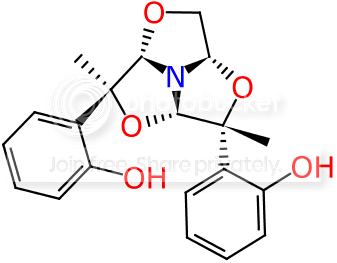
download4.png


Abstract

We designed and synthesized of 1,3,5-trioxazatriquinanes with o- or p-hydroxyphenyl rings as analogs of the κ opioid receptor agonist SYK-146 with m-hydroxyphenyl groups. Although almost all tested compounds did not bind to the opioid receptors, only 17b (SYK-524) with two o-hydroxyphenyl rings showed moderate or potent binding affinities and exhibited agonistic activities for the three opioid receptor types. Because the basicity of the nitrogen atom in the 1,3,5-trioxazatriquinane structure was predicted to be very low due to the electron withdrawing effect of the three oxygen atoms, SYK-524 was a novel non-morphinan and nonpeptidic opioid universal agonist lacking a basic nitrogen atom.

http://www.sciencedirect.com/science/article/pii/S0960894X14008439

 
Looks extremely difficult to synthesize and a mess of isomers to resolve. Looks unstable, too.

I wonder if 3,5-dimethyl-5-(3-hydroxyphenyl)-oxazolidine is an active opioid.
 
Looks more like one of natures more complex wonders.

Well, if anything wants to synth some up be sure to add a phenethyl group, or two. :) ;) (kinda an inside jk)
 
Unfortunately it looks like this one isn't going to be much fun... After having a look at the full paper, it's affinities are as follows:

Ki (nM):
μ: 20.5
δ: 88.8
κ: 9.17

EC50 (Emax):
μ: 57.6 nM (89.2% )
δ: 52.7 nM (73.6% )
κ: 9.95 nM (131% )

Oh well, so much for that line of thinking... Back to ring-opened morphinans for my hope of coming across an unscheduled opioid worth exploring...
 
Yeah it's really unfortunate...

There are a few compounds with that same 1,3,5-trioxazatriquinane core that are bound to 2 or 3 morphinan pharmacophores, which gives some interesting properties such as mu full-agonism paired with kappa antagonism. Those substances seem like they'd be great to explore, and they are quite a bit different from plain morphinans, which is good from the legal standpoint. Unfortunately, they seem to be a real bitch to synthesise, not to mention the fact that you need controlled compounds as reactants in the synthesis.

I think the directions that will be best to explore for the next legal novel opioid that isn't a death sentence for any inexperienced person (a-la bromadol) is azaprocin analogues (there are tonnes!) and ring-opened morphinans. Azaprocin and it's analogues are particularly interesting to me, I'm going to have to look really closely at them...
 
..I think the directions that will be best to explore for the next legal novel opioid that isn't a death sentence for any inexperienced person (a-la bromadol) is azaprocin analogues (there are tonnes!) and ring-opened morphinans. Azaprocin and it's analogues are particularly interesting to me, I'm going to have to look really closely at them...
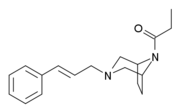
Old thread I know.. but I came across this wiki entry of a piperazine drug AP-237 related to azaprocin. Apparently it was used in China in the 80s before withdrawing it due to reinforcing. It is claimed that this simple molecule is about as potent as morphine (so one would expect the nitro even more potent may be 1/2 fentanyl). Yet a quick pubmed search shows its LD50 a wooping 900+mg/kg in rats! which is ridiculous!. either It is a selective mu Opioid agonist as claimed and the LD50 is BS or it is not a mu agonist and have analgesic action via receptors systems other than MOR. Does anybody knows anything about this molecule??

AP-237 (1-butyryl-4-cinnamylpiperazine) is an opioid analgesic drug that was widely used in China to treat pain in cancer patients as of 1986.[1] It is one of the most potent compound among a series of analgesic acyl piperazines compounds first synthesized and reported in Japan in the 1970s.[2][3][4] AP-237 has analgesic potency comparable to that of morphine but with a relatively higher therapeutic index. The drug were initially claimed to be a non-narcotic analgesic. However, subsequent studies have shown AP-237 and similar acyl piperazines to be potent and selective agonists of mu opioid receptor (MOR) with relatively low affinity for the delta opioid receptor and the kappa opioid receptor.[5] In accordance with these studies, results from the intravenous self-administration experiments in rats showed that AP-237 has a marked reinforcing effect with tolerance and dependence quickly developing.[1] In addition, the morphine antagonist naloxone reverses the effect of AP-237 and precipated withdrawal symptoms in AP-237 treated rats further indicating a mechanism of analgesia mediated via selective agonist activity at mu opioid receptors
here is the structure: AP-237

220px-AP-237.png


and that of Azaprocin:
180px-Azaprocin.png
 
Now that IS interesting.....

Could be just the thing once I'm done with my sunifiram project=D

Is this one of a large family of opioids, or is it one of a kind? what analogs are known if any?
 
Old thread I know.. but I came across this wiki entry of a piperazine drug AP-237 related to azaprocin. Apparently it was used in China in the 80s before withdrawing it due to reinforcing. It is claimed that this simple molecule is about as potent as morphine (so one would expect the nitro even more potent may be 1/2 fentanyl). Yet a quick pubmed search shows its LD50 a wooping 900+mg/kg in rats! which is ridiculous!. either It is a selective mu Opioid agonist as claimed and the LD50 is BS or it is not a mu agonist and have analgesic action via receptors systems other than MOR. Does anybody knows anything about this molecule??


here is the structure: AP-237

220px-AP-237.png


and that of Azaprocin:
180px-Azaprocin.png

:)

Am I the only one to notice that among the most potent homologues, the length of the amide is adjusted so that they key cinnamate WITH a para nitro is in it's minimum energy confotmations?

While I'm at it, why hasn't 4-phenylphenapromide NOT having turned up yet may suggest either plain fentanyl is so cheap and easy to make, why do so.
 
Top