• H&R Moderators: streaM Freak

Cooking oils - The good, the bad, and what do you use?

can you elaborate on 'better than butter'? I hold coconut oil in high regards, but not as high as butter. I hold olive oil really high-up. am the type that will not eat a bite of something, if it has processed/hydrogenated fats in it.
Would be interested in learning more about whaty ou're getting at. I couldn't say there's a 'best' oil (outside of blends) because, afaik, the body needs things that butter has that olive oil don't, and vice versa. I like olive oil for it's poly-unsat's and like coconut/butter/meat-oils for their satty content. I like salmon w/ skin for the u3's. I think it's hard(or, missing the point) to name 'best fat', and yes that does apply to cooking oils- the best oil/fat for cooking, that i keep on-hand, is coconut. Your chart is interesting but i may've misspoke earlier, it's not 'burning point' that concerns me, it is what temperature starts to 'denature', for lack of a better term, the lipids in the oil/fat. I'm ignorant how that would stack up to the burning points, maybe it's tightly correlated but maybe not. I do know that the list you posted had extra virgin olive as much higher burning point than coconut, but iirc the stuff is photosensitive.. i would be interested in a more coherent approach to cooking oils than i currently use, but i don't think burning point is the most important metric there. regardless, i do appreciate that link it was informative :)

Ah, I may have misunderstood your question regarding the oils - I have no idea when they would begin to denature, so I can't help you there. And when I said "better than butter", I believe I've read that the main fatty acid in coconut oil may be healthier than the main fatty acid in butter.

Also, ebola is actually totally right. I just looked into it, and I guess the jury is still out on how harmful saturated fats actually are. The only thing we seem to know for sure is that trans fats are bad, but it seems that there's no consensus on the harm of saturated fats. Which is news to me! - I thought we had that shit figured out by now.
 
Also, ebola is actually totally right. I just looked into it, and I guess the jury is still out on how harmful saturated fats actually are. The only thing we seem to know for sure is that trans fats are bad, but it seems that there's no consensus on the harm of saturated fats. Which is news to me! - I thought we had that shit figured out by now.

and this is why I started the thread, I've been following this thread meticulously and I'm still none the wiser!

I'm still using coconut oil and occasionally vegetable oil, but I have no clue if this is actually good or bad for me.
 
So you're going to completely ignore the statement based on that?

I hope you don't always interpret the actions of people so falsely.

Are you still using your anti-virus definitions from 1994? I don't think so. Past studies serve as springboards for current medicine and natural science, but their data is not always to be trusted. 20 years is a very long time. There are large differences between studies on humans (or other mammals), and a study documenting the smoking point of a specific oil. One is a relatively basic bio-chemical property, and the other is the complex working of many different variables, some of which cannot be accounted for. I am positive there are newer, better studies with a fairer representation of the topic. I saw many referenced a few years ago even during a nutritional physiology class.

A good place to start actually understanding the science behind this stuff would be to read about cellular membrane dynamics (start with the fluid mosaic model) and components, and basic bio-chemistry. What is necessary for a healthy cell membrane? What happens (especially to local tissues) when a defective cell membrane leads to loss of function and/or cell death.

Also, when talking about saturated fats one cannot leave out cholesterol. Which saturated fats have it, and which don't? Do we need cholesterol as well? What ratios of LDL/HDL are correct for optimal heart health. How do saturated fats effect membrane fluidity? Which ratio of saturated, mono-unsaturated, poly-unsaturated are best for optimal cell membrane fluidity?

Form = function, and through this it is also obvious why the double bond on a trans-fat is so easily broken leading to unhealthy consequences. Certain vitamins are able to catch free-radicals, and can also help with countering the damage done by them.
 
, I've been following this thread meticulously and I'm still none the wiser!

same here.. i've read heavily on diet for so many years, and have come to the (sad) conclusion that we don't know a fraction of what ppl imply is known. The closest-to-sure things I've seen are that trans fats are always bad; sufficient (but not excessive) amounts of o3 and o6 are important (as is the ratio of 3:6) ; and that, like most things, it's better to get things from whole foods (for instance, fish oil pills compared to fatty salmon)

When it comes to coconut oil (and saturated fat in general), it pisses me off to find ppl on both sides of the fence, w/ completely opposing opinions, and I can read and read and still not make up my damn mind on who's right :|


Still, I guess i'm going to stop purchasing olive oil altogether now, because I dislike its flavor and its expensive, so if it's not so good nutritionally (or at least inferior to sunflower oil), and sunflower is cheaper and tastes neutral, that's going to 100% replace olive oil for me) Will still hold out with my coconut oil, because i use that for more than just calories (will eat it for energy boost by itself pretty frequently), and animal fats aren't going anywhere for me cuz I'm leaning to them being healthier than most consider them.


Ebola- what are the main factors that make saturated fat effects hard to dissect? The only one i'm familiar w/ is 'burned meat', which i understand to be particularly unhealthy, and since it's typically in the presence of lots of sat fat, it's hard to separate them in studies. Would love to know what else to look for (because I cook my meat very slow&low, to avoid any burning; in fact, only food i ever eat that has any burning is scorched onions&peppers cuz, well, i just cannot help myself on that one!)
 
What about the trans fats? ->


The oil is removed by a combination of high temperature mechanical pressing and solvent extraction. Traces of the solvent (usually hexane) remain in the oil, even after considerable refining. Like all modern vegetable oils, canola oil goes through the process of caustic refining, bleaching and degumming--all of which involve high temperatures or chemicals of questionable safety. And because canola oil is high in omega-3 fatty acids, which easily become rancid and foul-smelling when subjected to oxygen and high temperatures, it must be deodorized. The standard deodorization process removes a large portion of the omega-3 fatty acids by turning them into trans fatty acids. Although the Canadian government lists the trans content of canola at a minimal 0.2 percent, research at the University of Florida at Gainesville, found trans levels as high as 4.6 percent in commercial liquid oil.24

24. S O'Keefe and others. Levels of Trans Geometrical Isomers of Essential Fatty Acids in Some Unhydrogenated US Vegetable Oils. Journal of Food Lipids 1994;1:165-176.

download


Source: Fallon, Sally, and Mary Enig, "The Great Con-nola." The Weston A. Price Foundation. 28 July 2002. http://www.westonaprice.org/know-your-fats/the-great-con-ola

The amount is negligible. People are making trans fat sound horrible by saying it increases bad cholesterol. Well you know what else can have an affect on cholesterol? FOODS THAT FUCKING HAVE CHOLESTEROL.

Ignoring the fact that it's dietarily insignificant, the tiny amount in say a quarter of a cup of canola oil is probably going to have less effect on your LDL/HDL than eating a couple tablespoons of butter.
 
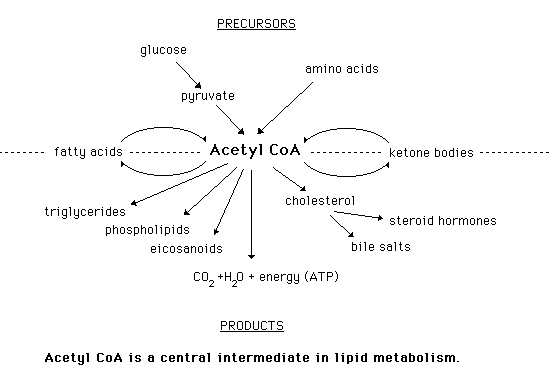
^^...I was under the impression that trans fats are so bad because of the 'trans' double bond which is requires far less energy to split open (causing free radicals) than a similar fat with a 'cis' double bond. The process of cholesterol synthesis in the body does not selectively use trans fats over other fats. In fact in order to form cholesterol one needs Acetyl-CoA. Acetyl-CoA can be formed from fatty acids (first packaged in the form of TAGs (triacylglycerides)), among quite a few other precursors. The body normally produces the amount of cholesterol it needs (from whatever TAGs are most available). I tried to be simple/concise. Let me know if something is unclear.

Acetyl-CoA synthesis:
fa_overview.gif


Acetyl-CoA:
220px-Acetyl-CoA.svg.png


Cholesterol synthesis (ignore the statins ;P)
nrd1112-f1.gif

http://www.nature.com/nrd/journal/v2/n7/fig_tab/nrd1112_F1.html
 
Last edited:
bmxxx, I would not go so far as to trust me and switch your diet up completely. I just wanted to show that there is a lot more to this topic than the quick answer of coconut oil. I personally think switching up the fats among healthy fats is probably not a bad idea. After reading this thread I spent a bit more on a better quality sunflower oil, and also purchased a rapeseed oil for omega-3s (I highly doubt I get enough from other sources). We can get pretty deep into this shit biochemically, but then I feel we start to lose the connection to reality (or realize how incomplete our knowledge is). To assume we are smart enough to think that the pictures of things we have created are infallible would be very presumptuous.
 
it would be (presumptuous) but i don't think we're expecting infallibility or some perfect picture, just trying to get closer to 'right' on these things :)
Is rapeseed a high o3 oil? Is it 'good' omega3, ie is it EPA/DHA, or is it ALA which the body only gets a small fraction of compared to epa/dha?
 
Same thing with stir fry, is there anyway to get out of using oil? I read somewhere that you can gently heat onions to release a natural oil - I tried this and it doesn't work.

Would cooking in water work for a lot of things - For example could you stir fry with water?

You can indeed sort of make a stir-fry with water. Cooking with water rather than oil is an entire technique. Other than trying it myself, I've seen 'frying' with water featured on an episode of the Hairy Bikers, and in an issue of the National Enquirer which claimed Mario Lopez lost his shit at a resteraunt when the cook refused to switch all his oil-fried dishes for water-fried dishes, because he didn't know how to cook that way. These sources blatantly make me NOT an expert LOL.

In my own experience, if you fry veg with water it won't necessarily taste as rich, and you need to keep adding warm water as you go along or everything just gets really dry. You also need to put all the veg in at the right time, each item having the right texture from being perfectly cooked adds a quality that distracts from the lack of crisp oil-texture. You can also use stock, or tomato juice/chopped tinned tomatoes - you cook stews, soups, sauces and various one-pots in water, often not adding oil. It all becomes a bit of a grey area. Not to mention the classic cooking in wine.

I associate gently heating onions with them caramalising, but that requires oil anyway. That said, the resulting onions are slimy (in a good way) and I reckon you could get away with using less oil in a stir-fry or similar if you used just enough to caramelise the onions, and then cooked the other veg in the onions. But by the end, the onions may be overdone/dry... :?

It should be recognized that sesame oil should be used more as a seasoning than a fry oil, on account of its low smoke-point and high ratio of omega-6s to omega-3s.

ebola

I've read a few places that sesame oil is basically as healthy as olive oil, people just don't use it as much because of it's strong taste. I personally ADORE the taste and it's one of my go-to oils - marmite and sesame oil sandwhich, nom nom.

What about hemp cooking oil?

This seems to be growing in popularity in the UK, and I have a bottle of some hemp oil brand 'Good Oil' that is supposedly great for everything you may need an oil for. According to their website (and therefor probably written with some bias):

"What's GOOD about GOOD OIL - British Cold pressed hemp oil?

Higher content of Omega 3, 6, & 9 (the good polyunsaturated fats) than any other culinary oil
Naturally rich in Omega 3
1 table spoon (10ml) of Hemp seed oil contains 94% of the daily recommended intake of Omega 3
Half the saturated fat of olive oil
Can be used for dressing, dipping and cooking
Contains ZERO trans fats
10 ml of Good Oil contains as much GLA as 6 Evening Primrose Oil capsules
Hemp Seed oil can contribute to treat ADHD, cardiovascular disease and rheumatoid arthritis
Contributes to the health of hair & skin, and helps cholesterol, immune system and joints" - http://www.goodwebsite.co.uk/good-products/good-hemp-food/good-oil-hemp-oil (full nutritional info at link).

I can't believe how popular coconut oil seems to be! I have to be honest, it's always been WAY out of my price range.

I use olive oil, sesame oil, and organic butter. And that one bottle of Good Oil. Sesame and butter are my favorites, taste-wise.

EDIT:

Using less oil seems the best route. Non-stick pans are a must for this, in my book. Come to think of it, they're a must for cooking with water, too. Good tips in this PDF: www.uel.ac.uk/wwwmedia/microsites/hrservices/documents/hs/Cookingwithlessfat.pdf
- "Try cooking using an oil-water spray. Fill a small plastic spray bottle with seven-eighths water and one-eighth oil of your choice. Use your oil-water spray when cooking under the grill, in a griddle pan, in a frying pan or in roasting pans before adding foods.
- Be aware that some vegetables will soak up more oil than other vegetables. Partially replace some of the oil that you would have used with small amounts of water when cooking these types of vegetables.
- Snacks such as samosas can be lightly brushed with oil and then baked or grilled rather than being deep-fried."

 
Last edited:
Sorry for being a lazy SOB, as I could have searched within the thread but...what's the verdict/peoples thoughts on sesame seed oil?

I use it conservatively when simply stir frying vegetables. Sometimes with meat (chicken) and a sauce.

Is it bad? Any health benefits?

I intend on doing some reading on it after sobering up after the mini binge currently in progress.

Ha! Forget it as i see links and posts pertaining to my queries above XD.
 
The only time I use olive oil is flavoring crap. It's definitely not a cooking oil.


Bullshit, loads of things require olive oil for cooking.

Anything where the oil you're frying/sweating in is going to end up in the final product you need to use something nice tasting like olive oil or butter (depending on what sort of dish it might be). For instance when sweating down onion or shallot to make a simple tomato sauce or a risotto you're going to use olive oil (or pomace at least) because you don't want a load of shitty neutral flavour oil floating around in the final product.

Heat's going to destroy a lot of the flavour of a good olive oil but you would use a lower grade one because you'll still be able to taste it in the final dish. A tomato sauce with an olive oily film on the top as it simmers is delicious, if it was a veg oil it would be vile.

Also if you're frying something like aubergine or courgette it needs to be fried in olive oil because the flesh soaks up so much of it. Fried aubergine dripping with veg oil would be horrible (as happens when you fry aubergine after it soaks it up and then lets it out as it cooks), dripping olive oil not so bad.
 
Also if you're frying something like aubergine or courgette it needs to be fried in olive oil because the flesh soaks up so much of it. Fried aubergine dripping with veg oil would be horrible (as happens when you fry aubergine after it soaks it up and then lets it out as it cooks), dripping olive oil not so bad.

You may not be cooking certain things hot enough either. Aubergine (eggplant), depending on what you are going for, is actually best done with very, very little oil in the proper pan (i.e. not teflon, I have a non-teflon, non-stick that I like). Sautéing is ok with olive oil, but frying is a no go, and to flavor with olive oil, it is usually used fresh at the end.

Frying eggplant (i.e. submerging it in oil) would also use some sort of a batter, and a proper frying oil. If you are frying eggplant without a batter I have no idea what you would be using it for because it sounds pretty nasty.
 
Aubergine should be salted for half an hour first, it significantly reduces its absorbency

Bullshit, loads of things require olive oil for cooking

I cook pretty much everything in olive *shrugs* - unless its something like a stir fry and I'm using a blazing hot pan in which case I use peanut or canola - my food always tastes fine. I wouldn't cook with an extra virgin olive oil but if you use a very light oil then there's not much flavour to destroy anyway.
 
Last edited by a moderator:
I heard about most of the oil are good for health but I think using less oil is best to cook any food. Using less oil is also good for health and save you from many diseases.
 
Top