• N&PD Moderators: Skorpio

Ketamine's Antidepressant effects - NMDA antagonist

Does blocking AMPA result in the psychoactive effect eliminated too? A researcher I was speaking to the other day was quite convinced that ketamines AD effect was purely as a result of its psychoactive-induced behavioural/thought changes, rather than a pharmacological one.

No offense to this researcher, but that's a fairly ridiculous statement. That's like saying leaves blowing in the wind are due to the air moving, not the wind. You can't have psychoactive induced behavioral/thought changes without a pharmacological action, otherwise you just have a placebo.

 
That's not a very charitable interpretation though. The researcher could have meant that alterations in cognitive patterns not directly linked to well understood physiological processes mediate relevant anti-depressant effects rather than clear biochemical mechanisms more directly associated with NMDA antagonism itself. As an analogy, if I consider having pizza for lunch, yes, this is a physical, neurological process, but we won't get too far trying to describe precisely what happened in my brain to elicit such.

ebola
 
No offense to this researcher, but that's a fairly ridiculous statement. That's like saying leaves blowing in the wind are due to the air moving, not the wind. You can't have psychoactive induced behavioral/thought changes without a pharmacological action, otherwise you just have a placebo.


Her point was that ketamines AD effect was mostly due to its psychoactive effects, rather than any intrinsic property linked to NMDA antagonism. The purpose of most research into ketamine nowadays is to create a pharmaceutical that has the same AD efficacy without inducing psychotic symptoms. Should add as a random site note that she's involved in ongoing research into psilocybins antidepressant effect, so I assume she has no broad prejudice against psychoactives in general =D
 
For me what worked was maintaining threshold effects for 2-4 days, which was ~12 mg / hour taken intranasally, until effects at that dosage abated. Then I stopped with the k. During the treatment, I felt less depressed in that I was ever so slightly disconnected from my frustrations. But toward the end and afterward, I was...well, magically non-anhedonic, energetic, and active. I was finding value in engaging the world that was absent when I was depressed, a world more vivid and exciting. Basically, I regained my ability to be interested in things and people, crippling ennui having evaporated, looming anomie becoming less daunting. This state felt nothing like anything K induces immediately and lasted ~2 weeks. I wasn't dissociated but rather...er...associated. :P

This regimen was empirically derived through 1 person's (Jamshyd's) trial and error, and has been replicated by a couple of people. Clearly, this is weak evidence that the dosing schedule I chose was ideal.

I'm beginning to see the wisdom of this sort of dosing schedule. In fact, given the moreish nature of the NMDAR antagonists, I can see the potential allure of consuming your whole supply in a few days, and then chilling out until your next Rx is due/next paycheck comes through/etc., and could see someone "accidentally" ending up on this kind of schedule, even if they were nominally on daily dosing.

Additionally, you won't get the same tolerance as you would get on daily dosing, which I hear can get extreme. Also, TMI in the name of science, I've been noticing that it's a little hard to take a leak, especially while I'm feeling buzzed. Not to the point where it's painful...just I thought I had to go...but here I am...and I'm not going. I've noticed the same issue with with marijuana, which I'm often using around the same time, so it may just be the weed paranoia causing me to freak about KLUTS. It sounds like ketamine (especially oral ketamine) isn't kind to your bladder in the long run, so perhaps staggering the doses would be less harmful than daily dosing, in a systemic sense. Have any of you guys noticed this as a side effect?

ETA: the compounding pharm is on the case, and should have an intranasal form delivered in a few days, so hopefully the combination of a not-oral ROA and a smaller dose mg-for-mg will ease any bladder woes.
 
As an analogy, if I consider having pizza for lunch, yes, this is a physical, neurological process, but we won't get too far trying to describe precisely what happened in my brain to elicit such.

Why? It can't be that complex.
 
perhaps it is simply the body's natural reaction to the introduction of an NMDA receptor antagonist into one's system, aka the method by which you develop tolerance. the body somehow compensates for the action of the ketamine, in this case it seems most likely to be AMPA upregulation, and thereby creates an antidepressant effect. this would also explain why ketamine's efficacy as an antidepressant lasts far past the acute effects, but still fades over time, as this is exactly how tolerance develops and fades to any foreign substance acting on the brain. your body adapts to the new neurotransmitter imbalance by rebalancing, and gradually lifts the rebalance as the substance is no longer introduced to the brain. just a thought.
 
tussman said:
Why? It can't be that complex.

Ummm...okay. It's actually in the running for most complex phenomenon ever observed. :P This involves the sum interaction of all neural circuitry, which is not only currently computationally intractable but also nearly entirely unmapped. It's rather easy to demonstrate how gross neurochemical changes induce relatively global changes in the activity of neural circuits, but getting to something as specific as the relationship of specific patterns of physical activity to specific cognitions? We're nowhere near understanding that.

ebola
 
I love reading this forum because reading the debates of geniuses is making me smarter :)

I thought ketamine stimulated the growth of serotonin neuron axons to make the synapses (which are growing to an unhealthy length which is the clinical diagnosis of "depression") a healthy distance apart. I remember reading an article that claimed it worked rather instantaneously and lasted upwards of a week.

For me, the antidepressant effects are most pronounced in the afterglow of a decently strong dissociative experience, and they're characterized by a gigglish euphoria and a lack of stress. and, depending on how intense the trip was, a thankfulness for everything that is good in my life after having to accept the loss of everything that tied me to this earthly realm the night before.

Dissociating the negative emotional response from the stimuli is one of the key factors in therapy, so it would make sense that dissociation from sensory input could facilitate such a thing.
 
Glutaminergic transmission is too prolific and widely distributed in the brain for this to be possible. Remember that dissociatives are specific to NMDA-type receptors, expressed mostly in the hippocampus. They exert downstream effects of varied sorts, and AMPA receptors are key and relatively directly affected.
Have you got references for ketamine being specific to NMDA subunits that are expressed the hippocampus?
 
If Ketamine really does upregulate AMPA, then it seems to me that Ketamine would cause anxiety, no? Every Glutaminergic agonist, upregulator or allosteric modulator I've heard of is a substance that does a fucking fantastic job at giving people seizures, convulsions, and panic reactions. Why would Ketamine be any different if there wasn't something that was down regulating Glutaminetgic transmission? I know ketamine antagonizes NMDA, but I mean why would ketamine be any different unless it decreased overall Glutaminergic activity?
 
It can't be that complex.

If it was trivially easy, we'd have artificial intelligences comparable to humans. How qualia arise from lower level electrical signals in the brain is still pretty mysterious.

If Ketamine really does upregulate AMPA, then it seems to me that Ketamine would cause anxiety, no? Every Glutaminergic agonist, upregulator or allosteric modulator I've heard of is a substance that does a fucking fantastic job at giving people seizures, convulsions, and panic reactions.

because indirect modulation of AMPA is different than direct modulation. Ketamine is thought to act to increase AMPA transmission because it blocks NMDA receptors and because the two systems are linked biologically, not because it's a direct AMPA agonist.

Every Glutaminergic agonist, upregulator or allosteric modulator I've heard of is a substance that does a fucking fantastic job at giving people seizures, convulsions, and panic reactions.

Also, there are multiple subtypes of glutamate receptors; not all of them are excitotoxic. AMPAkines for instance (shit like piracetam) are non-excitotoxic.

More practically, ketamine is an anxiogenic in that if you can't orient yourself in space and you're hallucinating shit, some people are liable to freak out. It's not anxiogenic like something like THC or pentylenetetrazol.
 
If Ketamine really does upregulate AMPA, then it seems to me that Ketamine would cause anxiety, no? Every Glutaminergic agonist, upregulator or allosteric modulator I've heard of is a substance that does a fucking fantastic job at giving people seizures, convulsions, and panic reactions. Why would Ketamine be any different if there wasn't something that was down regulating Glutaminetgic transmission? I know ketamine antagonizes NMDA, but I mean why would ketamine be any different unless it decreased overall Glutaminergic activity?

Receptor upregulation is a relatively slow process. After the signal comes in (ketamine blocking the NMDAr in this case) the body needs to synthesize new receptors, process them and insert them into the membrane. Upregulation also tends to be long lasting, because receptor downregulation is equally slow.

If AMPAr upregulation has any noticeable effects, I wouldn't expect them until after most of the acute effects wear off, or even the day after.
 
If Ketamine really does upregulate AMPA, then it seems to me that Ketamine would cause anxiety, no? Every Glutaminergic agonist, upregulator or allosteric modulator I've heard of is a substance that does a fucking fantastic job at giving people seizures, convulsions, and panic reactions. Why would Ketamine be any different if there wasn't something that was down regulating Glutaminetgic transmission? I know ketamine antagonizes NMDA, but I mean why would ketamine be any different unless it decreased overall Glutaminergic activity?

The idea that ketamine, because it is an NMDA antagonist, decreases overall glutaminergic activity (presumably you mean on the whole brain scale) is obviously too simplistic. You are disregarding the possibility that NMDA antagonists preferentially target particular receptors and/or cell types.

For instance, Olney and Farber (1995) proposed that NMDA antagonists block the excitation of GABA interneurons, which reduce inhibition to glutaminergic afferents, thus increasing glutamate release in the frontal cortex. A number of animal experiments with microdialysis have confirmed increases in extracellular glutamate, and human neuroimaging studies have (mostly) showed net increases in brain activation in multiple regions as measured by FDG-PET and fMRI (see Deakin et al 2008).
 
sekio said:
Also, there are multiple subtypes of glutamate receptors; not all of them are excitotoxic. AMPAkines for instance (shit like piracetam) are non-excitotoxic.

I think, however, there are some known AMPAkaines that are known excitotoxins.

ebola
 
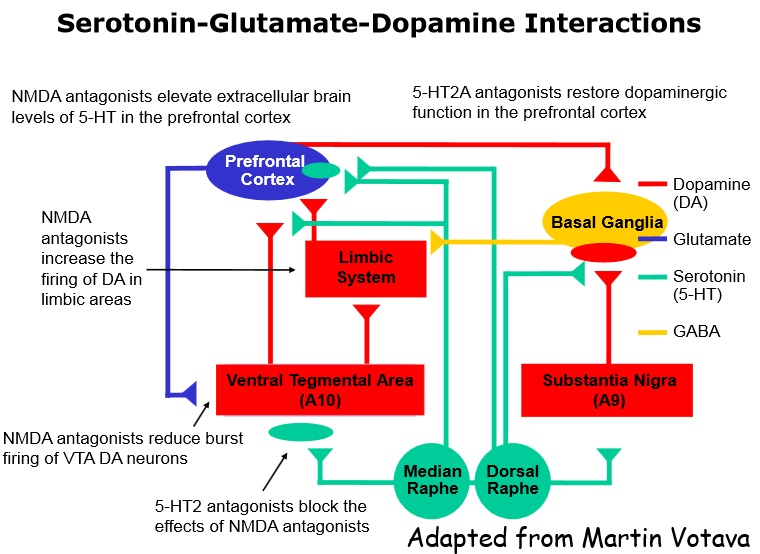
Not directly related to anything but came across this [simplified] diagram in one of my uni lectures, perhaps interesting for some of you =D

uiLmkyr.jpg
 
Also, there are multiple subtypes of glutamate receptors; not all of them are excitotoxic. AMPAkines for instance (shit like piracetam) are non-excitotoxic.

Can you name another one? Because Piracetam is actually a cyclic derivative of GABA. It binds to AMPA as a positive allosteric modulator. While that provides it's nootropic effects, it has other effects that are quite comparable to Gabapentin/Pregabalin. There's also evidence to suggest that Piracetam may have an exact same mechanism of action as Gabapentin/Pregabalin. Piracetam binds to the alpha2delta subtype of calcium channel (just like Gabapentin/Pregabalin) and inhibits channel movement there.

It's speculated that this channel is most present on GABAergic neurons. By inhibiting this channel, you greatly increase the likelihood of the GABA neuron gaining an action-potential and thus, this indirectly stimulates GABAergic activity. That would explain why Piracetam isn't anxiogenic.

sekiboi said:
More practically, ketamine is an anxiogenic in that if you can't orient yourself in space and you're hallucinating shit, some people are liable to freak out. It's not anxiogenic like something like THC or pentylenetetrazol.

I always freak out when I'm hallucinating. I can only tolerate very minute doses of anticholinergics. Otherwise, they give me hallucinations and so I panic. Same with antihistamines, and NET/SERT inhibitors. Even if it's something like Doxepin, which is an adrenergic antagonist, serotonin antagonist, etc. But doxepin also has moderate SERT and NET inhibition which gives me hallucinations.

All of those medications make me agitated and gives me panic attacks. Which is rather paradoxical because they should do the opposite.

Ambien is well known for giving people hallucinations, but the ambien hallucinations don't bother me. They're exactly the same as other drug type hallucinations in terms of the things I see, but I don't panic about them.

My point is, I don't nessecarily think that's correct.
 
Note the words - "some people". Some people also get really... erratic on Ambien. Everyone, of course, is different, and situational factors also play a role.

There are plenty of references in the medical literature to "ketamine emergence" - turns out the K-hole you experience while coming down from an anesthetic blast of K makes people lose their shit sometimes (especially children). It's counteracted with diazepam or other benzos occasionally.

There are a couple types of metabotropic glutamate receptors (mGluRs) that have various effects on the psyche when inhibited/induced. Those are the most well documented "non-NMDA" glutamate receptors and they are, as far as I know, more like the serotonin receptors than the NMDA receptors in structure. (they are GPCRs).
 
Can you name another one? Because Piracetam is actually a cyclic derivative of GABA. It binds to AMPA as a positive allosteric modulator. While that provides it's nootropic effects, it has other effects that are quite comparable to Gabapentin/Pregabalin. There's also evidence to suggest that Piracetam may have an exact same mechanism of action as Gabapentin/Pregabalin. Piracetam binds to the alpha2delta subtype of calcium channel (just like Gabapentin/Pregabalin) and inhibits channel movement there.

It's speculated that this channel is most present on GABAergic neurons. By inhibiting this channel, you greatly increase the likelihood of the GABA neuron gaining an action-potential and thus, this indirectly stimulates GABAergic activity. That would explain why Piracetam isn't anxiogenic.

Info like this is why I'm here. This is pretty interesting.
 
There are a couple types of metabotropic glutamate receptors (mGluRs) that have various effects on the psyche when inhibited/induced. Those are the most well documented "non-NMDA" glutamate receptors and they are, as far as I know, more like the serotonin receptors than the NMDA receptors in structure. (they are GPCRs).

Given that pretty much all the glutamate receptors modulate most of the other types in at least one way, it would be interesting to see what sort of psychoactive effect could be achieved by having them activated very selectively. Someone earlier mentioned that ketamine-induced antidepressant effect was nulled by blocking AMPA, anyone got citation for that?
 
nAON: PMID: 21669235

Ketamine at 120 mg IV for treatment resistant depression induced focal seizures one week post-administration for me.
No prior anxiety attacks or partial complex seizures.

Intuitively, this would seem to indicate AMPA potentiation. Not entirely sure how to reverse this, though.

The seizures are not intractable and respond to AED and benzo; however, would L-theanine (an AMPA inverse agonist?) be of value?
 
Last edited:
Top