• N&PD Moderators: Skorpio

What makes a molecule active ?

QUARE

Bluelighter
Joined
Oct 29, 2012
Messages
668
Location
Studying research chemicals
What makes a molecule active ?
The subject is probably too complex to be all explained here so if you want you can simply direct me to works I can read. If you want to explain it here you may also, it could be a pretty good thread.
 
Right... I know it has something to do with the structure being similar to our neurotransmitter
Ex: Methamphetamine is similar to Dopamine
927566Methamphetamine.png
859180Dopamine2svg.png

And why this is not active, it pretty much a random molecule I drawn from a phenethylamine skeleton but its probably inactive, what make one active and another not.
116023astychem.png


Its more complex than just the shape even if my molecule would be more close to DA it could be not active
EX:
45120734dichloro25MeOphenethylamine.png

This is probably not active even if its pretty close to DA structure.
 
This question might be cast at a level of generality too severe to yield very useful answers (at least in terms of what you have in mind). Those compounds that act as drugs in some way interact with the cellular machinery in our bodies. It is most common for psychoactive drugs to in some way interact with neuronal receptors for neurotransmitters or transporters responsible for regulating neurotransmitter levels. Similarity to known neurotransmitters provides a good jumping off point for the development of drugs, as neurons are 'built' specifically to interact with neurotransmitters. Sometimes small changes to a molecule can drastically affect how it interacts with receptors, hence seemingly small modifications to neurotransmitters often yielding inactive compounds.

ebola
 
What you're asking, requires a long response as it's not a black-white answer. So I apologies for that, but that's what you get for being curios ;)

What makes a chemical able to be "active" is entirely relative to what you're referring to. I'm going to assume you mean able to cross the blood-brain barrier (BBB). However, the term "active" could apply to any substance that is able to alter bodily function in some way. Therefore, drugs don't have to have an effect on the Central Nervous System in order to be active. They can just as easily have mind altering effects, without crossing BBB.

However, like I said above, I going to assume you mean able to have an effect on the brain. If this is what you mean, my answer is quite different. As far as I'm aware, we don't exactly know what allows a substance to cross the blood-brain barrier. I know that a lot of it has to do with it's electrical charge. Another huge part of what can cross BBB is how soluble in lipids the substance is, and how soluble the substance is in water (but this applies to all solvents in general). Generally - the substance has to be able to be soluble in both (to some degree) to allow it to cross BBB. If it's only soluble in fats, it's not going to cross BBB. If it's only soluble in solvents, it won't cross BBB.

This is known as hydrophilic-lipophilic balance. Hydrophilic-lipophilic balance refers to; if a substance is 100% soluble in lipids (fats), then it cannot be soluble in water (solvents). If a substance is 100% soluble in solvents, then it cannot be soluble in lipids. A substance, therefore, has to have a ratio near 50%/50% solubility in order to cross the blood-brain barrier. (Hope I explained this correctly)

As ebola also said, it also has to do with how "similar" the chemical is to endogenous substances. Although, this is relative to polarity as well. A substance can be exactly the same as a neurotransmitter, but be a different isomer or have a different charge and therefore will not be able to cross BBB.


Methamphetamine is similar to all the monoamine neurotransmitters, not just Dopamine. That's because, Methamphetamine, like all the endogenous monoamines, employs a Phenethylamine skelaton, and therefore is a Phenethylamine derivative, just like the natural chemicals that circle around in your brain meats. (Serotonin isn't as Phenethylamine, but it's pretty damn similar) Just take a look at all of them.

This is Methamphetamine...

NSFW:
800px-Methamphetamine.svg.png


Now just compare that to the Monoamines. There pretty damn similar.


Dopamine

NSFW:
500px-Dopamine2.svg.png


Epinephrine

NSFW:
426px-Epinephrine_structure.svg.png


Norepinephrine

NSFW:
426px-Norepinephrine_structure_with_descriptor.svg.png


Serotonin

NSFW:
304px-Serotonin-2D-skeletal.svg.png


Referring back to hydrophilic-lipophilic balance...

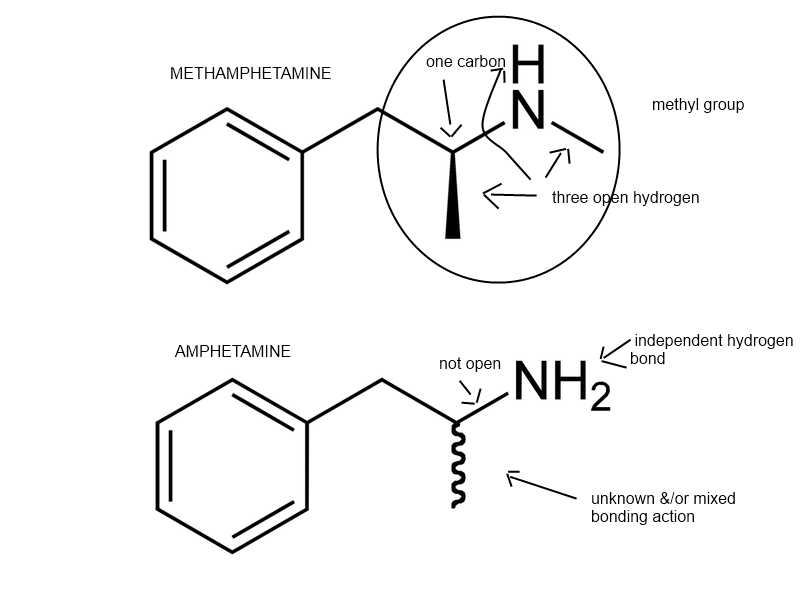
Methamphetamine is able to cross the blood-brain barrier far better than Amphetamine. This is due to the fact that Methamphetamine has a more balanced hydrophilic-lipophilic relationship and is, therefore, a "more polar" substance. But what causes this? Well, this would be due to Hydrogen. As someone brilliantly demonstrated in the Amphetamine talk page on Wikipedia....

NSFW:
Stereochemestry.png


As you can see in the picture above, Amphetamine has an amide off the chain where Methamphetamine has a Methyl group. Methamphetamine also has three, permanently open hydrogen atoms (meaning permanently open for "bonding") off the bottom chain (I don't know how to refer to these chains at the moment. If someone could enlighten me, that would be great!) Amphetamine, on the other hand, is "less polar" than Methamphetamine due to it's mixed bonding actions, and it's "less polar" amide group.

This allows Methamphetamine to cross the blood-brain barrier far better than Amphetamine. And while Amphetamine does cross BBB, it's under-balanced polarity stops some of it from ever being able to cross the blood-brain barrier.

(Again, hope I explained this correctly. Although, I'm sure someone won't hesitate to correct me if I'm wrong.)

 
Last edited:
Swampfox, you are wrong in your explanation of polarity.... Here's a start: methamphetamine is less polar than amphetamine.

We know how compounds get into the brain, by the way. They are either transported across the BBB by special transport protiens (in the case of large or charged compounds), or they diffuse through the fatty lipid membrane and into the blood in the brain.

Hydrophilic-lipophilic balance, which is never referred to as such (it's referred to as log-P, or partition coefficient, by chemists), does not have to be close to 50/50 water/octanol. In fact, many common drugs prefer fats by a factor of 100 to 1000 fold. Drugs like caffeine and tramadol, which prefer either water or fat, are in the minority.

LogP is measured by taking the logarithm of the ratio of how much of a compound ends up in the water, and how much ends up in the octanol (fat) when you have equal volumes. A compound with a logP of 0 prefers water and fat 50/50. A compound with a logP of -1 has a tenfold preference for water, and a logP of 1 has a tenfold preference for fats.
(Amphetamine's logP (caclc.) is 1.72, methamphetamine is 1.88.)

"Mixed bonding action"? What are you talking about? Go back to an organic chemistry textbook and read up on dipoles and how to read line diagrams. It seems to me you don't really know what you're talking about - what you've circled isn't a methyl group, and "independent hydrogen bonds"? What? just... what? (The squiggly line denotes a chiral centre that can be either R or S, not "mixed bonding action".) Moreover, hydrogens bonded to carbon generally cannot participate in hydrogen bonding, due to the strength of the C-H bond. And methamphetamine doesn't have an amide.

That last diagram is so wrong, it makes my head hurt.

Methamphetamine crosses the BBB more effectively, because it is more lipophilic. Simple as that.
 
Last edited:
swamp fox said:
I'm going to assume you mean able to cross the blood-brain barrier (BBB).

This is more of a prerequisite for psychoactivity than an anchor for its central definition.

They can just as easily have mind altering effects, without crossing BBB.

How so? The only sense in which drugs that fail to cross the BBB are psychoactive is in terms of altering some extra-CNS biological process which the mind monitors (eg, the unpleasant 'rush' of peripherally released epinephrine). . .or I guess you could have bioconversion of something that doesn't cross the BBB into something that does.

However, like I said above, I going to assume you mean able to have an effect on the brain. If this is what you mean, my answer is quite different. As far as I'm aware, we don't exactly know what allows a substance to cross the blood-brain barrier. I know that a lot of it has to do with it's electrical charge. Another huge part of what can cross BBB is how soluble in lipids the substance is, and how soluble the substance is in water (but this applies to all solvents in general). Generally - the substance has to be able to be soluble in both (to some degree) to allow it to cross BBB. If it's only soluble in fats, it's not going to cross BBB. If it's only soluble in solvents, it won't cross BBB.

Well, actually, because the BBB consists of series of tight cellular junctions, nonpolar compounds (ie, lipid soluble compounds) tend to cross it more readily than less polar compounds. The cells involved however actively transport a series of larger molecules (eg, peptides) across it.

ebola
 

I'm pretty sure this thing would explode spontaneously.

Why do these programs allow fluorine to form more than one bond? Are there compounds where F is bonded to two things at once?
 
Swampfox, you are wrong in your explanation of polarity.

That's what I was afraid of. My understanding of anything more than 11th grade chemistry is entirely self-taught - 99% of it being Wikipedia information. Wikipedia has a lot of good, general information, however, it does a poor job at explaining most science concepts.

"Mixed bonding action"? What are you talking about? Go back to an organic chemistry textbook and read up on dipoles and how to read line diagrams. It seems to me you don't really know what you're talking about - what you've circled isn't a methyl group, and "independent hydrogen bonds"? What? just... what? (The squiggly line denotes a chiral centre that can be either R or S, not "mixed bonding action".) Moreover, hydrogens bonded to carbon generally cannot participate in hydrogen bonding, due to the strength of the C-H bond. And methamphetamine doesn't have an amide.

That last diagram is so wrong, it makes my head hurt.

In this subject? Yes I really don't know what I'm talking about all that well. And while I'm wrong - I did state in my post that Methamphetamine has a Methyl group (the hydrogen bound to one nitrogen) and amphetamine has an amide (the two hydrogens bound to one nitrogen. Although, now that I read that outloud, this isn't an amide.)

That diagram wasn't made by me. It was drawn by someone in the Wikipedia talk section of Amphetamine. I'll admit that I thought it was explained incorrectly, but I assumed the person knew what they were talking about. So, I looked at it, interpreted it with prior knowledge, and formulated an explanation around it. I do this a lot in fact - as this is one of the only ways that I can really, solidly, learn something. However, if I don't know the subject very well, obviously, my explanation of it is bound to be wrong.

sekio said:
Methamphetamine crosses the BBB more effectively, because it is more lipophilic. Simple as that.

Good to know.

You should contribute to Wikipedia. Because their explanation on solubility of a substance in lipids and solvents, in the relation of pharmacodynamic action - is entirely wrong. Based on your explanation...
 
Last edited:
Further discussion of polarity follows.

The quick and dirty metric for determining a compound's polarity is: symmetry, and homogeneity. "Polar-ness" is a factor of how much the electrical charge is unbalanced on the various bits of the molecule. Every bond between 2 different atoms has a polar character to it. We call this polar character a "dipole moment". Molecules with larger dipole moments are more polar.

Compounds that consist mostly of carbon and hydrogen are not very polar. Even if they are branched and unsymmetrical. The carbon-hydrogen bonds aren't very polar, and also they are roughly equally distributed over the molecule. When we start adding heteroatoms like oxygen, you get polar compounds.

If the molecule is symmetrical and the polar character of each side of the molecule is balanced, it is much less polar than a lopsided one. We can see evidence of this comparing diethyl ether, and tetrahydrofuran. THF is a 5-membered ring with one of the vertices being an oxygen, and has a larger dipole moment than ether, which is symmetrical.

On the opposite end of the polarity spectrum, are highly asymmetrical molecules, molecules that like to exist as charged compounds - like salts. Water is not symmetrical (the molecules are closer to a V-shape) and has a strong dipole moment. So do compounds like methanol, ethanol, etc.

Polarity should not be confused with water solubility, or ability to hydrogen bond. You can have polar solvents that do not donate hydrogen bonds. (like, say, ethyl acetate or dichloromethane) You can also have compounds that hydrogen bond, but don't mix with water. (like octanol)

Anyway, to sum this up, let's ask ourselves: why exactly, is methamphetamine less polar than amphetamine? Because adding a methyl group to the amine "balances out" some of the polar character of the carbon-nitrogen bond (the only polar bond on the molecule).

It is also important to note, that even when administered directly to transporter protiens (i.e. ignoring the factor of absorbtion and diffusion into the brain), methamphetamine is stronger than amphetamine. So distribution into the brain plays only a minor role.

Food for thought: If drugs needed to be both water soluble, and lipid-soluble to work, why are the gaseous anesthetics used in medicine all nonpolar halogenated ethers?
 
(explanation of polarity here)

That was another amazing explanation, Sekio. Bravo. Just curios, what are you studying?

On topic. That makes much more sense and it was actually my first interpretation of the information. So, using prior knowledge of Methamphetamine's mechanism of action, does the same mechanics apply to Methamphetamine's ability to be "absorbed" (I think the correct word would be "diffuse" but, using the word incorrectly would be confusing) into the uptake cells of Monoamine neurotransmitters?

I apologies, but the ambien I took around 20 minutes ago is really starting to kick in. I would have powered through it, but anythingd I would have said (beryond me typing this) would have been utter bullshit. Again, I apologies for having to wait to formulat the rest of my thoughts. and I will reply. in full tommorrow.
 
does the same mechanics apply to Methamphetamine's ability to be "absorbed" (I think the correct word would be "diffuse" but, using the word incorrectly would be confusing) into the uptake cells of Monoamine neurotransmitters?

That's "binding affinity". While lipophilicity does play a role in the binding of compounds to certain receptors (greasier is better, to an extent) & transport protiens, a more important factor is exactly how the molecule "fits" into the protien it's binding - the combination of shape and charge acts as a molecular "key". Some molecules like to bind to protiens quite tightly, moreso than you would expect from their lipophilicity. There's a metric called LipE / LLE (Lipophilic ligand efficiency), which measures in short, how much more a molecule prefers to bind the enzyme rather than nonspecific oils.

Neurotransmitters are chemicals by the way. Neurons are cells that make up the brain. Transporter protiens are on the outside of the cells - anchored into the cell walls.

Drugs bind to these like any other liquid-phase reaction, they diffuse around and eventually collide and interact with the transport protiens. Molecular mechanics are kind of ungraceful.
 
When a drug bind to a transport protiens its known as protein binding right ? For exemple, morphine has 30-40% protein binding, how does it affect its psychoactivity ?

I'm pretty sure this thing would explode spontaneously.

Why do these programs allow fluorine to form more than one bond? Are there compounds where F is bonded to two things at once?

Probably, BTW im just playing with those, I have very poor knowledge on how all this work and thats actually why im asking this question
What makes a chemical able to be "active" is entirely relative to what you're referring to.

I should have said Psychoactive, my bad. Ibuprofen is active but doesnt not have effect on CNS. What I really mean is what makes a molecule able to enter the brain AND have affinity for certain receptor or enzyme or transporter.


Also being similar to the neurotransmitter doesnt seem to be essential, look at Phencyclidine
Phencyclidine_structure.svg

PCP affect, Glutamate, Dopamine, Acetylcholine and Endorphin/Enkephalin
Glutamate
Glutamins%C3%A4ure_-_Glutamic_acid.svg

Dopamine
Dopamine2.svg

Acetylcholine
Acetylcholine.svg

and do I really need to show you endorphin and enkephalin? They are pretty big molecules.
None of these chemical is close to PCP why does it bind to it ?
 
Last edited:
I should have said Psychoactive, my bad. Ibuprofen is active but doesnt not have effect on CNS. What I really mean is what makes a molecule able to enter the brain AND have affinity for certain receptor or enzyme or transporter.

I think you've gotten a pretty good explanation on the "able to enter the brain" part so I'll skip that.

Receptors, transporters, all of the proteins in the brain that drugs effect, are complex 3-dimensional objects, made up of amino acids strung together and folded back and forth onto each other. Somewhere on the 3-dimensional structure there will be a small "pocket", a small folding in of the external surface. The surface of this pocket is made up of the amino acid side chains and backbones, which can be electron donating or accepting, or non-polar.

If a small molecule, like a drug or a neurotransmitter, has electron donating parts where the receptor has electron accepting parts, if it has electron accepting parts where the receptor has electron donating parts, or if it has non-polar parts in the same place the receptor has non-polar parts, then those interactions will increase the affinity between the receptor and the small molecule. If those interacting parts don't line up correctly, then the receptor will repel the molecule, and affinity will decrease.

So affinity is determined by the correct positioning of electron donating, electron accepting, and non-polar groups in the drug or neurotransmitter. That pattern is different for every receptor because the amino acids in the receptor are different, so the spacing of those parts is unique to each receptor. The specific pattern required for a certain receptor is called the "pharmacophore".
 
When a drug bind to a transport protiens its known as protein binding right ? For exemple, morphine has 30-40% protein binding, how does it affect its psychoactivity ?

Usually when they talk about a drug's protein binding, they mean blood plasma proteins. This is measured by giving a subject a drug and then drawing blood from the subject. Whatever portion of the drug they don't find in the liquid part of blood, they divide that by the total drug mass and multiply by a hundred.

More or less.

Like if you give someone a gram of Depakote, and Depakote has a protein binding of 90%, you'd expect to only find 20 micrograms of Depakote per mL of blood (instead of 200 micrograms:

(1000 mg Depakote) / (5000 mL of blood) = 0.2 mg per mL.

I think.
 
When a drug bind to a transport protiens its known as protein binding right ? For exemple, morphine has 30-40% protein binding, how does it affect its psychoactivity ?


Probably, BTW im just playing with those, I have very poor knowledge on how all this work and thats actually why im asking this question


I should have said Psychoactive, my bad. Ibuprofen is active but doesnt not have effect on CNS. What I really mean is what makes a molecule able to enter the brain AND have affinity for certain receptor or enzyme or transporter.


Also being similar to the neurotransmitter doesnt seem to be essential, look at Phencyclidine
Phencyclidine_structure.svg

PCP affect, Glutamate, Dopamine, Acetylcholine and Endorphin/Enkephalin
Glutamate
Glutamins%C3%A4ure_-_Glutamic_acid.svg

Dopamine
Dopamine2.svg

Acetylcholine
Acetylcholine.svg

and do I really need to show you endorphin and enkephalin? They are pretty big molecules.
None of these chemical is close to PCP why does it bind to it ?


That's the delema that we run into in psychopharmacology. Phencyclidine doens't look similar to any endogenous substances, however, it's main binding affinity is for the glutamatergic NMDA receptor as an antagonist. However, study's on PCP and it's derivatives (such as Ketamine, and other disassociatives) have shown that it has more than one effect on the body, and actually effects multiple different area's and systems.

In the case of PCP and Ketamine, they both have slight AMPA, and Delta-Opioid affinity (Ketamine is also a Kappa-Opioid agonist). But they also, interesting enough, are both potent anticholinergic drugs (drugs that block acetylcholine) and this is accomplished by extremely strong antagonization affinity for the Muscarinic Acetylcholine Receptors. This likely contributes to a lot of PCP and Ketamine's hallucinatory effects.

While they "look different" their chemical structure isn't (I'm assuming) all that different from the natural neurotransmitters. Tricyclic opiates (these are the derivatives of Opium alkaloids) we thought were the only non-endogenous substances that were able to affect the Opioid system for years. However, in the 1960's, we discovered Fentanyl. And that showed us that substances can have opioid affinity without being an opium derivative.

they have similar effects and both affect the same system in the Central Nervous System, but are the anywhere near the same as one another (in terms of molecular structure)? Nope, they are not related at all.

To sum up your question and my answer, we don't really know why the chemicals have the effect that they do, on what system they affect. However, we do know that it has a lot to with polarity (being able to cross BBB) as well as being able to solute into the protein of a specific receptor of cell.

Another thing I can add is how all Opioid agonists, also bind to and agonize Sigma-1. But not all Sigma agonists bind to Opioid receptors. The same thing applys to the NMDA glutamate receptor. A lot of Levorotatory isomers of NDMA antagonists are also Opioid agonists, where as, the Dextrorotatory isomers of the same substance, have little, or almost no binding affinity for Opioid receptors.

Two good examples for this are Methorphan and Methadone. The dextrorotatory enantiomer of Methorphan and Methadone (these would be better known as Dextromethorphan - the OTC antitussive agent, and Dextromethadone) are both potent antiglutamatergic drugs, but have little to no affinity for Opioid receptors. while the Levorotatory isomers of the same molecule (these would be Levomethorphan, and Levomethadone) both have binding affinity for Opioid receptors that is much greater than their antiglutamatergic effects.
 
Last edited:
What makes a molecule active is: it alters neural signalling. All explanations of psychoactivity inevitably boil down to this at the end, and everything else is just this by proxy.

There are many, many ways to do this, of course. Let's consider a few examples:

Some ligands bind to a "receptor", which is a protein expressed on the surface of a cell, usually a neuron, though in some cases, such as CB2, it is expressed on glial cells. NB: Prevailing opinion is that CB2 agonism is psycho-inactive. I have never believed this, as it contradicts experimental data. These are most of the drugs you're familiar with, such as LSD, which binds most strongly to 5-ht1a, 5-ht1b, 5-ht1d, 5-ht2a, 5-ht2c, 5-ht5a, 5-ht6, and D2 receptors. In order to exhibit this kind of activity, the drug viz substrate has to form a receptor-substrate complex held together usually by Van der Waals (dipole-dipole) and hydrogen bonding interactions. In some cases, the receptor-substrate complex will alter the conformational structure of the receptor protein, i.e. the way it "folds", which can activate intracellular signalling mechanisms or open or close an ion-channel.

Some things, channel-blockers or channel-openers (are there any?), bind to locations inside of an ion-channel directly. An ion-channel is a structure made of several proteins and other biological macromolecules that controls the flow of specific ions into or out of a neuron, which can affect many things, most notably the initiation of an action potential, which is the "firing" of a neuron. Obvious examples include PCP, which binds to the inside of the NMDA voltage-sensitive nonselective cationic ion channel and blocks its function. In the ordinary case, the NMDA receptor allows cations of various types to flow into and out of neurons; PCP blocks the channel by sticking to the PCP-site and interrupts the flow of ions.

Other drugs act as transporter substrates. Endogenous neurotransmitters such as serotonin exist in the cerebrospinal fluid and are moved into and out of neurons by molecular transporters, which are again oligomolecular structures on the surface of neurons. Sometimes a drug will bind to the transporter and interrupt its function, acting as a transport inhibitor, such as cocaine which blocks the serotonin, dopamine, and norepinephrine transporters, preventing these monoamine neurotransmitters from returning to the inside of a neuron, on the other side of the spectrum reserpine binds to the vesicular monoamine transporter thereby preventing the same monoamines from moving out of the neuron. Occasionally a drug like AET will lock the transporters into the open state, reversing their function; these are releasing agents. Still other drugs like tianeptine act to enhance the function of the monoamine transporters; tianeptine causes the serotonin transporter to move serotonin more rapidly into the neuron.

Those are the "normal", well-behaved drugs we know and love. But there are also the "weird" drugs. Valproic acid, Depakote, instead of binding to cell surface proteins, inhibits an enzyme (histone deacetylase) involved in the metabolism of neurotransmitters, and in doing so causes unfathomable sadness. Selegiline likewise inhibits monoamine oxidase type B, but goes further in that the reactive alkyne moiety sticking off of its amphetamine nitrogen binds irreversibly to this enzyme, destroying it permanently.

Some ions, such as Li+, are uptaken by ion channels in place of the ions normally present in the body. In doing so, they disrupt the normal flow of ions into and out of the cell and cause the neuron to respond differently to stimuli than it should under "ordinary" conditions. A large number of ions are psychoactive in this way: Li+ is a mood stabilizer and anticonvulsant, Rb+ is a stimulant and antidepressant, Br- is a sedative and anticonvulsant, Mg2+ is an NMDA-antagonist, Pb2+ and Hg2+ are also psychoactive but woe is the fool who dare ingest them.

The general anaesthetics, though, break all of the rules, they simply disrupt the neuronal cell membrane in such a profound way that it no longer works properly. Nobody is entirely sure how it happens, but even noble gases like Kr and Xe manage to effect this despite their near-total inertness outside of the body: Kr will not even react with fluorine without plenty of encouragement.

http://en.wikipedia.org/wiki/Theories_of_general_anaesthetic_action

Are there compounds where F is bonded to two things at once?

H2F+
 
Totally agreed Atara...First a psychoactive compund has to alter neural signaling (trough enzymes or act directly to neurons receptors as being similar compounds to neurotransmitters) and also must be lipophilic enough to get trough Blood Brain Barier.
 
Top