• Psychedelic Drugs Welcome Guest
    View threads about
    Posting RulesBluelight Rules
    PD's Best Threads Index
    Social ThreadSupport Bluelight
    Psychedelic Beginner's FAQ
  • PD Moderators: Esperighanto | JackARoe |

Trimethoxy substituted N-benzylPEAs?

Deinonychus

Bluelighter
Joined
Oct 20, 2012
Messages
401
6U17yC7.jpg


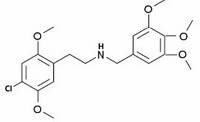
Anybody have any information, better yet experiences, with this compound/other N-benzyl PEAs that are trimethoxy substituted on the second ring?

IUPAC is [2-(4-chloro-2,5-dimethoxyphenyl)ethyl][(3,4,5-trimethoxyphenyl)methyl]amine.

I get why this substitution pattern would be pursued in an attempt at SAR-based drug design, but I think the reasoning is misguided. Obviously the meta, para, meta trimethoxy pattern mirrors that of mescaline, which is 3,4,5-trimethoxyphenethylamine. But if I understand correctly, the N-benzyl PEAs bind to 5HT receptors in a fundamentally different way than ordinary PEAs. This leads me to believe that while the placement of the trimethoxy groups on the N-benzyl ring will indeed alter the compound's activity, it will not be in a fashion that is in any way analogous to mescaline, due to the different methods of binding between PEAs and N-benzyl PEAs. So the placement of those methoxy groups there, if an attempt to create parallels to mescaline, will be motivated by incorrect deduction of SARs.

That said I don't know if there is a reason that is in fact valid for placing those groups there. Anybody want to put their two cents in, either on the structure itself or on their experiences with this or another similar N-benzyl PEA? My curiosity is piqued!
 
Last edited by a moderator:
If you ever happen to assay this one, just let me know how the effects are compared to 25C-NBOME. I think the addition of extra methoxy groups would not increase any desired effects, however maybe it would cross the BBB easier (although maybe not because it is bulkier? so maybe harder?)

Maybe it will turn out to be an n-benzyl superior to the nBOMES, maybe the mental trip will be better. This is a strange molecule, I like to look at new and strange psychedelics, and I've never seen this one. May I ask how you learned about it?
 
N-benzylated PEAs binding fundamentally different? I doubt that, it would be a miraculous coincidence unless you have another definition of 'fundamental'. Maybe I misunderstand what you are trying to say - care to explain?

I'm interested to know where you got the idea about this compound or where you heard about this N-substitution. Or in other words: what makes you or other people think that this is any better than the other known N-benzyls ? If there is this hope about such a possibility, what would be better about it? Higher affinity or efficacy (please kill me now), or attenuated affinity with retained efficacy a la LSD, so that it might play relatively nice?

Also what kind of approach would you like in this thread i.e. how is this not ADD material?
 
Fundamental might be my overstating it. What I mean is that due to the steric bulk of the N-benzyl ring, the electronegativity of the methoxy group or groups on the second ring, and the different shape of the molecular electron orbitals, the N-benzyl PEAs bind to the 5HT receptors in a different fashion than ordinary PEAs. The various functional groups are positioned differently relative to the receptor. I was trying to make the distinction that contrary to several discussions I've had about this compound, this is not '2C-C with a mescaline stuck onto it', and that because the N-benzyl PEAs sit in the receptor differently, there's not going to necessarily be any correlation between this substitution pattern and mescaline. An example of a structure activity relationship for mescaline being the decrease in activity as methoxy groups become ethoxy groups, with the decrease in activity varying depending on which methoxy group or groups gain a carbon. This relationship will likely not be found with N-benzyl PEAs with the meta, para, meta alkoxy substitution.

I don't mean that there is anything special about the orientation/resulting subjective effects of N-benzyl PEAs – or this compound specifically – relative to the receptor, just that the orientation is different than for the more ordinary PEAs, so SARs like the mescaline alkoxy pattern mentioned above will thus not translate.

And that brings me to this compound: namely, why? Because it can be done? Good enough reason for me! But because it looks to the human eye like a bit of a mescaline molecule pasted sloppily onto a normal PEA? Not good enough of a reason. So I was wondering if somebody who's got more chemistry in their mind than I could recognize a rationale other than vendors thinking that trimethoxy pattern looks clever.

As for possible effects, I cannot say, nor can I speak truthfully of binding affinities or active dose levels. Mostly I was somewhat... perturbed to see vendors trying to talk this up. I suppose that the N-benzyl PEAs in general were pretty much complete unknowns when they hit the market, but at least Nichols' team at Purdue had researched them to a degree. Given the extreme potency of these compounds I do not like the idea of vendors dreaming up new substitution patterns and placing their orders from the orient when there is, to my limited knowledge, absolutely no data on such compounds as this whatsoever.

As for ADD, I'm majoring in organic chem, so that forum is great fun (and good learning) for lurking, but a wee bit intimidating to be posting in with my level of understanding of chemistry. Also it is my impression that dreaming up new compounds and then posting threads when vendors are known to look into that forum from time to time may not be the most responsible idea, and is somewhat discouraged there. But since this is potentially being foisted upon the online RC scene I felt a need to try to find out if there's anything known about this one at all, so I compromised for PD.

It's worth pointing out that this may be a lark, either not enough interest can be drummed up for it or synthetic issues may arise, though without specifics I do not see huge obstacles. Looking back on this post for spelling I'm thinking maybe I'm getting old, lack of interest in new compounds like this, and it being my birthday yesterday. But then again it could just be prudent caution, think I'll go with that one instead :p
 
Hopefully you had a happy birthday. :D

Well, ADD is not only for the elite but also for those who would just like to learn more on a subject, as long as it isn't too basic. This certainly isn't basic, I would expect mostly reactions like "we won't know anything until we A) do receptor / 5-HT2A pharmacophore software modelling B) synthesize it and eat it, or C) run binding assays on it".

Still, your best bet is probably moving this to ADD if you want to chance some proper SAR input like if the third methoxy is a good idea considering 5-HT2A binding sites for electronegative groups. I am saying that because 25X-NBMD suggests that a dimethoxybenzyl could be an idea - an idea I've had myself and might have mentioned somewhere in ADD - probably with typical responses to it.

There is a 'I like to draw random molecules thread' in ADD but this obviously is not random.

I understand your concerns about vendors picking up on things in ADD but I think that you'd do well to either accept the downside to scientific discussion or just keep your ideas to yourself. I'm afraid it is basically one or the other because the more you would try to obscure this discussion from vendors, the more you also obscure it from people who can actually say something useful about the subject.
 
I think dimethoxylated/methylenedioxylated 25x series were made in Ralf Heim's thesis. They're less selective than the 'plain' 2-MeO-Bz's.
 
^ That's weird, I can just see ortho-subbed only 25X compounds when I just checked the pharma part. Maybe you meant some other article than I am looking at, let me check if I can find something else.

(And if you're right: yikes)
 
Try this wikipedia page for a starting point. Correction: Not Heim's original work, but a Nichols/CIMBI elaboration of it. The "NBMD" derivative is less potent than the parent compound, apparently... (I don't know how far I would trust dose advice on novel psychedelics from a publically edited encyclopedia!)

There is no obvious reason to believe that tacking even more MeO groups on the benzyl is worthwhile.
 
Yeah, time for me to eat my words about dangerous unknown compounds: I have actually taken 25I-NBMD. I titrated the dose up, largest dose taken was 2 mg bucally on complexed blotter. It was unspectacular to be sure, some sparkling and such visually but not mentally demanding, though I find the N-benzyl series tame in general, best combined with other compounds.

Send it off to ADD then, probably will get more attention.
 
Well, ADD is not only for the elite but also for those who would just like to learn more on a subject, as long as it isn't too basic. This certainly isn't basic, I would expect mostly reactions like "we won't know anything until we A) do receptor / 5-HT2A pharmacophore software modelling B) synthesize it and eat it, or C) run binding assays on it".

Still, your best bet is probably moving this to ADD if you want to chance some proper SAR input like if the third methoxy is a good idea considering 5-HT2A binding sites for electronegative groups. I am saying that because 25X-NBMD suggests that a dimethoxybenzyl could be an idea - an idea I've had myself and might have mentioned somewhere in ADD - probably with typical responses to it.

Where would one find the equipment/professionals to test using option a or c? (i am discluding in-vivo testing for obvious reason) I have requested a sample of this material and if granted would like to take some steps towards better classifying the material or sharing resources with someone who could.
 
Top