• N&PD Moderators: Skorpio

What happens when amphetamines wear off?

Mycotheologist

Bluelighter
Joined
Apr 8, 2012
Messages
141
When I take amphetamines, I often feel bad for the first 8 hours or so, then I get really sleepy for about 2 hours and after that I start feeling euphoric and have loads of energy. I'm aware that this is unusual, most people say they "come down" when the drug wears off. I come down when it kicks in and come up when it wears off. Does anyone here have a good understanding of the pharmacology involved with amphetamine? All I know is that it binds to the phenethylamine neurotransmitter receptors such as dopamine and norepinephrine and causes more dopamine to be released into the synapse. Where does serotonin come into the picture? Is there a serotonin rebound when it wears off? Thats the only theory I can come up with for why I feel so good when the drug wears off. I should mention that opioids amplify the euphoria when the amps are leaving my system but xanax completely kills the euphoria. I don't know enough about pharmacology to make sense of this.
 
I know is that it binds to the phenethylamine neurotransmitter receptors such as dopamine and norepinephrine and causes more dopamine to be released into the synapse.

Amphetamine does not bind to monoamine receptors - it binds to monoamine transport protiens that help your cells "clean up" after a chemical signal is released, and either prevents the neurotransmitter from being returned to the cell or makes the transport protiens go in reverse. Normally amphetamine causes the release of mostly norepinephrine and some dopamine.

Some people find amphetamines are unduly anxiogenic, especially in large doses, or after continued usage. What dose are you using?

Amphetamine does not cause serotonin release at normal concentrations. Methamphetamine and MDMA do, however.

I think you should just write this off as a strange drug reaction. Some people have them. (i.e. benzodiazepines causing anxiety, caffeine causing sedation, et cetera).
 
I come down when it kicks in and come up when it wears off. Does anyone here have a good understanding of the pharmacology involved with amphetamine?

I mean, this isn't exactly a fair pharmacological question. Amphetamines are among the most mechanistically elusive psychoactive substances ever studied. Presently, not even the most well-read, seasoned scientists working in the field of pharmacologic research have a full understanding of amphetamine's MOA, let alone a bunch of laymen (and a small handful of trained chemists/pharmacologists/neurobiologists) on Bluelight. The fact of the matter is that amphetamines tend to consistently elicit a broad set of predictable responses, including but not limited to improvement of executive function, reaction speed, coordination of movement; increased cardiac output, blood pressure, etc.; stereotyped behaviors such as punding, finger-drumming, or foot-tapping; and a few subjective effects, e.g. euphoria and the like. Even the effects listed above appear to be heterogeneous in their occurrence, the distribution of which appears to be unpredictable without the aid of genetic testing or preexisting knowledge of an idiosyncratic reaction due to illness or something; and once you consider all the other ancillary effects that these drugs can induce, what you're left with is anything but explicable.

For instance, some people can ingest large doses of amphetamine and experience only a small degree of subjective 'drug-liking.' Some users, myself included, experience palpitations on doses as low as 5mg, and severe dry mouth at dosages >10mg. Vasoconstriction is similarly variable - some get speed-dick, some do not. The point of all this being, I've ceased to be amazed by reports of bizarre responses to amphetamines that I encounter on the internet, if only because I've read of so many that I'm considering writing The Varieties of the Crystal Experience. That said, your particular variant is most unusual - it's as though you exhibit something akin to an inversion or 'mirror-image' of the drug's typical dose-response profile. I cannot begin to imagine what mechanism underlies the phenomenon, but I feel compelled to tell you that the answer of which you're in search is not likely to be found on these boards or anywhere else...at least for the next few decades. We (i.e., the scientific community) are simply not there yet.

If I were forced to speculate, however, I suppose that some wacky mutation affecting the behavior of the catecholamine transporter(s) or receptor(s) might explain it. Or maybe your drug/neurotransmitter metabolism is fucked up. Do you respond idiosyncratically to any other drugs? If I were you, I would look for a clinic or a hospital currently conducting studies on psychostimulants (or their respective addicts) and inquire as to whether or not you would be an eligible research participant.

 
Some people find amphetamines are unduly anxiogenic, especially in large doses, or after continued usage. What dose are you using?

Amphetamine does not cause serotonin release at normal concentrations. Methamphetamine and MDMA do, however.

I think you should just write this off as a strange drug reaction. Some people have them. (i.e. benzodiazepines causing anxiety, caffeine causing sedation, et cetera).

I've tried all kinds of doses, from 5mg to 100mg. I find that low doses give worse side effects strangely enough. What do you mean when you say normal concentrations? Do you mean higher doses of amphetamine cause more serotonin release?

If I were forced to speculate, however, I suppose that some wacky mutation affecting the behavior of the catecholamine transporter(s) or receptor(s) might explain it. Or maybe your drug/neurotransmitter metabolism is fucked up. Do you respond idiosyncratically to any other drugs? If I were you, I would look for a clinic or a hospital currently conducting studies on psychostimulants (or their respective addicts) and inquire as to whether or not you would be an eligible research participant.


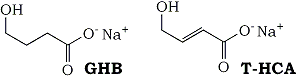
Yeah, I get ideosyncratic responses to most drugs. My psychiatrist diagnosed me with high functioning autism, that might have something to do with why drugs affect me in abnormal ways. I need to find a doctor who is interested in psychopharmacology who will allow me to experiment with various classes of drugs to gain a better understanding of my neurophysiology. I want to try a selective dopamine agonist and antagonist to see what effects they have. Same goes for noriphephrine and serotonin. In fact, I want to experiment with selective agonists and antagonists for every receptor known to man. For example, I wonder what effects delta opioid antagonists have. Salvinorin is a delta opioid agonist. If you put a double bond in the middle of GHBs alkyl chain, you get a selective GHB agonist:
t-hca.ghb.gif

I'm real curious to see what affects a selective GHB agonist would have. There is such a wide range of different classes of drugs known to man, we could learn all kinds of things about our personal neurophysiologies by experimenting with them.
 
I don't think we're dealing with a true paradoxical reaction here. Don't take this the wrong way, but I think it's a little presumptuous to assume that you are some sort of neurophysiological oddity.

From what I gather, the experience you reported could comfortably fall within the broad spectrum of amphetamine's pop pharmacokinetic variability. Obviously, this is a simplistic conclusion, but it would need to be ruled out before making further assumption.

And please, state with specificity the amphetamine(s) in question, along with doses, dose frequency and ROA(s). Differences in activity are highly dose-dependent. 5mg of d-METH is not remarkably different than 5mg of d-AMP, but disparity grows with dose.
 
No. You're thinking of the kappa receptor, I take it?

Oh yeah. I always get the two mixed up. I always hear about mu receptors when it comes to the effects of opiates but relatively little about delta.

selective GHB agonism is excitotoxic.

I know, if I get my hands on a selective GHB agonist, I'll be mighty careful. From what I read, GHB agonism causes glutamate to be released and thats what causes the excitotoxicity. I suppose the excitotoxicity could be attenuated by co-administering an NMDA antagonist. I know NMDA receptors isn't the only class of glutamate receptors though, I'm not sure how the other class relates to glutamate excitotoxicity.

From what I gather, the experience you reported could comfortably fall within the broad spectrum of amphetamine's pop pharmacokinetic variability. Obviously, this is a simplistic conclusion, but it would need to be ruled out before making further assumption.

And please, state with specificity the amphetamine(s) in question, along with doses, dose frequency and ROA(s). Differences in activity are highly dose-dependent. 5mg of d-METH is not remarkably different than 5mg of d-AMP, but disparity grows with dose.
Sorry, I'm talking about d-AMP. I've been prescribed dexedrine for a couple of years so I've had plenty of time to experiment with it, yet this drug is still a big mystery to me.
 
NMDA receptors aren't close to the only class. That's only one of three types of ionotropic glutamate receptor. Plus there's the metabotropic with the 8 identified subtypes, I can't hazard a guess as to how many different types of NMDA receptors there must be. I believe these contain four or five combined subunits, with seven available subunits, I would imagine that there are a dozen or so different combinations present in the brain, and probably three or four common ones.

Ionotropic receptors are so complicated. Multiple binding sites, variations in subunits present, etc.

I don't know that taking ketamine to test trans-HCA will give you a good test of what trans-HCA is actually like... Could be interesting though! Maybe that'll be the new speedball. nmda antagonist + ghb agonist...
 
Top