



-
Neuroscience & Pharmacology Discussion Welcome Guest
Posting Rules Bluelight Rules Recent Journal Articles Chemistry Mega-Thread FREE Chemistry Databases! Self-Education Guide -
N&PD Moderators: Skorpio
You are using an out of date browser. It may not display this or other websites correctly.
You should upgrade or use an alternative browser.Morphine chemistry
- Thread starter X11400
- Start date

 The only one anyone but a handful of researchers has ever come across, the one from poppies that is used in all medications, is the levorotatory enantiomer. It is, of course, primarily used for its mu opioid agonist activity:
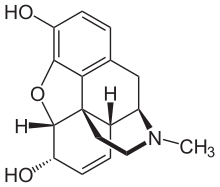
The dextrorotatory enantiomer seems to have very weak mu opioid activity in vitro and in vivo:
Stereospecific and nonstereospecific effects of (+)- and (-)-morphine: evidence for a new class of receptors?
Preference conditioning produced by opioid active and inactive isomers of levorphanol and morphine in rat
Stereoselective effect of morphine on antinociception and endogenous opioid peptide levels in plasma but not cerebrospinal fluid of dogs
It also looks to be a non-competitive NMDA antagonist, which is unsurprising given its structural similarity to dextromethorphan:
d-Morphine, but not l-morphine, has low micromolar affinity for the non-competitive N-methyl-d-aspartate site in rat forebrain. Possible clinical implications for the management of neuropathic pain
Thanks S.J.B.The only one anyone but a handful of researchers has ever come across, the one from poppies that is used in all medications, is the levorotatory enantiomer. It is, of course, primarily used for its mu opioid agonist activity:
The dextrorotatory enantiomer seems to have very weak mu opioid activity in vitro and in vivo:
Stereospecific and nonstereospecific effects of (+)- and (-)-morphine: evidence for a new class of receptors?
Preference conditioning produced by opioid active and inactive isomers of levorphanol and morphine in rat
Stereoselective effect of morphine on antinociception and endogenous opioid peptide levels in plasma but not cerebrospinal fluid of dogs
It also looks to be a non-competitive NMDA antagonist, which is unsurprising given its structural similarity to dextromethorphan:
d-Morphine, but not l-morphine, has low micromolar affinity for the non-competitive N-methyl-d-aspartate site in rat forebrain. Possible clinical implications for the management of neuropathic pain
Dawg you’re the general lol. For some reason google made it really hard for me to be able to answer this question on my own, so your input was and is greatly appreciated.The only one anyone but a handful of researchers has ever come across, the one from poppies that is used in all medications, is the levorotatory enantiomer. It is, of course, primarily used for its mu opioid agonist activity:
The dextrorotatory enantiomer seems to have very weak mu opioid activity in vitro and in vivo:
Stereospecific and nonstereospecific effects of (+)- and (-)-morphine: evidence for a new class of receptors?
Preference conditioning produced by opioid active and inactive isomers of levorphanol and morphine in rat
Stereoselective effect of morphine on antinociception and endogenous opioid peptide levels in plasma but not cerebrospinal fluid of dogs
It also looks to be a non-competitive NMDA antagonist, which is unsurprising given its structural similarity to dextromethorphan:
d-Morphine, but not l-morphine, has low micromolar affinity for the non-competitive N-methyl-d-aspartate site in rat forebrain. Possible clinical implications for the management of neuropathic painThanks S.J.B.
No problem!For some reason google made it really hard for me to be able to answer this question on my own, so your input was and is greatly appreciated.
Nagelfar
Bluelight Crew
The six position isomer of regular morphine? That makes sense seeing how 6-MAM and others are.I believe that the isomer with the 6 isomerized is more potent.The six position isomer of regular morphine? That makes sense seeing how 6-MAM and others are.
Yep - It's in 'Opiates' by R. Lenz et al.


