



-
Neuroscience & Pharmacology Discussion Welcome Guest
Posting Rules Bluelight Rules Recent Journal Articles Chemistry Mega-Thread FREE Chemistry Databases! Self-Education Guide -
N&PD Moderators: Skorpio
You are using an out of date browser. It may not display this or other websites correctly.
You should upgrade or use an alternative browser.I Like to Draw Pictures of Random Molecules
- Thread starter nuke
- Start date
- Status
- Not open for further replies.



adder
Bluelighter
- Joined
- Mar 28, 2006
- Messages
- 2,849
I was considering it a few months ago and even gave it a name trifludrone. :D Its pharmacologic profile has even already been studied along with 2- and 3-trifluoromethylmethcathinones (article). It wouldn't necessarily be better than 4-BMC or 4-CMC, I bet there's too much serotonin release vs. dopamine release, it would also be much more expensive to synthesize than plain mephedrone, and it's potentially a 5-HT2B agonist. Thus it would actually hardly make an ideal RC in my opinion. 3-CF3-methcathinone looks much better and it could be a great improvement over 3-MMC, but it seems even worse as a 5-HT2B agonist.
Eli Lilly investigated norfluoxetine as an antidepressant but they dropped it because of cardiac side effects. It's funny that they're fine with fluoxetine on the market as if norfluoxetine wasn't produced as a metabolite.
SkyblueMolly
Bluelighter
The above image is wrong it's 1-ethynyl cyclohexanol as sonn stated.
I HATE this stupid BS why the hell do people make terminal alkynes as attempted CNS depressants. These compounds are legit plasticizers they are UNDOUBTABLY carcinogens, let's alkylate our DNA shall we? Let's let cytochromes readily epoxidate this and get fking wrecked. And the quinone form is probably preferred, a suicide inhibitor of cytochrome id guess
NO TERMINAL ALKYNE DRUG are safe unless they are conjugated alkynes (couple cases of top drugs actually, even antifungal. These however cns depressant examples are so dangerous.
Please to anyone who reads this, DO NOT ingest these drugs.
I was referring to the alkane, NOT the alkyne! I just wonder if 1-Ethyl-1-Cyclohexanol(an alkane) is active. Since it's molecularly similar to the alkyne, maybe the alkane is active as well. The above image IS what I intended. It describes 1-Ethyl-1-Cyclohexanol.
wezface
Bluelighter

Fairly in love with this gal right now
blueberries
Bluelighter
Hmmm...
Cocaine base sans the second group and a whopping dihexane chain in place of the phenyl ring. What exactly would this achieve? I'm guessing you're going for in vivo metabolism to a more suitable candidate but then wouldn't a propyl group work better so to create that phenyl? With this either you'd get a 12 sided ring or two benzene rings, the former wouldn't substitute for cocaine or any of the tropanes, the latter however I'm not so sure but that phenyl seems pretty essential when comparing the other tropanes. Also the lack of the second group seems like the death of such a compound. I suppose you could ply for the MPH analogue but still, I'm doubtful.
sekio
Bluelight Crew

SONN
Bluelighter
3,4 - methylene dioxy - 5, methoxy phenethylamine? or amphetamine or cathinone for that matter
definitely notated wrong ^ but i'm sure many people have already thought of this molecule structure before. idk that was the first one I thought of haha
pharmakos
Bluelighter
IndoleMeridian
Greenlighter
- Joined
- Jan 8, 2014
- Messages
- 8
4-MeO-6-APB. The APB analogue of MMDA.

And also the APB analog of DMMDA:

I'd imagine they'd be pretty identical to their parent compounds, just as 6-APB is to MDA itself. Also, perhaps more potent too, like 6-APB.
Also, in a similar likeness to 4-thiomescaline (a highlight from shulgin's PIHKAL), here is my proposition for 4-thio-lophophine (considering how good lophophine itself sounded):
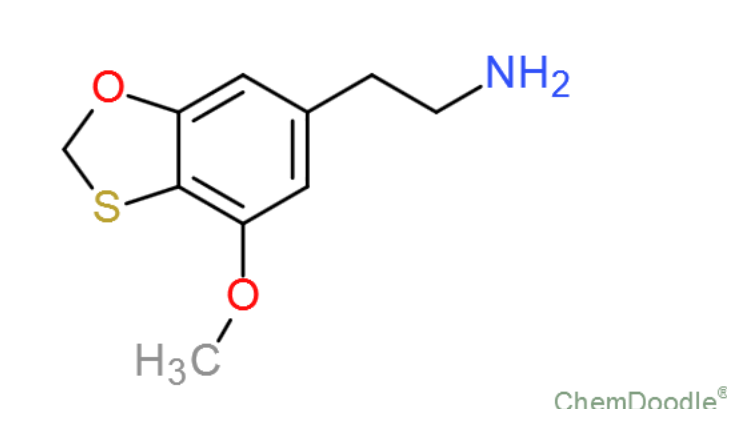
also, it is known that a 4-thio substitution on any phenethylamine/amphetamine will give it MAOI properties. So 4-thio-lophophine would have qualities comparable to MAOIs+lophophine, "lophohuasca" if you will.
DOV, or 2,5-dimethoxy-4-vinylamphetamine:

^ this one can actually be synthseized from DOI or DOB. 2C-YN and 2C-V have been made this route from 2C-I, and 4-vinylamphetamine from 4-IA.
Also, we know adding DMT to magic mushroom culture will make it naturally convert to 4-HO-DMT. So here's something that could be made starting only from a regular grow set-up and 5-MeO-MALT added to the substrate:
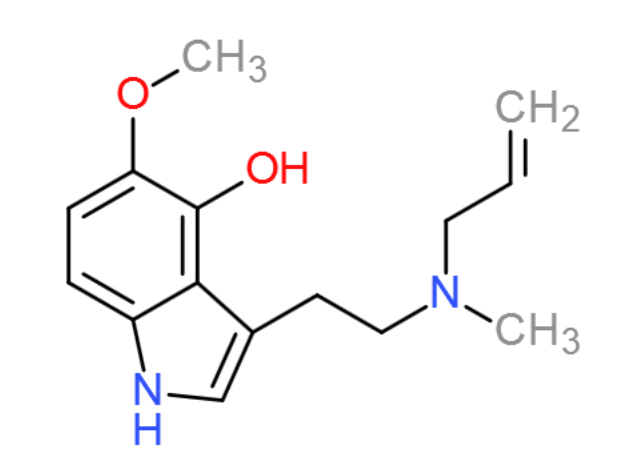
^ any amateur mycologist care to try this one out as a home project? Last edited:
IndoleMeridian
Greenlighter
- Joined
- Jan 8, 2014
- Messages
- 8
oh, what am i saying--i have plenty more ones to think of. ill go crazy today.
25B-NBOAc
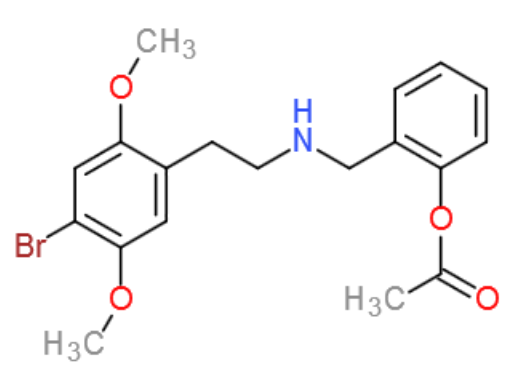
^O-acetyl prodrug for 25B-NBOH.
LML (Lysergic acid 2,N-methylallylamide)

^alkenyl analog of LSB.
ECYPLA (Lysergic acid N,N-ethylcyclopropylamide)

^ring-conformed analog of EIPLA, which is currently the most potent dialkyl LSD analog known (unless you consider LSZ a dialkyl structure).
NBZF-mescaline (n-benzofuranyl-mescaline)
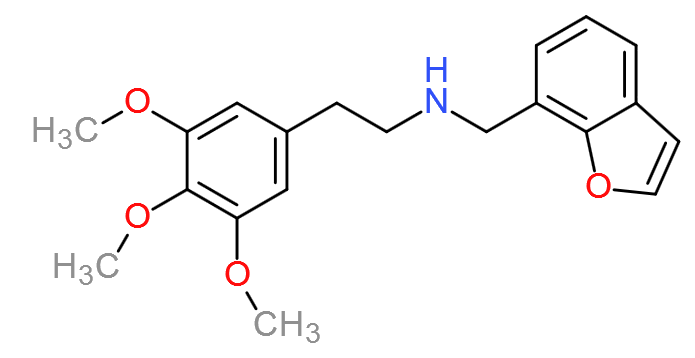
who knows, maybe this could be more potent than the NBOMe? one can only guess until they try.IndoleMeridian
Greenlighter
- Joined
- Jan 8, 2014
- Messages
- 8
That´s intriguing and nice!
How did you learn it?
I didn't learn it---there are papers about the biosynthesis of synthetic psilocin analogues online. You can grow the 4-HO- analogue of any possible tryptamine given that its 4-position is not bonded to anything other than hydrogen.
http://countyourculture.com/2012/02/17/biosynthesis-4-substituted-tryptamine-derivatives/
http://onlinelibrary.wiley.com/doi/10.1002/jobm.3620290608/pdf
Erikmen
Bluelight Crew
- Joined
- May 3, 2014
- Messages
- 20,707
This page is to talk about 1-Ethyl-1-Cyclohexanol, or 1E1C for short. Since ECH(1-Ethynyl-1-Cyclohexanol) is active and 2m2bOH(2-methyl-2-butanol) and 2-Methyl-3-butyn-2-ol is active, 1-Ethyl-1-Cyclohexanol might be active.
1-Ethyl-1-Cyclohexanol might have a similar dose range to 1-Ethynyl-1-Cyclohexanol.
A picture of 1-Ethyl-1-Cyclohexanol (1E1C)

Does anyone have any reports on 1E1C? Has anyone tried 1E1C?
The melting point is about 35 degrees Celsius.
I wonder if 1E1CP is active.
Here's 1-Ethyl-1-CycloPentanol.

Any information on the effects of this compound?
Melting Point: -10°C
Boiling Point: 155-160°C
I´m glad you explained.
crmt28
Bluelighter
- Joined
- Jun 19, 2014
- Messages
- 52
Inorganic Psychedelics! Would any of these be possible?
4-boryl-2,5-dimethoxy-phenethylamine / 4-methylboryl-2,5-dimethoxy-phenethylamine / 4-dimethylboryl-2,5-dimethoxy-phenethylamine
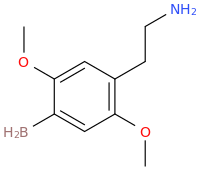
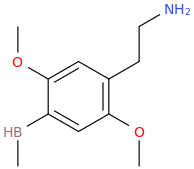

or maybe oxyboryl compounds instead:
4-oxoboryl-2,5-dimethoxy-phenethylamine / 4-hydroxyboryl-2,5-dimethoxy-phenethylamine / 4-(methylhydroxyboryl)-2,5-dimethoxy-phenethylamine / 4-dihydroxyboryl-2,5-dimethoxy-phenethylamine


SkyblueMolly
Bluelighter
More molecules.
Here's a random molecule! It's O-Methyl-Desomorphine. I'll call it mesomorphine for lack of a better name.

DL-ark
Bluelighter
Shouldn't it then be desocodeine?More molecules.
Here's a random molecule! It's O-Methyl-Desomorphine. I'll call it mesomorphine for lack of a better name.
- Status
- Not open for further replies.


