



-
-
AADD Moderators: Tronica
You are using an out of date browser. It may not display this or other websites correctly.
You should upgrade or use an alternative browser.
You should upgrade or use an alternative browser.
Aust fed police charge swim 6 counts importation border controlled substance
- Thread starter ahura999
- Start date
- Status
- Not open for further replies.




specialspack
Bluelighter
"Methylone is an analogue of MDMA and methcathinone"
specialspack
Bluelighter
thats what im hoping for !!!
analogue of both ? ok
Why are you hoping for that? That's what they've charged you with..?
It's definitely an analogue of methcathinone. Probably also an analogue of MDMA.
specialspack
Bluelighter
UK law is different. We don't have an analogue law. I'm looking at the Australian law.
The analogue definition is pretty broad:
The analogue definition is pretty broad:
A substance is a controlled drug if the substance (the drug
analogue) is, in relation to a controlled drug listed in
subsection (1) (or a stereoisomer, a structural isomer (with the
same constituent groups) or an alkaloid of such a controlled drug):
(a) a stereoisomer; or
(b) a structural isomer having the same constituent groups; or
(c) an alkaloid; or
(d) a structural modification obtained by the addition of one or
more of the following groups:
(i) alkoxy, cyclic diether, acyl, acyloxy, mono-amino or
dialkylamino groups with up to 6 carbon atoms in any
alkyl residue;
(ii) alkyl, alkenyl or alkynyl groups with up to 6 carbon
atoms in the group, where the group is attached to
oxygen (for example, an ester or an ether group),
nitrogen, sulphur or carbon;
(iii) halogen, hydroxy, nitro or amino groups; or
(e) a structural modification obtained in one or more of the
following ways:
(i) by the replacement of up to 2 carbocyclic or
heterocyclic ring structures with different carbocyclic or
heterocyclic ring structures;
(ii) by the addition of hydrogen atoms to one or more
unsaturated bonds;
(iii) by the replacement of one or more of the groups
specified in paragraph (d) with another such group or
groups;
(iv) by the conversion of a carboxyl or an ester group into an
amide group; or
(f) otherwise a homologue, analogue, chemical derivative or
substance substantially similar in chemical structure;
mmmm yes broad indeed
broad indeed
UK law is different. We don't have an analogue law. I'm looking at the Australian law.
The analogue definition is pretty broad:
broad indeed
specialspack
Bluelighter
It means going from this:
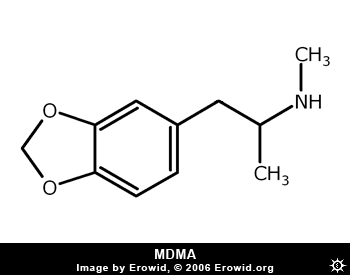
to this:
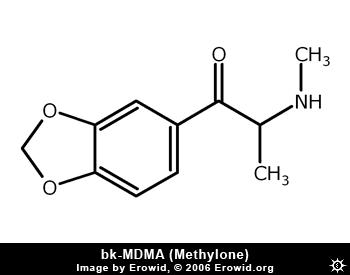
Adding an oxygen on the beta carbon, which is the second one away from the nitrogen.
to this:
Adding an oxygen on the beta carbon, which is the second one away from the nitrogen.

Mr Blonde
Bluelighter
I have no doubts that under federal law, 3,4-methylenedioxymethcathinone would be illegal.
I'm going to close this for now, as it seems pretty clear that all we can do is point you to the actual written law and advise you to speak to a lawyer. I don't see any harm reduction value in allowing this thread to stay open, and there isn't much we can do to help you.
PM me to discuss this, or if you need an electronic copy of the Criminal Code if you haven't already got one.
You should definitely apply for Legal Aid.
I'm going to close this for now, as it seems pretty clear that all we can do is point you to the actual written law and advise you to speak to a lawyer. I don't see any harm reduction value in allowing this thread to stay open, and there isn't much we can do to help you.
PM me to discuss this, or if you need an electronic copy of the Criminal Code if you haven't already got one.
You should definitely apply for Legal Aid.
Mr Blonde
Bluelighter
Adding this by request of ahura999:
"Khat goes by numerous names: Khat, qat , chat, qaadka, kus-es-salahin miraa, tohai, tschat,Abyssinian tea, African tea, African salad, and brown cows (in tablet form).
Qat leaves are crimson-brown and glossy but become yellow-green and leathery as they age. The leaves are up to 5 cm wide and up to 10 cm long and emit a strong aromatic smell and have astringent and slightly sweet taste (Sawair et al., 2007).
The stimulant effect of Khat is related to the cathinone content of the leaves (Kalix, 1990).
Cathinone is metabolized rapidly to cathine (norpseudoephedrine) and norephedrine, which possess weak central stimulant properties because of their less lipophilic character (Geisshüsler and Brenneisen, 1987).
Khat is of interest as it one of a few plants that are legally consumed for their
ethnopharmacological properties.
Debates over the legal status and health effects related to consumption of this plant are currently underway in many parts of the world on account of the spread of consumption from eastern Africa resulting from migration among East African communities (Klein, 200
Current Australian regulatory considerations
The current guidelines for important khat are clearly set out.
http://www.health.gov.au/internet/ma...e-imp-khat.htm
In Australia, the importation of khat is subject to regulation 5 of the Customs (Prohibited Imports)Regulations 1956 and is prohibited unless the importer holds a licence and permit issued by the Office of Chemical Safety (OCS).
A request to AQIS for data on khat license permits resulted in the release of aggregate data for license permits for the period 2003-2008. Unfortunately these permits do not contain data on the volume of khat imported. Permits are needed for importation and a licence/permit is required for the importation of khat for personal use. Khat import permits require details on whether the permit is for fresh or dried khat.
The current licensing arrangements allow for the importation of 5kg of khat under one permit each month. Using the 2007 data, it is estimated that an average of 33 kg was imported per permit in 2007.
It is possible that if permits were renewed each month, on average it suggests that each permit could be responsible for 2.8 kg of imported khat each month in 2007.
As a projection of what could have been imported using the current licensing arrangements, it is possible that the market could have risen to 33,180 kg in 2007 if every permit was used to import 5 kg each month.
The expansion of the marketplace is substantial in the Australian community.
On the basis of this evidence, if there were significant harms (eg mental health, crime and acute health) associated with khat it certainly would have become evident in health and criminological data in this time period.
For example, a rudimentary analysis of the import data suggests that in 2007, the importation of khat supported a retail market of around $2.2 million (18,380 kg producing 73,520 two hundred and fifty gram bundles at $35 a bundle).
This estimate is based on an average import weight per permit per month of 2.8 kg. The market could expand under the current regulatory regime to $3.9 million annually, if every permit was used to import the maximum amount allowed under federal regulations.
Compared to other psychoactive drug markets, this is a very small marketplace. As a comparison, the retail heroin market in Smith Street Fitzroy alone was estimated in 2000 to be 10 Khat: a literature review worth approximately $10 million annually (Fitzgerald unpublished data).
2.1 Pharmacology
This review of the pharmacology of khat is limited to human studies. There is a substantial literature from animal studies on khat and cathinone, which have been recently reviewed (Feyissa & Kelly, 200.
Pharmacokinetics
According to several early studies, on average around 100–300g of khat can be chewed in a 3-4 hour khat session (Nencini & Ahmed 1989; Kalix ,1990; 1994).
The most detailed account of Khat pharmacokinetics is reported by Toennes et al., (2003). In that study, Toennes et al., (2003) conducted a pharmacokinetic study following administration of 36–59 g of khat or approximately 0.5 mg/kg body weight.
The mucosa of the mouth is thought to be the first absorption segment, where most of the active constituents are absorbed (mean ± SD 59 ± 21% for cathinone and 84 ± 6% for cathine). The extraction of the active constituents from the leaves by chewing is very effective with only 9.1 ± 4.2% remaining as a residue after chewing (Toennes et al., 2003). Similar findings were reported in Brenneisen et al (1990) who examined the pharmacokinetics of cathinone (0.6 mg/kg body weight). The second adsorptive segment is the stomach and small intestine.
Peak plasma levels of cathinone are obtained 1.5–3.5 h after the onset of chewing khat (Feyissa & Kelly, 200. After 1-hour of chewing, plasma levels range from 40 to 140 ng/ml (mean 83 ng/ml).,
Cathinone is detectable in plasma for up to 24 hours after khat consumption. The elimination half-life is 260 min (Widler et al., 1994). Metabolism of cathinone is rapid. Only 2% of administered cathinone was found unchanged in the urine (Brenneisen et al., 1986; Nencini & Ahmed, 1989).
Blood pressures are elevated for about 3 hours after 1 hour of chewing of 0.6 g/kg, about one quarter of the amount consumed in a traditional khat session (Toennes et al., 2003). This dose is comparable with a mean oral dose of 45 mg cathinone.
Cathamines are excreted in breast milk and detected in the urine of breast-fed babies 2-4 hours after ingestion (Graziani, et al., 200.
Cardiovascular effects Khat has direct effects on the cardiovascular system causing clear increases in heart rate and blood pressure in humans (Brenneisen et al., 1990).
Brenneisen et al (1990) examined the effects of cathinone (0.6 mg/kg body weight). This dose is equivalent to approximately 25% of a normal dose.
This dose produced pressor effects (increased blood pressure) over a 2-hour period consistent with the pharmacokinetic profile for cathinone. At this dose level the pressor effects whilst statistically significant are relatively mild. It is unclear to what extent these changes are dose dependent.
These findings have been reproduced in other pharmacokinetic studies that also monitored cardiovascular changes. Significant increases in systolic and diastolic blood pressures persist for between 3 and 4 hours after the onset of chewing
khat (Toennes et al 2003; Widler et al 1994).
There is evidence of increased risk of myocardial infarction among khat users (Al-Motarreb et al., 2005), however other studies show less convincing evidence
of the links between cardiac dysfunction and khat use (Al-Hebshi & Skaug 2005: p304).
buse potential Using a systematic framework to assess the harm of current and future drugs of abuse, Nutt et al., (2007) ranked a range of 20 psychoactive substances in terms of social harm, physical harm and dependence potential.
The ranking system positioned khat as the least harmful substance in the group of substances evaluated in the United Kingdom by a panel of experts.
Khat is not a scheduled drug in the United Kingdom. Following from the recommendation of the Advisory Council on the Misuse Of Drugs (ACMD, 2005) khat remains a nonscheduled substance in the United Kingdom.
Although the ACMD (2005) suggested that dependence on khat was likely, the nature of this dependence was compared to a dependence on caffeine. The ACMD noted that:
“ the vast majority of people who use khat do not use in a dependent fashion and there is no evidence of more widespread drug misuse amongst khat users”.
(ACMD, 2005: p22)
- Status
- Not open for further replies.