Barley Grass - Revealing it's secrets on Bluelight - LSH ?
Ah, gather ’round, bairns, an’ lend yer ears, fer I’ll be tellin’ ye the tale o’ barley, brew, an’ the rare magic that slips unseen through the shadowed corners o’ the cauldron.
It begins wi’ the golden grains, barley ripe as a summer’s sun. I take ’em, aye, and let ’em soak an’ sprout in my old wooden troughs, till tiny green shoots peek like shy sprites. Then, I dry ’em, crush ’em, an’ cast ’em inta barrels wi’ water as clear as a mountain stream. Here, the wild yeasts, invisible as the wind, dance on the sugars, nibblin’ an’ sighin’, turnin’ sweet juice inta somethin’ alive. This, bairns, is what we call fermentation. It hisseth an’ bubbleth, breathin’ life inta the barley like a slumberin’ giant wakin’.
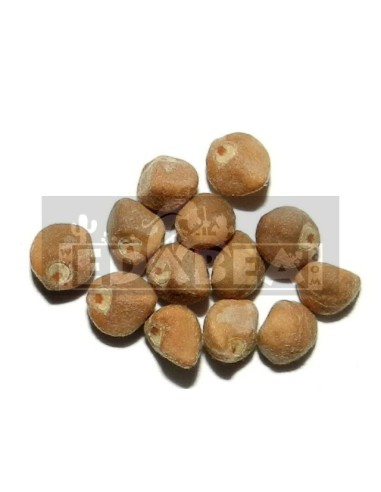
But mark me words, the true wonder be not in barley alone. Deep in the heart o’ the brew, a subtle spirit is born—ethanolamine, a glintin’ shimmer in the murky depths. Alone, ’tis a mild trickster, warmin’ the bones an’ whisperin’ secrets o’ chemistry. Yet, when mingled with fermented barley leaf—aye, not the grain, but the tender green leaf—and the extract o’ Hawaiian baby woodrose seeds, a transformation most curious occurs.
Under the spell o’ transamidation, somethin’ rare an’ mystical unfolds. The ethanolamine, sly as a fox, binds an’ twists wi’ the other essences, shapin’ itself inta a substance the old tongues call LSH. ’Tis a light that hums with visions, a doorway that opens in the mind, not in the eyes. Only a witch—or a brave soul wit’ respect for the old ways—can coax it without burnin’ the fingers or the spirit.
An’ so, the tale goes on, whispered in kitchens an’ forests, in barrels and bottles, where barley ferments and magic brews, and where ethanolamine waits, ever sly, for the leaf an’ seed that will call it into the light.
--------------------------------------------------------------------------------------------------------------------------------------------------
Barley grass, under fermentation does many relevant changes. Just a 24 hour period releases proline a transamidation catalyst that is trapped in the lipids and also providing lactic acid , which is also a transamidation catalyst , providing a double hit approach that fits like a glove for amides such as LSA . All that is missing is an amine.
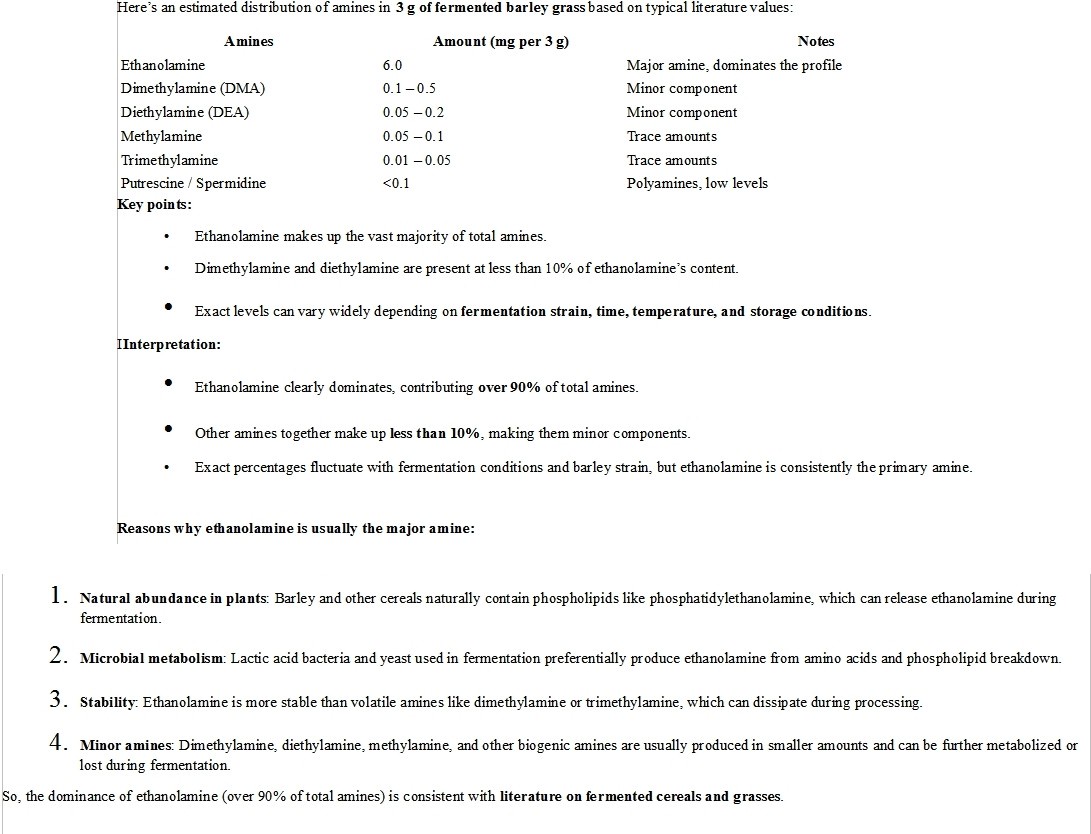
Number one amine produced during the first day of fermentation is ethanolamine that is released from PE (phosphotydylethanolamine) from where it's been trapped.
The amine responsible for forming lysergic acid hydroxyethylamide (LSH) is 2-aminoethanol, more commonly called ethanolamine.
Paper on ethanolamine in barley:
Biochem. Physiol. Pflanzen 183, 10 - 25 (1988) VEB Gustav Fischer Verlag Jena “Metabolism of [14C]-Monoethanolamine in Hordeum vulgare” HANS ECKERT, PETER REISSlIfANN and HANS BERGMANN
Phosphatidylethanolamine (PE) contains ethanolamine as the "head group" attached to a phosphate, which is attached to a lipid backbone. To obtain
free ethanolamine, those chemical bonds must be broken.
Conceptually, this can happen in several ways:
Enzymatic breakdown
Certain enzymes called phospholipases cut phospholipids into smaller pieces.Additional enzymes can then remove the phosphate-containing group and ultimately release free ethanolamine.This is how many organisms naturally recycle membrane phospholipids.
Human intestines have enzymes that do a real good job also.
Microbial metabolism
During decomposition or fermentation, they may break PE down and release ethanolamine-containing intermediates.However, the same microbes may then consume the ethanolamine, so release does not necessarily mean accumulation.
Chemical hydrolysis
Strong acidic or alkaline conditions can break the bonds linking ethanolamine to the rest of the molecule.I
n a laboratory, this can liberate ethanolamine from phospholipids, although it may also produce other breakdown products.
Phosphatidylethanolamine in barley leaves
Plant leaves are rich in chloroplast membranes, which have a lot of phospholipids, including phosphatidylethanolamine (PE).Typical PE content in green leaves is higher than in grains—roughly 1–2% of dry weight, sometimes a bit more depending on species and maturity.
Effect of fermentation
Fermentation by microbes can
break down phospholipids, releasing
free ethanolamine. So, fermented barley leaves may have
higher free ethanolamine than unfermented leaves, but the total ethanolamine (bound + free) won’t increase beyond what was originally in the leaves. Let’s assume
1.5% PE content and
30% of PE’s weight is ethanolamine (rough estimate, including both free and bound after fermentation).
Estimate for 3 grams of fermented leaves
PE content: 3 g × 0.015 = 0.045 g = 45 mg
Ethanolamine fraction: 45 mg × 0.3 ≈ 13.5 mg
Conclusion
In 3 grams of fermented barley leaves, you might get roughly 10–15 mg of ethanolamine, which is much higher than grains or cheese per 3 g. Fermentation helps release it, so this is closer to the bioavailable amount.
| Food (3 g) | Estimated Ethanolamine (mg) | |
|---|
| Aged goat cheese | ~1.5 mg | |
| Fermented barley grain | ~1.3 mg | |
| Fermented barley leaves | ~13.5 mg | |
Fermented barley leaves have roughly 10× more ethanolamine per 3 g than cheese or barley grain.
Fermentation matters—it can liberate ethanolamine from phospholipids, making it more available.
A few general observations: A long, active fermentation is not necessarily better. Many microbes can
consume ethanolamine once it is released. Ethanolamine is associated with membrane lipids such as phosphatidylethanolamine, so methods that increase breakdown of plant cells and phospholipids are generally more important than methods that maximize alcohol production.
Dried and finely ground barley grass would generally be preferable to fresh whole grass because it exposes more surface area and contains more plant solids per gram.
Fermented barley leaves contain a multitude of volatile compounds, including alcohols, esters, aldehydes, acids, and other nitrogenous compounds. These compounds often have strong odors that can easily mask ethanolamine’s scent.
Additional research has shown that reactive ethanolamine levels can be low, in the ug range but mostly at the 2-6 mg range. For how to increase ethanolamine levels in barley grass, AI does a good job in that department. With instructions for any level of expertise. AI is good for increasing the availability of any compound that can be derived from barley grass thru fermentation, altho it's based mostly on barley grain or wheat grass science due to minimal scientific research on actual barley grass.
The transamidation between LSA and ethanolamine can take hours or days under mild heat in the presence of proline and lactic acid.
Health benifets of barley Grass
“Preventive and Therapeutic Role of Functional Ingredients of Barley Grass for Chronic Diseases in Human Beings”. Yawen Zeng , 1 Xiaoying Pu , 1,2 Jiazhen Yang , 1,2 Juan Du, 1 Xiaomeng Yang, 1 Xia Li, 1 Ling Li, 3 Yan Zhou, 4 and Tao Yang
History of Barley
The Journal of Phytopharmacology 2024; 13(5):402-406 “Importance of Barley (Hordeum vulgare Linn.) as food and medicine from past to present: A brief overview “ Mehvash Alvi, Mohammad Nauman Saleem
This is research spurred by Matts (Tregar) research on Barley Grass Isovaleraldehyde + discovery of LSI.
Pic with additional info