• Psychedelic Drugs Welcome Guest
    View threads about
    Posting RulesBluelight Rules
    PD's Best Threads Index
    Social ThreadSupport Bluelight
    Psychedelic Beginner's FAQ
  • PD Moderators: Esperighanto | JackARoe |

Tryptamines L. asiatica - lilliputian hallucinations

I ask again; do you share the same skepticism (re hallucinations) for the toxicity of this mushroom? I've never tried it and don't know anyone who has, but I do take the literature seriously when it mentions toxicity causing hospitalisation.
I know I'm not the person you're talking to here but, just from the stance of someone who has been on the test team for a major ethnobotanical supplier, it can be exceptionally difficult to predict toxicity in any meaningful capacity without titration with tolerance breaks involved. How do you figure out how to time the tolerance breaks? Tragically, vibing that shit out. Also, how do you figure out adequate homogenizations for whatever the given material is, storage conditions, ideal route(s) of administration and interactions with other medications? What about batch variance? All of these things are so chaotic in the realm of natural products chemistry, I would absolutely fucking always advise people play it safe with natural products of dubious origin.
Really? I am genuinely curious WHY have you held this exact suspicion? That alone raises my eyebrow even farther. Feel free to DM me on the matter.
Oh just the surface level approach to the study of psychopharmacology through this lens of there being like, forgotten realms of things like LSA adducts which, even if we could regain knowledge of, would somehow also have proper cultural context to be useful. It's interesting, sure. Lysergamide chemistry is also some of the more challenging shit I've ever worked on and I've only worked with it in limited capacities, just cleaning up an LSA extract to any meaningful degree is tricky, just the losses of tripeptides alone in hydrolysis is a real kick in the dick when trying to crunch numbers on things like this. Ergot Alkaloids by Hoffman is a great book on the subject but I sure do wish Alexander Stratford would eventually write a book-length piece on chemistry. The peer reviewed literature he's a part of absolutely fucks.

To whatever extent I do suspect that things as simple as mint oil or specific types of wine could alter the impacts of LSA-fungus colonize plant material, I think that the most useful way to approach it is by blind trialing people, seeing if there's a noticeable difference, and if there is, taking it at face value and functioning under the assumption that some nerds with mass spectrometers will figure out the details later on, but right now let's focus on how to best use these as tools for healing and the sort. Just my personal take on the approach of hyperanalyzing things that are pretty blurry to begin with, it's fun and I enjoy it a lot but I often try to remind myself that it's not as useful as actually getting my hands dirty applying these things with folks.

 
Love it.

Yeah I am not going to lie, there was a moment where I thought the exact same thing, oh shit this is Tregar - or someone on his side or team? Whatever that's fine if the case but why? Truth is important and coming to these assumptions led me to kinda be dissapointed in the whole ordeal.

I have yet to try the hbwr extraction of his BUT i am glad we went through the motions...because it got me hella excited about morning glories and growing psychedelics/learning extract teks,
As I just recently made my first heavenly blue lsa extraction and also had my first taste of HBWR seeds.
 
How it is possible that there are almost no mentions from fellow psychonauts about this mushroom?
Yunnan province of China must be quite well travelled by westerners and similar exotic drugs are actively searched and tried by people like us (mad honey from Nepal is one example)
I am not saying that it does not exists, but lack of reports is quite suspicious.

Btw. I have no doubts that Tregar and Allylbenzene are somehow connected.
 
Exactly that's how I feel..a best kept secret? I am SURE there is even more out there that we have yet to stumble over, like other dmt like containing plants - like the honey locust tree apparently was used by Cherokee Natives and was similar to Ayahuasca for example seems interesting
Lilliputian hallucinations sounds wicked wild like either way this induced state maybe has similarities to other psychedelics which really fascinates me.
 
I am SURE there is even more out there that we have yet to stumble over

2 notable examples that remain unacknowledged in modern literature are mescalines unique bioactivation process and that of allylbenzenes. I specified modern because the allylbenzene aminated metabolites were detected & characterised in the 70s (see here) and since then we only see anecdotal reports; likewise with mescaline reports.

The best explanation (rationalisation) is that mescaline has poor lipid solubility implying limited ability to cross the bbb (thus requiring high doses). As for allylbenzenes, they're usually dismissed as anti-cholinergic despite no pharmacological data showing this afaik. Toxicology reports on nutmeg intoxication assume an anticholinergic mechanism which might be true for whole nutmeg (see toxic trimyristin) - but not implicitly for the allylbenzenes it contains.
 
Last edited:
I suspect that dimethyl 3,5-bis(4-hydroxyphenyl)-1H-pyrrole-2,4-dicarboxylate and dimethyl 3,5-bis(4-hydroxyphenyl)-1H-furan-2,4-dicarboxylate are responsible for the effects at hand, and the bluing is possibly a result of gyrocyanin. Read about this first here: https://www.sciencedirect.com/science/article/abs/pii/S0367326X2500156X

Edit: Daturamycins are kinda-sorta similar in shape, but there are still some major differences. Maybe that suggests an anticholinergic (or similar) mechanism for L. asiatica? Not sure, just throwing it out there. Is anybody here aware of similar compounds to the ones I mentioned in this comment?
 
Last edited:
Dated 2025 wtf.

Initially it reminds me of this:
Clausenamide is a plasticity-promoting natural product isolated from the leaves of Clausena lansium, an evergreen native to Southeast Asia and southern China.
...clausenamide exhibited the highest level of cortical synaptogenesis, with this effect likely being dependent on its ability to act as a 5-HT2AR partial agonist.
10.1021/acschemneuro.5c00767
 
Last edited:
Dated 2025 wtf.
Yeah it's pretty recent, I very obsessively keep up with academic literature in the field of pharmacology. I need to start accumulating it for posting on the Drug Studies forum, but honestly there are already many folks doing a fantastic job at cataloging things to begin with so I try to contribute more via conversational means if that makes sense.

Also wow, Clausenamide is definitely not the furthest off, thank you for the info here!
 
Cyclized phenethylamines and partial lysergamides have been recent hyperobsessions for me as far as research goes, have you looked into the 3-phenylpiperidines kicking around like the LPH-X series that Lophora patented? In addition there are some neat ones like OSU-6162 and some weirder ones that are sigma PAMs and mildly serotonergic. All are quite fascinating, but the synthetic routes towards them seem to be quite tricky so I'm hopeful that a more approachable route will be found for the sake of clandestine, Shulgin-style exploration of the scaffold to be possible some day.

More-so that the compounds from this 2025 paper weren't (at least from what I've seen) overtly associated with the hallucinogenic effects.
I gotcha, yeah it's definitely shocking to see, I suspect we may be in some sort of golden age as far as the research of hallucinogenic drugs and it really lights a figurative fire under my ass to keep researching and trying to build an interconnected, thorough and still firmly skeptical understanding of all SARs related to these things that I can find. If you would like, I would be more than happy to whip up a thread here in the PD forum about the more bizarre 5HT2a agonists I've found which are likely to induce psychoactivity. Also there's this one kappa specific agonist called 4-Allyl-6-oxa-noribogainalog which I hope may open the figurative floodgates surrounding the exploration of small molecule kappa opioid selective PAMs which may be able to induce salvia-adjacent effects, while also having synthetic routes which are as I said in a very clunky manner earlier, approachable enough for some future hero to do some Shulgin-esque explorations of the molecules.
 
Cyclized phenethylamines and partial lysergamides have been recent hyperobsessions for me as far as research goes, have you looked into the 3-phenylpiperidines kicking around like the LPH-X series that Lophora patented?
Sure the LPH 3PIPs. See 2C-B-3PIP, then overlay it with 9-oxaergoline.

a thread here in the PD forum about the more bizarre 5HT2a agonists I've found which are likely to induce psychoactivity.
I'm focusing on polypharmacology but for sure 2A is one of many things of interest! I think that there are many ways to activate the downstream mechanisms by which the 2a receptor causes hallucinogenic effects.
 
Last edited:
...and the bluing is possibly a result of gyrocyanin.

Gyrocyanin is similar to Variegatic acid:
Both gyrocyanin and variegatic acid are follow-up products of the terphenylquinone atromentin, a key intermediate for pigments... (source)
Variegatic acid (3,3',4,4'-tetrahydroxypulvinic acid) is an orange pigment found in some mushrooms. It is responsible for the bluing reaction seen in many bolete mushrooms when they are injured.

Apparently Variegatic acid has an inhibitory effect on P450 (CYP) 1A2, 2C9, 2D6, and 3A4.

Re atromentin:
In this study, two novel diarylcyclopentenones daturamycins A & B (1 and 2), one new p-terphenyl daturamycin C (3), and three known p-terphenyl derivatives (4–6)...
...
A previous study has shown that the formation of 2,5-diarylcyclopentenone proceeds via the terphenylquinone atromentin (source)
Beilstein_J_Org_Chem-18-1009-g002.jpg


Daturamycins are kinda-sorta similar in shape, but there are still some major differences. Maybe that suggests an anticholinergic (or similar) mechanism for L. asiatica?
Imo the anticholinergic explanation is overused; a classic example of this is to explain the psychoactive (uplifting, stimulant, psychedelic) qualities reported of allylbenzenes (note that most allylbenzene botanicals also contain acetylcholinesterase inhibitors).
 
Last edited:
...we can't test for it and we can't even confirm it's true. We have a mushroom that's been studied for 70 years...that's never been proven to contain any psychoactive compounds and has very flimsy anecdotal evidence backing it up...
...
I'm keeping an open mind, but the truth is there is no virtually no hard data yet.

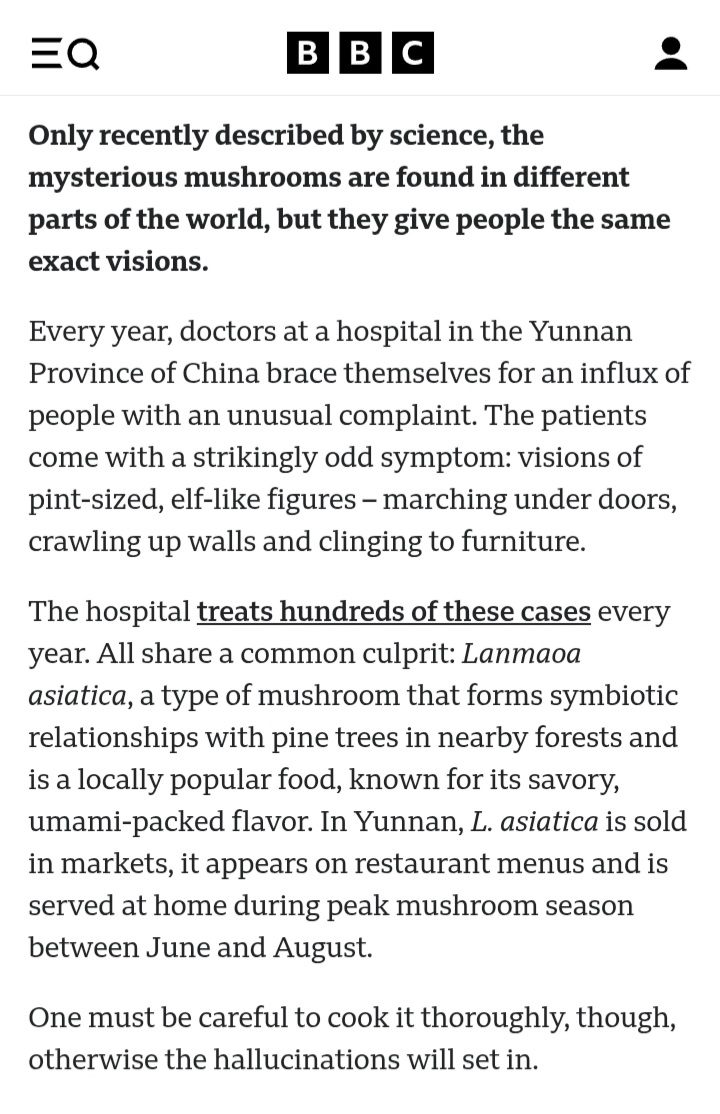
From the OP BBC news article (fyi BBC is considered the most reputable news source in the world):

Screenshot-20260711-185447-Brave.jpg


Until you can test for something and confirm a fact repeatedly, skepticism is healthy.
Should we be skeptical about the reported toxicity (and hospitalisations) of this mushroom, the hallucinations, neither or both?
 
Last edited:
Dated 2025 wtf.

Initially it reminds me of this:

10.1021/acschemneuro.5c00767
There's another study showing how it has effects similar to that of Piracetam! Fascinating compound...


The neuroprotective effects of (−)-clausenamide has been studied in anisodine-induced amnesia model (Duan and Zhang, 1998). It was found that (−)-clausenamide ameliorated anisodine-induced memory deficits in step-through test in mice. Pretreatment with (−)-clausenamide significantly ameliorated anisodine-induced reduction of acetylcholine in a dose-dependent manner in the frontal cortex, hippocampus and striatum.
 
lol, considered by whom? By somebody less reputable, surely.
Well the BBC have reported on key things like 911, the recent NASA space mission and global warming/climate change. So why would they lie! The BBC has high standards when it comes to truth, fyi they have a dedicated anti-misinformation team called "BBC verify".

BTW, the media has a long history of totally making shit up with regard to drugs.
Of this I'm aware. But here we're talking about documented hospitalisations associated with ingestion of Lanmaoa asiatica.

Untargeted Metabolomic Analysis Using UPLC–MS/MS Reveals Metabolic Changes Associated With Lanmaoa asiatica Poisoning
...
Poisoned patients primarily exhibited neuropsychiatric symptoms, including hallucinations (75%) and general weakness (60%), along with gastrointestinal symptoms such as nausea (60%) and vomiting (45%)

Tbf I'm not against questioning this peer-reviewed paper.
I do that quite often.
 
Last edited:
Well the BBC have reported on key things like 911, the recent NASA space mission and climate change. So why would they lie! The BBC has high standards when it comes to truth, fyi they have a dedicated anti-misinformation team called "BBC verify".
So? The statement: "BBC is considered the most reputable news source in the world" is logically meaningless. BBC Verify might make a statement like that, and it would be true because BBC Verify considers it to be true. However, Alex Jones (who also reports on 911/NASA/climate change) could make an analogous statement, "Alex Jones is considered the most reputable news source in the world", and that would be true too because Alex Jones considers it to be true. So? It means nothing because the reputability is based on circular logic, and all alternatives are implied within the statement to be less reputable.

Answer the question: "By whom is BBC is considered the most reputable news source in the world?" And then sociological considerations come into play. We must consider the entity that is providing that endorsement of BBC or Alex Jones or whatever. Who do they represent (if not a person), and what are their particular interests? Media reporting isn't really about truth and lies. It's about narrative and the power inherent in that narrative.
Of this I'm aware. But here we're talking about documented hospitalisations associated with ingestion of Lanmaoa asiatica.
Yes, and oddly the article indicates that all of these documentations came from a single hospital "in Yunnan Province in China". They don't actually say which one, but maybe details are inside one of the linked academic articles. I could not retrieve the full text of the one that looked relevant.

Anyway the article seems to be almost entirely based on discussions with the researcher, Colin Domnauer and includes a lot of speculation and rumor basically. The way it's narrated gives the impression that a lot more is known than actually is. I wish the researcher luck in hunting down these connections, but they may not be there. If only one location is reporting actual intoxications, it could be some local folklore (like ghost stories) or even some propaganda to draw tourists in.

I'm not committing to any particular view here, I'm just saying that article and the nearly identical one published in The Atlantic are thin on sourcing and detail and very heavy on narritive. This pattern is extremely common in popular media today including on many important topics like world events. Very often the few relevant facts are buried deep into the article, and often those facts contradict the impression one would come away with by reading the headline.
 
The statement: "BBC is considered the most reputable news source in the world" is logically meaningless.
Actually tbh it's "meaningless" by default since - imo - BBC is a very biased source of political "news", it's considered the UK government state news channel. Imagine if FOX news told every US citizen with a TV to pay $150/year license fee (for the privilege of watching FOX channels). Well that's what happens here in England. Really.

Anyway the article seems to be almost entirely based on discussions with the researcher, Colin Domnauer
Yes, I was in email contact with him a few months ago. I just found his paper:
Domnauer, C., & Dentinger, B. T. M. (2026). Phylogenomic systematics of Lanmaoa (Boletaceae) reveals cryptic diversity, resolves global evolutionary relationships, and suggests a novel psychoactive lineage. Mycologia, 118(4), 732–742. https://doi.org/10.1080/00275514.2026.2670968

The way it's narrated gives the impression that a lot more is known than actually is. I wish the researcher luck in hunting down these connections, but they may not be there. If only one location is reporting actual intoxications, it could be some local folklore (like ghost stories) or even some propaganda to draw tourists in.
Healthy skepticism...but there is much data indicating these mushrooms do indeed cause hospitalisations and more.

Some preliminary info I found; this from a 2024 paper:
Mushroom poisoning demonstrates distinct regional and seasonal patterns. In our study, Lanmaoa asiatica poisoning peaked in July, in line with previous research (13). The predominant clinical presentation among poisoned patients was the neuropsychiatric type and mixed type, characterized by visual hallucinations, fatigue, and dizziness. Some patients reported hallucinations of “little people” or “elves” dancing poisoning, which intensified when they closed their eyes. Gastrointestinal symptoms, such as nausea and vomiting, were common among patients who ingested Lanmaoa asiatica.
Ref #13:
13 Li W, Pires S, Liu Z, et al. Mushroom poisoning outbreaks - China, 2010-2020. China CDC Wkly. 2021; 3(24): 518-522. https://doi.org/10.46234/ccdcw2021.134
Dai, R., Duan, Z., Yang, J., Ning, D., Liu, Y., Gong, B. and Meng, Q. (2024), Neuropsychiatric symptoms following the consumption of Lanmaoa asiatica, a poisonous mushroom native to Yunnan. Hong Kong J Emergency Med, 31: 299-303. https://doi.org/10.1002/hkj2.12046

A 2023 paper:
A total of 398 patients with acute Lanmaoa asiatica poisoning admitted to the emergency department of the Affiliated Hospital of Yunnan University from January 2020 to December 2021 were selected as the study objects.
...
The poisoning of Lanmaoa asiatica is mainly neuropsychiatric type 12-24 hours (82.51%), and the main symptoms are hallucinations (90.70%), delirium (35.18%), dizziness (30.65%) and mania (9.05%).
LI Ya, LI Haijiao, FU Yangshan, et al. Analysis of epidemiology and clinical characteristics of Lanmaoa asiatica poisoning. J Clin Emerg, 2023, 24(5): 258-261, 265. doi: 10.13201/j.issn.1009-5918.2023.05.007

A 2025 paper:
This study employed ultra‐high performance liquid chromatography–tandem mass spectrometry (UPLC‐MS/MS) to analyze the plasma metabolic profiles of patients with Lanmaoa asiatica poisoning and healthy controls. A total of 20 patients were included, with an average age of 36.9 ± 13.08 years.
Dai R, Duan Z, Han B, Peng Y, Zhu L, Shen Y, Meng Q. Untargeted Metabolomic Analysis Using UPLC-MS/MS Reveals Metabolic Changes Associated With Lanmaoa asiatica Poisoning. Food Sci Nutr. 2025 Jul 8;13(7):e70583. doi: 10.1002/fsn3.70583. PMID: 40635726; PMCID: PMC12237617.

An older 2008 paper:
Xiao ren ren are widely known in Yunnan province, China, at least at the mid-elevations where Han Chinese and Yi people predominate. The phrase means "little men" or "little people" (xiao, little; ren, man or person, the redundancy being an idiom to indicate lots of men or people, which the standard plural form renmen does not necessarily connote). Xiao ren ren are typically glimpsed or experienced after dining on inadver- tently undercooked, blue-staining boletes of uncertain identity. The people of Yunnan seem almost universally amused by the xiao ren ren rather than fearing them or revering them.
Arora, D. Xiao Ren Ren: The “Little People” of Yunnan. Econ Bot 62, 540–544 (2008).
DOi: 10.1007/s12231-008-9049-0
Author:
David Arora
Department of Forest Science
Oregon State University
3200 Jefferson Way, Corvallis, OR, 97331, USA

...


The notion that this is all part of some illusionary landscape seems far-fetched. Do you think, perhaps, that Colin Domnauer & David Arora (authors) are being paid by the Chinese gov to promote Chinese tourism.

That 2025 paper was funded by Yunnan Provincial Science and Technology Department (suspicious?). The 1st author (in both 2024 & 2025 papers) is from "Department of Emergency, The First People's Hospital of Yunnan Province". His pubmed listing (here) shows several papers.​
And that ref 13 was from China CDC. Even the Chinese CDC appears implicated in this. According to Didgitals logic, I am presumably also implicated in the conspiracy(?)​
 
Last edited:
If only one location is reporting actual intoxications, it could be some local folklore

From this article:
BT: And that's so strange. ... I struggle to understand how it has flown under the radar for so long. ... Why are we only just talking about this now?
CD: The first reports of psychoactive boletes actually go back to the 1930s to 1960s in Papua New Guinea. That's actually a time before we even knew about psilocybin mushrooms, and yet psilocybin mushrooms have exploded in the last century to become globally popular. But this mushroom went the opposite way and faded into obscurity. And I think the reason for that is twofold. One, the scientists who were initially studying this mushroom in Papua New Guinea were unable to isolate any psychoactive compounds and couldn't determine the species responsible for the effects. And secondly, because these symptoms sounded so bizarre and fantasy-like — seeing little people — I think this biased them toward believing that it wasn't possible. In fact, they concluded that this whole phenomenon of "mushroom madness" was all just a social act, a myth, or a way for the people to behave in ways they ordinarily wouldn't. But they concluded the mushrooms were just like a scapegoat, they weren't actually physiologically active, it was just an excuse to do these things.

But since that time, we've had more reports coming from other cultures — from China, and now over the last two years from the Philippines.

That's multiple independent cultures reporting the same specific type of hallucination.

So to summarise his reasoning, he thinks (shortsighted?) scientists dismissed the hallucinogen claims associated with this mushroom ... and here we are, 60 years later.
 
Last edited:
So to summarise his reasoning, he thinks (shortsighted?) scientists dismissed the hallucinogen claims associated with this mushroom ... and here we are, 60 years later.
Yeah yeah yeah... It's a nice story, but he has no idea. I wish him well in his research but wonder why he has so much time to talk to the media when he's got a long way to go to confirm most of the stuff he's speculating about. And no, I don't really think the whole story is a Chinese conspiracy, but I do think the information being presented is much less complete and more speculative than the narrative implies.

With all due respect, all the content you just posted adds little to the discussion. We're all going to have to wait to see what comes of this, and it doesn't look like the research is moving very fast at all.
 
Top