-
Neuroscience & Pharmacology Discussion Welcome Guest
Posting Rules Bluelight Rules Recent Journal Articles Chemistry Mega-Thread FREE Chemistry Databases! Self-Education Guide -
N&PD Moderators: Skorpio
You are using an out of date browser. It may not display this or other websites correctly.
You should upgrade or use an alternative browser.LSD light-version
- Thread starter ungelesene_bettlek
- Start date



Ham-milton
Bluelighter
- Joined
- Jul 20, 2007
- Messages
- 5,738
These were discussed pretty in depth in the ring-substituted mescaline thread (I think?).
I doubt it'd be active as drawn, though.
ladyinthesky
Bluelight Crew
ungelesene_bettlek said:what would we get if we removed the rest of the LSD molecule from the two core elements?
probably nothing...but im not chemist
dorothyperkins
Bluelighter
- Joined
- Oct 18, 2007
- Messages
- 426
It's worth checking i think. It's a conformationally constrained version of AMT, and it's constrained in the same conformation as the amine in LSD though probably not the conformation that is active for amphetamine or AMT. Taking a fairly wild guess, i think it would be more active as a 5HT2A agonist than a monoamine releaser. N,N-dimethylation might help too.
It has a nice symmetry to it!
Ham-milton
Bluelighter
- Joined
- Jul 20, 2007
- Messages
- 5,738
But LSD has a lot more to it than that. Look at what happens when you make tiny changes to the LSD molecule, it doesn't take much to completely abolish activity.
dorothyperkins
Bluelighter
- Joined
- Oct 18, 2007
- Messages
- 426
Yeah you're probably right. Would be interesting to see some work done on the active conformations of tryptamines though.
ungelesene_bettlek
Bluelighter
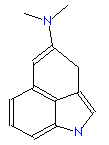
thanks for your answers... what i'm ultimatively thinking about is if the theory, that LSD contains both a phenethylamine and a tryptamine core makes any sense in terms of psychopharmacoly (the AMDiPT thread got me thinking about that again).
what I'm thinking of now in this direction is the isomery stuff - LSD is active in its R form. now shouldn't that mean that the alpha-methylated tryptamine in it is in its S isomer as well, while the amphetamine in its S isomer (correct me if i'm wrong). but psychedelic amphetamines are more active in their R form as well!
and which is the more potent isomer of AMT actually?
i guess you mean this thread?Ham-milton said:These were discussed pretty in depth in the ring-substituted mescaline thread (I think?).Last edited:
fastandbulbous
Bluelight Crew
All of the compounds discussed that are optically active all have the same conformation about the carbon atom/nitrogen atom that corresponds to the 6 (/n-methyl) position of LSD. In those cases, the most active isomers all have the same 3D cibfirmation as that of LSD (ie R-isomers of sub amphetamines and the S-isomer of AMT & 5-MeOAMT)
Holy_cow
Bluelighter
- Joined
- Nov 29, 2007
- Messages
- 171
Has been done by Nichols et al.: Further Studies on Oxygenated Tryptamines with LSD-like Activity Incorporating a Chiral Pyrrolidine Moiety into the Side Chain. J. Med. Chem. 1999, 42, 4257-4263.dorothyperkins said:Yeah you're probably right. Would be interesting to see some work done on the active conformations of tryptamines though.
R-3-(N-methylpyrrolidin-2-ylmethyl)-4-hydoxyindole had about 1/5 the potency of LSD in rats and therefore is the most potent "tryptamine" described so far. I have personally tried the 5-MeO derivative. It's fully active at 2mg, but very sedating. I had to lay down when the effect set in, or take a stimulant with it. It's not worth the effort in my opinion. Works are now under way to create a new compound using an indole with an optimized ring substitution and a R-3-(N-methyl-pyrrolidin-2-ylmethyl)- moiety. This should yield the most potent "tryptamine" ever created and might come close to LSD in potency. Since Nichols created some PEAs as potent as LSD, it's time to bring out a "tryptamine" with LSD-like potency. Since DOI and LSD have been shown to cause different effects on glutamate overflow (http://www.nature.com/npp/journal/v31/n8/pdf/1300944a.pdf), which might explain their different "highs", it would be great to have a "tryptamine" with LSD-like effects on glutamate.hi bettlektüre
i have had the same idea as you and posted about the molecule you have drawn as well as the dimethyl version or another analog (in the mescaline thread) in multiple threads. i have searched the internet but as far as i know none of these substances have even been synth'd. i would be quite interested in any information about activity; they would fit in the F&B model quite nicely
my favourite of these substances is a conformationally restricted dmt with a double bond in the C ring (see picture). it would be just as planar as lsd. also the one in the mescaline thread could prove interesting as the electron density is a little more similar to lsd than with this one…
edit:
@cow: sounds very interesting, but you link is dead
Attachments

johanneschimpo
Bluelighter
Deleted member 81238
Bluelighter
you are right, how could i forget!Pomzazed said:Black, seems like enamine wont be so stable tho
dorothyperkins
Bluelighter
- Joined
- Oct 18, 2007
- Messages
- 426
Holy_cow said:Has been done by Nichols et al.: Further Studies on Oxygenated Tryptamines with LSD-like Activity Incorporating a Chiral Pyrrolidine Moiety into the Side Chain. J. Med. Chem. 1999, 42, 4257-4263.
R-3-(N-methylpyrrolidin-2-ylmethyl)-4-hydoxyindole had about 1/5 the potency of LSD in rats and therefore is the most potent "tryptamine" described so far....
Oh yeah i forgot about that one! Wonder if he's going to try different ring sizes, or did he? I don't have the paper.
Do you think the 5-MeO one would be even more potent than Nichols 4-OH one? 2mg sounds like quite a high dose, the rats must be really sensitive to it! What optimised ring substitution pattern do you think would work well?
I just came across the original molecule of this thread, it's apparently a serotonin agonist but the article gives no more information or references. There's a similar analog above it with no discussion of activity. They're on page 5:
http://www.iupac.org/publications/pac/1997/pdf/6903x0559.pdf
haribo1
Ex-Bluelighter
- Joined
- Nov 29, 2006
- Messages
- 4,822
The only 2 substitutions on the LSD structure that retain acticivity seem to be
1)replacement of the 6-N substitution (N-methyl->N-ethyl->N-allyl)
2)replacement of the diethyl moety with 2,4 dimethyl azetidine (which yields 3 isomer)
Oh, and I suppose esterifying the indole introgen as well.
fastandbulbous
Bluelight Crew
^ Substituting a morpholine ring for the diethylamine forming the carboxamide give LSM which is active at about 300ug. Equally there are aeveral other substitutions to the amide nitrogen that give avtivity, just not as potent as LSD (mono-substituted amides like the sec-butanolamide appear to me active as well, again with a drop in potency
Oh, and I suppose esterifying the indole introgen as well.
You mean amide formation with an acyl group at the indolic nitrogen. Not had our cup of coffee this morning? (Also, Methylation at the 1 (nitrogen) pos produces an active drug, only a fair bit less potent than LSD (think 1-methyl LSD - can't remember sill designationm no. - is active at about 1mg).
It will actually allow a fair degree of 'fiddling about' (now I've got a pic of Keith Moon as Uncle Ernie from the film version of 'Tommy' in my head!), just not much while retaining an active dose like that of LSDharibo1 said:The only 2 substitutions on the LSD structure that retain acticivity seem to be
1)replacement of the 6-N substitution (N-methyl->N-ethyl->N-allyl)
2)replacement of the diethyl moety with 2,4 dimethyl azetidine (which yields 3 isomer)
Oh, and I suppose esterifying the indole introgen as well.
I do not think you can make that categoric statement, the secondary butylamide is active, the morpholine analog is active.
there is aslo some evidence that more complex substuents on the caroxylamide nitrogen do not abolish activity.
on a more fundemental level only the relatively easy to synthesise modifications of lysergide have been done, other ones which require total synthesis of the lysergic skeleton have not been done. it is almost guaranteed that some of these will be active and some of them will have similar activity levels to lysergide itself.
the benz[cd] indoles discussed by the OP are known and have been discussed on this forum previously. some of them are DA agonists, the SE activity is not well documented and the research dates fro before the identification of the various serotonin receptor subtypes and much before the multiple downstream signalling was suggested as being important.
ungelesene_bettlek
Bluelighter
I just got to know that someone had this idea long before me: http://en.wikipedia.org/wiki/LY-293,284