• Psychedelic Drugs Welcome Guest
    View threads about
    Posting RulesBluelight Rules
    PD's Best Threads Index
    Social ThreadSupport Bluelight
    Psychedelic Beginner's FAQ
  • PD Moderators: Esperighanto | JackARoe |

Tryptamines Alexander Shulgin

mr peabody

Bluelight Crew
Joined
Aug 31, 2016
Messages
5,947
Location
Frostbite Falls, MN
90


Chemophilia – An Interview with Ann and Alexander Shulgin

Berkeley, California, 1993

Alexander (Sasha) and Ann Shulgin were on the frontier of designer neurochemistry, developing a plethora of miraculous pharmacological keys that unlock different aspects of the brain is hidden potential. They are known to many as the authors of the underground best-seller PIHKAL: A Chemical Love Story, the title of which is an acronym for Phenethylamines I Have Known and Loved. Alexander was a long-standing, well-respected research chemist and professor of pharmacology at the University of California at Berkeley, where he earned his doctorate in biochemistry in 1954. He authored 150 scientific research papers, twenty patents, and three books. Although Alexander was quite outspoken regarding his opposition to the so-called war on drugs, he was a scientific consultant for such state-run organizations as the National Institute on Drug Abuse, NASA, Lawrence Radiation Laboratory, and the Drug Enforcement Administration (DEA).

In private, in his government-licensed research lab, Alexander spent the last thirty years of his life discreetly yet legally designing hundreds of new psychoactive compounds, particularly psychedelics. Along with his wife, Ann, and a small, brave, and dedicated research group, they sampled each new drug as it is developed. Through the cautious escalation of dosage, they discovered and mapped out the range of each new drugs effects, experimenting with the various aspects of their psychological and spiritual potential. Most of Alexanders psychoactive designer molecules are unknown to the public, but a few, such as 2CB (an MDMA analogue) and DOM (better known as STP), have received widespread distribution. Their research continued until Sasha's death in 2014. Their book, PIHKAL, details their truly remarkable adventures and, for those with a solid background in chemistry, and provides the esoteric recipes for recreating hundreds of Alexanders finely crafted magic molecules.

Alexander and Ann made a very compatible research team: they complemented one another; and their relationship reflects a deep commitment to inner exploration. They were extremely warm, and anxious to share what they had learned through their experimentation. We interviewed them at their home in Lafayette east of Berkeley in northern California in 1993. Ann was strong, solid and grounded, very much connected to the earth. Before moving to northern California as a teenager she had lived in four countries. She worked as a medical secretary at the UCSF Medical Center. She was also a psychotherapist.

A wild electrical current seems to buzz through Alexanders nervous system, as evidenced by the white hair that seems to stand on end on his head and face, and the excited manner in which he explained everything. Alexanders research laboratory, just a short walk from the main house, was filled by a complex of interlocking flasks, glass beakers, plastic tubes, heating coils, and countless bottles; it looked dramatic enough to be used as a Hollywood movie set. The only chemicals that we sampled, however, were in the cheese sandwiches that we had for lunch before we began the interview. Even so, we do feel ourselves to be in an altered state.

DJB

David: What was it that inspired you to write Pihkal?

Alexander: I was inspired partly by the history of Wilhelm Reich. I discovered that in his very last years he got into very unusual and not totally acceptable areas of hypotheses, such as making rains fall by means of electro-static guns and other such ventures.

The FDA filed a lawsuit against him for promoting radical equipment that had not been approved by them. They put him in jail and he died there. After his death the FDA took all his lab books and papers and burned them. One of the reasons I wrote Pihkal was because I could see the need to get a lot of information that had not been published into a form that just could not be destroyed.

Ann: And I couldn't imagine him writing all that fun stuff without my help. (laughter) I co-authored one paper with him before and discovered that its a great ego-boost to do good writing; I never had anything published before. It became the most exciting thing in the world to do, especially because it was pushing against the establishment.

My model and my hero was Castaneda, but what I wanted to do was bring in the personal which he failed to do, marriage, kids, love, soup, every day reality. Our feeling about psychedelics is that if you use them in the right way, they enrich your everyday life. You learn to think a different way about the ordinary things you see.

Rebecca: What is a phenethylamine, why is it so special and what role has it played in your research?

Alexander: There are a collection of neurotransmitters in the brain and two of the largest families are the phenethylamines and the tryptamines. And it turned out that all the known psychedelics around the time I got curious in this area, back in the 50s and 60s, were either phenethylamines or tryptamines. It has now been shown that this is a very good guide. Nature said, here are the two basic building blocks, and if you are going to do something with the brain, it is going to be with one or the other.

David: Why did the two of you use ficitonal names in the book when the story was obviously autobiographical?

Ann: Among the drugs we were writing about some, like LSD, are illegal. It was risky enough writing the book in the first place. We didn't know what to expect from the establishment, if anything. Some people late at night with baseball bats smashing up the lab was a perfectly reasonable possibility. Using fictional names gave us a deniability.

The second reason was so that I could tell my children that the sex in the book wasn't actually us. (laughter)

Also, we didn't want to jeopardize our next book. At this point, not only has there been no fire from heaven descending on our heads, and the DEA itself one of our best customers, it is easy to look back and ask why were we worried.
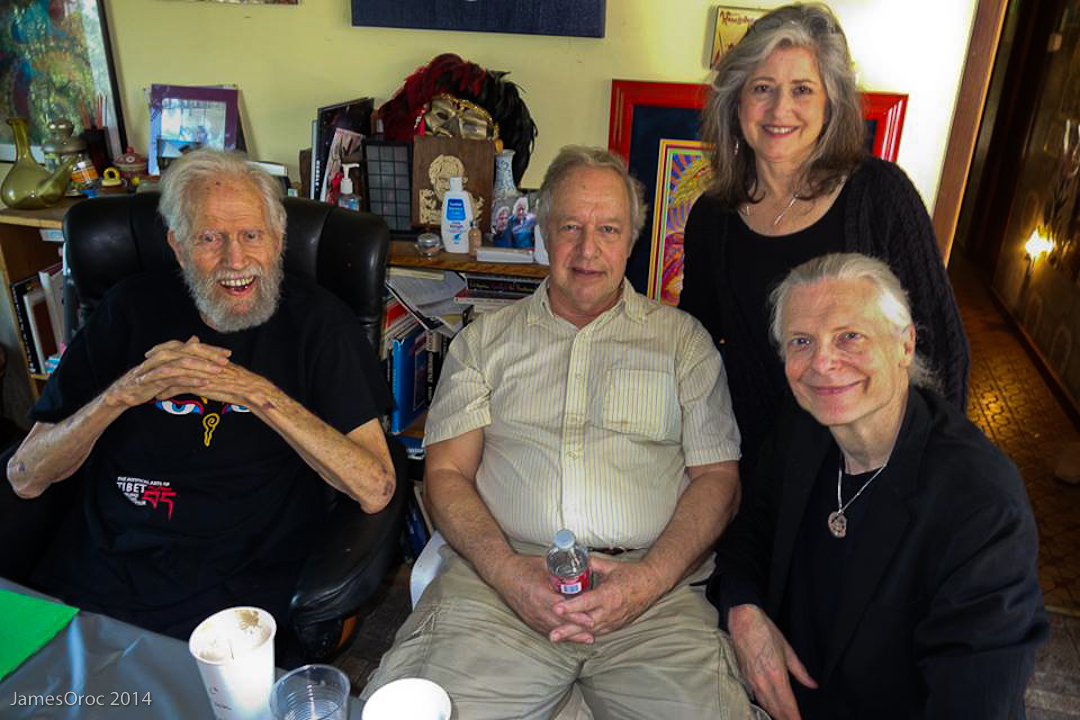
Sasha-Shulgin.-Nick-Sand-and-Alex-and-Allyson-Grey-at-the-Shulgins-last-easter-gathering.jpg


Alexander: One of the things I did was to send a score copy of the book to people within the DEA with covering phrases like, Here is a book that will provide you with a lot of information which may be useful to you.

David: What was their response to it?

Ann: They loved it. One of the higher administrators of the DEA in Washington said, My wife and I read your book and its great!

David: Sasha, how did you become a chemist?

Alexander: My doctorate is in biochemistry, but I found that it didn't have the magic and the music of chemistry. In my teaching class at Berkeley I would ask, How many people are taking organic chemistry? And you'd hear this groan. Why? Because the typical instruction would be, Go and read pages 83-117 in the textbook, and we will have a quiz on Monday. People hated it! Chemistry, however, is an art, its music, it is a style of thinking. Orbitals are for mathematicians, chemistry is for people who like to cook!

Some of my colleagues would often have a goal and if something went wrong they'd try and find out how else they could get it to go right. My argument has always been, if something went wrong, "Oh wow! Out of this will come something unexpected." That led me into a very great curiosity about the mind process, which was greatly amplified by my first mescaline experience.

Drugs do not do things, they are allowing you to do things. It is not an imposition from the outside. People tend to say, What did that drug do? or, How did the drug do what it did? or, I took a drug and it did such and such. In each instance, this is giving up your power to an inert white solid. The drug catalyzes and facilitates but it doesn't do things. That puts it in perspective. You don't have to give credit to a drug.

David: And it also encourages the person to take responsibility.

Alexander: Completely. You cant live without that.

Rebecca: Do you ever find yourself making a judgment that what you are experiencing is a quality of the drug rather than something inherent in your own psyche?

Alexander: If I do then that experience is sure to be a bummer! (laughter)

Look at yourself in the mirror, it is a good catharsis. Its me and the drug. Its a relationship which is available to everyone. Everybody has the possibility of going into some sort of ecstatic experience, at any time, without drugs, even at the grocery store. Now there's a thought! (laughter)

Ann: If this were a property of the drug, it would be the equivalent of the atom bomb! It is very useful for us that Sasha's metabolism is just about as different from mine as it could possibly be. I had a crisis week which was brought about by 40mg of something which turned out later to be absolutely inactive. That is the placebo effect, which can happen on any drug. But he has often taken a drug which he seems to have a perfectly okay time on at an active level, and I will take it and have a terrible time!

Rebecca: But haven't you found that these drugs do have a certain character to them, a tendency to bring out a particular aspect of the psyche?

Ann: The drug has a physical effect if nothing else, and how my own individual chemistry and metabolism uses that drug might be quite different than the way somebody else does it.

David: Do you think that the states of consciousness you produce with your molecules could be produced by the endogenous neurotransmitters in the brain, or are you producing states of consciousness that are unique and have never been and could never have been produced before without the drug?

Alexander: I think they are deeply embedded in the human animal.

Ann: (to David) I have a compulsion. Its a mother thing. Could you put your left foot up please? (She ties his shoelace...)
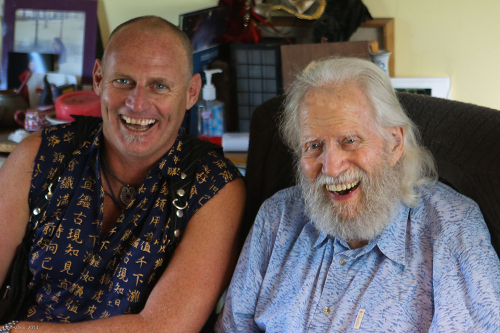
James-Oroc-and-Sasha-enjoy-a-laugh-1.jpg


Alexander: I was asked almost the same question a few years ago, so I made up a chart about telephones. The finger dial system phone can be seen as an analog of the brain. All you're doing, if you dial the number one and release it, is making one very fast break in the integrity of the system. If you dial the six and release it, it makes six breaks in the system. Then the relay gets broken three times when you dial three, two times when you dial two and then five times, and you have the number 6325. You see, you make the circuit by the number of times you break the relay. In fact, if you are very fast with your two fingers you can dial 911 by hitting the cradle, which gives you the dial tone 9 times very fast and then once and then once again.

Then you have the push button system. Every time you hit a button you are actually activating two frequencies simultaneously. They devised frequencies so that there is no harmonic interference which could give you a false signal. You are not imposing breaks in the system, you are super-imposing two non-conflicting frequencies in the system.

I look upon this as the true analog of the human brain. The numbers represent serotonin, dopamine etc. If you want a signal to come through, you get this neurotransmitter combination which combines with this and that, and the next thing you know you have a thought process and memory.

But when they designed the system, they didn't make it three by four, they made it four by four. These extra four stops have the rather unimaginative names of A, B, C and D and to operate them there is a very secret frequency of 1633 cycles per second. So if you play around with these, you get into areas you wouldn't believe! The military and deep computer language use these four additional stops. But they are not visible on your telephone.

And of course, these stops represent your psychedelic drug neurotransmitter which also gets you into weird places. All the wiring is there but you don't have access to it because 2 million years ago it got bred out of us because it didn't have survival value, in spite of what Terence McKenna says. So the wiring of the brain can use a psychedelic, but the transmitter that makes it a functional network is not available.

David: How did you first start designing drugs, and from where do the two of you draw this courage to take unknown substances into your body?

Alexander: It doesn't take that much courage. You're not foolish. You don't take a whole teaspoonful to see if you burp. (laughter) You start out with a reasonable estimate of what you think might be an effective level, and you divide that by whatever number your wisdom and judgment tells you.

David: Nonetheless, you are still venturing off into the unknown.

Alexander: Admittedly, the first time is an unknown, but you start with a level where it would be hard to believe it would have an effect. Almost never are you surprised, and when you are surprised you learn from it.

shulgin_ann_article2_1.jpg


Ann: What takes real courage is being on the street or at a Rave and somebody gives you a little packet of something, and it doesn't say what it is or how much it is.

David: Well some people would call that stupidity rather than courage.

Alexander: People call what I do stupid too. (laughter) But I know what I have; I know its purity, and I know I can take it a second time.

Rebecca: You also have a number system which helps you to measure your reaction to a drug. It certainly beats having to come up with a barrel load of adjectives to describe what is happening.

Ann: Yes, and its helpful to the research group also. Everybody knows when its not just a plus 2. Perhaps it is a plus 2.65. (laughter)

Alexander: It does have the value of being able to be applied, not only to psychedelic drugs, but to anything from stimulants to sedatives. At the first level you are aware of something going on but you are not aware of how long it goes on. At the next level you are aware how long it goes on, but you can't give a name to what is happening. At the third level, whether or not you know how long it goes on or can give a name to whats happening, you don't choose to go out and do anything else because you are not totally in command of your physical and mental capacities. Each of these levels are different degrees of acceptance of the drugs action.

Rebecca: What therapeutic value have you found for the drug MDMA, and why was it made illegal?

Ann: I worked for two years as a co-therapist with a highly trained hypnotherapist before MDMA was made illegal, but psychotherapy with any kind of psychoactive drug was still not generally accepted in the medical community. The many therapists who were using it did not publish because it was not widely known and accepted by their peers.

One of the reasons that MDMA was made Schedule I so quickly was that the DEA found it in a lab which was making something else illegal, and decided to sweep it in with the rest of the stuff. They knew nothing about it.
3c51fa3bd03017166afb3110eafdae5f.jpg


Alexander: One of the rationalizations for it having been made scheduled was that a group in Chicago were studying the effects of MDA and had found some serotonin neuron changes in experimental animals. A member of this group was on Donahue and spoke about this. Immediately they said, "Well, if that happens to MDA, MDMA has almost the same name, it is almost the same compound, maybe it would also be a negative." In the report that came out it was stated that there are a lot of similarities between the two drugs, and that was one of the rationales for immediate emergency scheduling.

David: But there actually is some evidence that MDMA causes degeneration of the dendrites.

Alexander: Yes. It is temporary. The consequence of that is not understood. It is also species-specific: monkeys do, rats do, dogs don't, mice don't and the effects in humans are unknown.

David: So it is questionable as to how accurate the spinal tap studies were which showed that there was less serotonin...

Alexander: The results are ambiguous. There were two basic studies. One of them found no measurable changes. All of these were people who were alleged to have used the drug recently, but they did not make the very necessary check to see if the drug was in the person. If not in the person, you may be looking at long-term residues of something which may not be MDMA. The other study showed no significant difference but it was suggestive. (laughter)

Rebecca: Describe to us some of the applications of MDMA.

Ann: The most valuable effect of MDMA is that it enables insight. The patient or the client may regard the possibility of having insight into himself as a very threatening thing. One of the problems that most human beings suffer from is the suspicion that the core essence of who they are deep down is a monster. There is this terrible fear that when you get down to it, the essential you is going to be discovered to be a rotten little slime-bag. (A bit strange, if you ask me. -ed)

MDMA, in some way we don't yet understand, removes that fear. It allows you not only to take a really deep look at who you are but to show you that you are a combination of angels and demons, and that theyre all valid. Apart from the removal of the fear, there is also a kind of good-humored acceptance that this drug allows you to feel. There is a validation of the self which is a miraculous and marvelous thing to experience. MDMA does not remove common sense caution, you still don't cross the road at the red light, but this deep-seated fear is gone.

It is also an extraordinary tool for discovering repressed memories. When I was doing therapy, a great many of our patients were women who were professionals in the child-abuse field. An extraordinary number of them had gone into the field not knowing that they themselves had been sexually abused as children. MDMA brought out these memories. It is a tremendous uncoverer, but with the uncovering is a gentle, compassionate validation and acceptance.

We also worked with married couples. What it seems to do with two people who are having problems is, it allows them to forget the defensiveness of, "you said that first, no I didn't," kind of thing. They can drop all that, and get hold of the feelings of love again.

One of the most moving things that happened was when Sasha and I gave MDMA to one couple who ended up holding hands again and being able to reaffirm the commitment they had. Two weeks later their older son was diagnosed with leukimia. He died four years ago. They said that if they hadn't had that day with MDMA, they didn't know if they could have supported each other through what was an extremely difficult time. One of the things I want to do in our next book, Tihkal, is to write about psychotherapy with psychedelics.
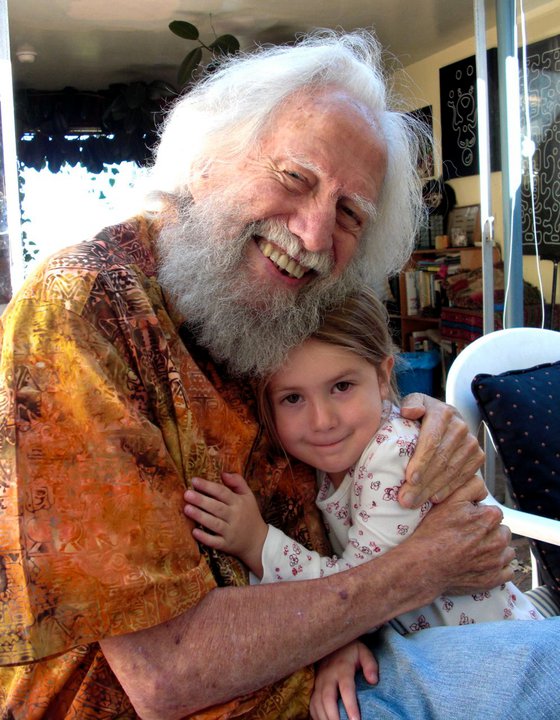
shulgin-hug.jpg


After MDMA was made illegal, all the therapists who had been using it told us they would never quit. Of course, the entire method of using it would change. They would have to know the patient for at least a year in ordinary therapy before they even mentioned it. The patient would also have to be able to deal with the fact that they would be committing a felony. Ive used the phrase that MDMA is penicillin for the soul, because that is exactly the way therapists feel about it. It is already used legally in therapeutic settings in Switzerland.

Rebecca: MDMA seems to work very differently to traditional therapeutic drugs. Thorazine is designed to suppress what is happening to the patient whereas MDMA opens it all up.

Ann: It also requires a different kind of training of the therapist. Handling one particular persons psyche for six hours is very different from fifty minutes.

Rebecca: PCP has a bad reputation because many people have become extremely violent while under its influence. Is there a drug, do you think, which could turn the Dalai Lama into a raving sociopath?

Alexander: In my case PCP didn't release any aggressive tendencies at all.

Rebecca: Why does it have this reputation then? Isn't it perhaps more likely to cause aggression than, say, marijuana?

Alexander: PCP, like Ketamine, is an anesthetic, people don't get feedback of pain. They don't know that they are exceeding their normal capacities of muscle. So the anesthetic aspects of it could allow violent behavior simply because the person may not be able to feel the consequences of their violence.

David: I spent years working in psychiatric hospitals and when somebody came in with a psychotic episode triggered by LSD (which was very rare) it was far less extreme than one triggered by PCP.

Alexander: It is an entirely different action on the nervous system. Most of the psychedelics as with most of the stimulants are usually considered sympathomimetics, they imitate the sympathetic side of the nervous system. PCP, Ketamine and Datura are parasympatholytics. Instead of actively participating in encouraging one side of the nervous system, they fail to discourage the other side of the nervous system when these two sides are in balance. Things shift in a direction either because you are pulling a certain way or else because you are releasing the restraints that keep you from going that way.

The analogy I give is in the dilation of the eye. The pupil of the eye is dilated because of two opposite things. One, you have things that are pulling it open and you have sphincter muscles that try to keep it closed. So, if you give a stimulant or a psychedelic, that activates the puller-opener mechanism and the eye dilates. The sphincter muscles are okay, they are just over-powered. If you force a light in that persons eye, you get a reflexive closing down of the pupil, and then it will open up again.

Now if you give something that craps up the sphincter muscles, like Ketamine, the eye dilates because the radials are pulling it open, and the sphincters don't have any power to keep it from happening. If you flash a light in that persons eye, it doesn't close because the mechanism that closes it doesn't work.

Rebecca: Why is it that the parasympatholytics: Datura, Belladonna, PCP and Ketamine, have this reputation for being the somewhat darker and weirder members of the psychedelic family.

Alexander: You have amnesia for what?s going on in there. There is a dream-like quality. You have an idea of what is happening but the detail is elusive.

Ann: I have never experienced what could be called an hallucination. The word hallucinogen is one we really don't like. (I very much agree with this. -ed)

Alexander: I have talked to people to whom that has happened. But the same thing can be said of finding Christ at a revival meeting. Suddenly there it was!

Ann: I have a prejudice against anything that causes amnesia. What is the point? If you can't remember, you can't learn anything!

Alexander: There was a person who was giving his impressions while on Ketamine. Just before he stopped talking entirely he said, I think I see it, I think I finally have it, in fact I know I have it, it is completely clear, its obvious? This went on for hours, and it turned out that it was the sole of someones shoe!

Ann: I like your question; is there a drug which could turn the Dalai Lama into a sociopath? I suspect that the Dalai Lama has developed his own consciousness sufficiently that he is already acquainted with this animal. So he's already made his choices. During psychedelic therapy, you eventually have to go to the monster and get to know it. The Jungians go as far as getting a good look at it and accepting that it is there. What we do is, we go into it and look out of its eyes so that we become it.

The worst terror I think a human being can experience is when he or she is facing doing that, because we are all afraid that we are going to get stuck in the demon. What you have to realize is that you have already made your choices of what side you're going to be on in this life. You have basically chosen whether you're going to be a nurturing person rather than a destroyer and soon.

Once you get inside the demon, the first thing you experience is the absolute lack of fear and then you begin to recognize that this is also the survivor aspect of yourself. There is a part that takes care of you. Then it begins to transform, and you recognize its quality of total selfishness, it is going to take care of you and nobody else, right? But it is your ally. And then you begin to recognize its positive aspects.

David: That is interesting, because part of the therapeutic process for people with multiple personality disorder involves an understanding that each personality has a particular function.

Ann: Absolutely. This is why I believe that all psychedelic use, even if its at a Rave, is part of a spiritual search. My suspicion is that psychedelics are going to be accepted, if they ever are, only when they are seen as tools for spiritual development. But the trouble is that the West basically treats the unconscious as the enemy, as if only an ax-murder will be found in there! For Gods sake, repress it! (laughter)

David: Because drug use can present serious problems, every society needs a well thought out drug policy. The American government's personification of drug users through the criminal justice system has, in the face of rational thinking, been a totally unsuccessful attempt at fighting drug abuse and has seriously eroded many of our constitutional rights. What do you see as the cause behind this zealously fought War on Drugs and what kind of drug policy do you envision for a tolerant society of the future?
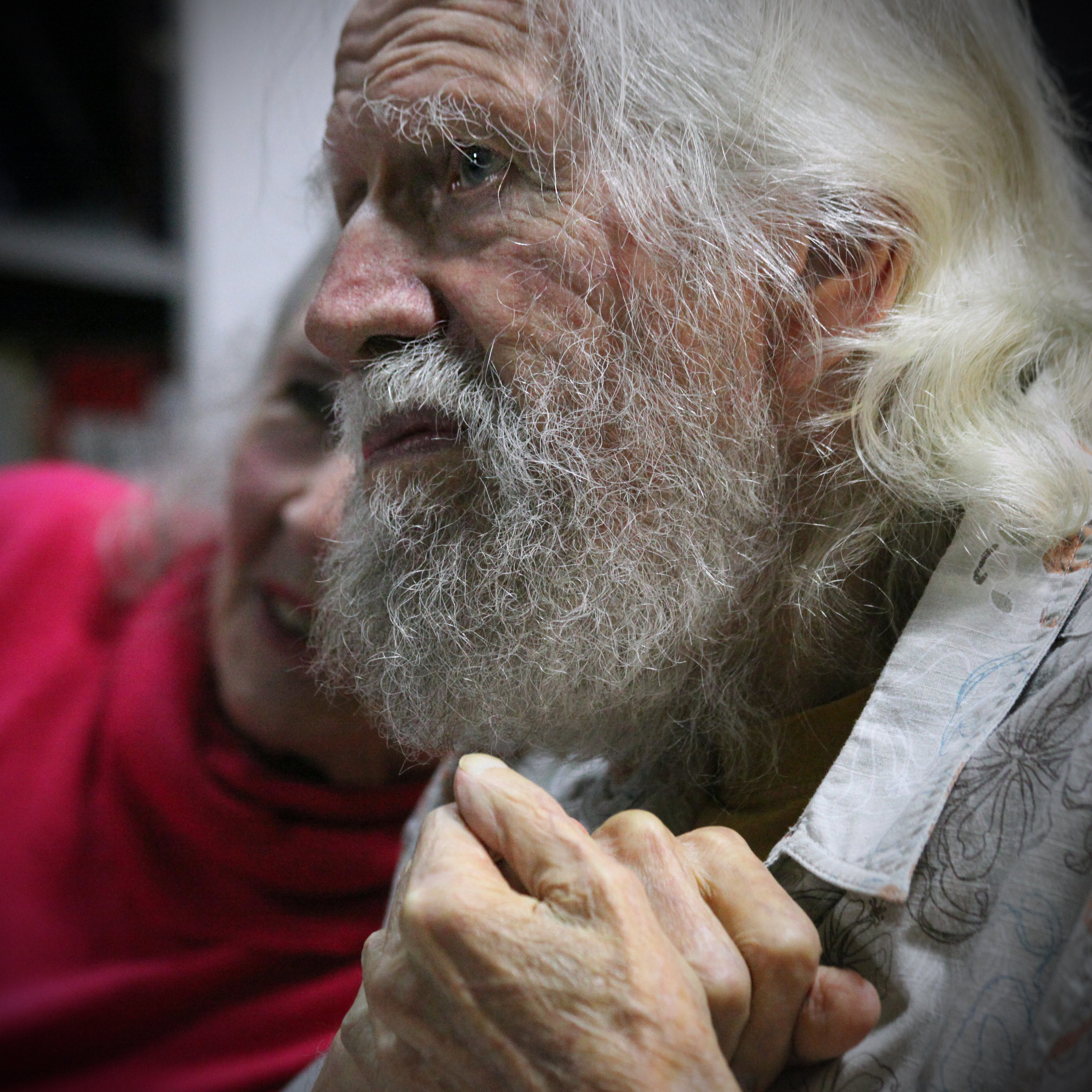
Shulgin_sasha_2011_hanna_jon.jpg


Alexander: Well two changes I see as indispensable. One is the laws will have to change and that is going to require the other part which is honest education and distribution of information about drugs and their actions. The way the term abuse is used nowadays is that it means any use of a drug which you don't approve of.

David: For a long time I thought all drugs should be legal and available to everybody until I read Mark Kleiman's book Against Excess. The cost of drug abuse to the taxpayer is a point he brings up.

Alexander: Well if someone has a drug abuse problem and he requires medical treatment, is that worse than having a drug abuse problem and being in prison, which also puts as strain on the tax-system? One of the reasons you can't rationally pin-point harm reduction is because you cannot measure harm. What is the harm of a person using a drug which is not approved of by society? To one person, trivial, to another person who's son has just died from an over-dose, immense.

So you cant put a quantitative value on harm. Also, if you want to reduce harm (and this is the argument for the Drug War), you cant put a number on the reduction. Lastly, the thing you do to reduce harm, itself does harm. If you remove drug laws you have ten thousand unemployed law-enforcement people, and they are going to see that in an entirely different light. On the other hand, they passed a law in Florida that if you are on welfare and you go into prenatal care and test positive for illegal drugs in your urine, you may suffer the confiscation of your child. A woman, instead of facing the possible loss of her child, just won't go in for the prenatal exam. What is the harm? You can't calculate it.

What would be the damage to society from changing the drug laws? If you look at it through one lens you can see that it is going to be horrendous, and if you look through another lens you can see that it is going to be a lifesaver.

Rebecca: I was in a hardware store and there was this big sign up which read, We ensure that our employees are tested for drugs. A strong 1984 feeling came over me. What do you think about urine tests?

Alexander: It is intolerable! There is no basis for a urine test unless there's a reason to believe that a person is incompetent in some way.

David: Even then you should measure their performance, not her urine.

Alexander: Exactly. If you run a bus into a group of pedestrians, and you stagger off the bus and go into the nearest bar for a drink, there may possibly be reason for a urine test. If a person is going to fly an airplane, and before he boards the plane you take a sample of his urine and send it off to Florida for analysis, it doesn't protect the people on that flight at all!

You have no protection even today for the presumption of innocence. That does not exist in the constitution. Taking of a urine sample is a presumption of guilt.

Rebecca: The drug laws haven't changed anything in the constitution, so why are we all getting this nasty feeling that our constitutional rights are being eaten away?

Alexander: Its how they are being interpreted. The perversion of the laws which were written with good intent but which have been allowed to be eroded is something which the constitution can?t even touch. I can show you the original writings of the social security law which says that your social security number should remain private.

The original laws of income tax documents say that your submission of an income tax form to the federal government shall be a private correspondence. Needless to say, that has been scrapped. You now have to get a fingerprint to obtain a drivers license, but California State Law states that a fingerprint serves one function only, to identify a person in the conjunction with a criminal charge. The measures which they can go to is frightening.

Rebecca: You talked in Pihkal about how racism has been one of the root causes of prejudice against various drugs.

Alexander: Right. The connection between racism and drugs started in the public consciousness with the building of the Trans-Continental Railway. To save on labor costs we hired Chinese immigrants and they brought with them the practice of opium-use. More and more regulations were put into place to limit and control access to opium which was soon considered a social evil. The marijuana laws were put into effect to control Mexicans coming over the border, and cocaine is nowadays very much associated with blacks in the inner cities.

Rebecca: What benefits have you both received from taking psychedelic substances?

Alexander: I think I have learned about myself a little more thoroughly from the inside out and I have learned to take myself a little less seriously. I have also learned not to take anything I hear as gospel, even if I say it myself! (laughter)

Ann: Psychedelics have allowed me not only to explore myself and my own levels of consciousness to an extraordinary extent, but by doing so I feel that I am beginning to understand what the human consciousness is. I also have a compulsion to understand what the universal consciousness is, lets aim as high as we can! (laughter) The exploration is never dull.

There are so many kinds of knowing, and the kinds of knowing that have the most impact are unexplainable. But I like to try to put into words the incomprehensible things that I find. These same experiences are in everybody's psyche, so if I find the right words I may be able to elicit some sort of response from the unconscious of the reader, and perhaps encourage people to be less afraid of understanding themselves.

Rebecca: What would you say to someone who suggested that drug use was simply a form of escapism?

Ann: It is amazing to me that people use the term escape in association with psychedelics. I have found them to be the most incredibly hard work, and Ive never escaped with any psychedelic experience.

Alexander: The same thing could be said about going to a symphony orchestra and listening to concerts or going to church. These could also be looked upon as escape.

Ann: The fact that we use the word escape that way, implies that everybody in this culture regards what they call reality as a grim and miserable thing.

Alexander: Eu as a prefix means normal. Euthyroid means you have a normal thyroid function. The word euphoria means that this is the way you should feel. If you don't feel the way you should feel, that would be dysphoric.

Ann: This culture regards a state of euphoria as something abnormal!

Rebecca: Have either of you had to face the problem of addiction?

Alexander: I have with nicotine, but not with any of the other substances I have used.
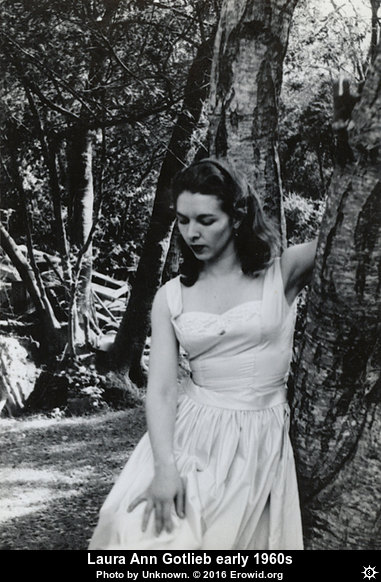
shulgin_ann_white_dress__i2015e0181_disp.jpg


Ann: The whole idea of using psychedelics is to train yourself to a different kind of perception which you should be able to use without drugs. Most spiritual teachers say that you should develop the altered states in a natural way and not use drugs to do it. Sasha says that is the equivalent of saying you should never go to a symphony or listen to a recording. You should produce the music yourself and you should not use any other tools besides your own body.

Well heck! Life is made interesting by giving yourself different forms. Yes, it is wonderful to sing and play the flute yourself, but it is also wonderful to go to a symphony.

Rebecca: You do need to be disciplined and motivated to reproduce that state when you are not on the drug.

Ann: Right. You must have an incentive to develop your own abilities. Insight is something which Ive found can be learned. You can learn to observe your own thoughts. You begin to get a different relationship to time, to yourself, and to the mayfly. These things don't need drugs, but drugs can show you where you can go.

Rebecca: Although you both believe strongly in legalization, you do think that some guidelines must be established for drug use?

Alexander: Absolutely. Giving a drug to a person who is not developed enough to use it in the opinion of people who have worked with it, giving a drug without consent, giving out false information about a drug, all these need to be controlled.

Ann: I like to make the rather obvious comparison of psychedelics with sex. Nobody in their right mind would say that sex is bad for us, but no one would advise someone under a certain age to try it! There is a certain stage of growth you need to go through before you are ready for either.

David: Terence McKenna claims that there is a spirit or a conscious intelligence that dwells within certain psychedelic plants. In Pihkal, you discuss how at times you felt the presence of some entity or force guiding your work. Do you see this as being related to what Terence has claimed and how do you explain this phenomena?

Alexander: I think this is like the intuitive going through a darkroom without lights on and being able to find the door. You don't see in the dark and yet you know there's a door there. As you get more and more experienced at working with plants or working in the laboratory and designing new structures, you get more of a feel for why they are and what they are.

One of the beauties of organic chemistry is that you cannot make a relationship between a continuing change here and a continuing result there. You cannot extrapolate from one molecule to another with any more confidence than you can extrapolate from one plant to another. So you begin to assign certain characteristics to what you are working with. Is this talking to leprechauns? No. But it has the smell of that. (laughter)

Ann: I think that there are forms of energy that some people see as elves or fairies. Whether they see these or not seems to depend more on whether the culture they live in allows for seeing such things. The Irish are famous for it. Is this because a certain kind of energy associated with natural things is translating itself telepathically into an acceptable form for the human who is looking at it? It is an open question.

Alexander: How do you discover the action of a molecule? A molecule when its hatched is like a baby. There/s no personality there. As the baby develops, your relationship to the baby develops, and eventually it forms into something of its own shape and character.

The first time I made MDOH I distilled it as I like to do before I make the salt. I found that it began a threshold activity at around 80mg, but I didn't know that something was amiss. I ran some tests and discovered that when I did the distillation of MDOH I had gotten it sufficiently hot to split up the hydroxy group. I had made a mixture of the base without the hydroxy group which had gone on to the MDOH and become an oxine. The material I was left with was MDA. So I had accidentally rediscovered the property of MDA.

I went back and made MDOH again keeping the vacuum temperature down, and I came out of it with a brand new compound that I never would have made before. So from a divorced position I had to come back and reinstitute a rapport because the material I had thought I had met, I had not met. You don't discover these things, you interact and develop them together. If you want to incarnate elves into the materials, thats fine, but either way, its a relationship.

Rebecca: That sounds very similar to the way alchemists viewed their work.

Alexander: Very much so. I was listening to Terence McKenna years ago at Esalen. He was talking about how if a drug comes from nature its okay, but if it comes from a lab it is suspect. Suddenly he realized that I was sitting in the audience. (laughter) In essence I said, Terence, I am as natural as they come. To me it is not any different making a chemical in the laboratory that's new - that you can get to learn and interact with - than it is interacting with a plant.

David: As John Lilly said, "Plants are chemists, too."

Ann: Exactly, and some of them will kill you. Just because its natural doesn't mean its benign.

Alexander: I have studied alchemy a bit and it is very much about feedback. Who cares if you melt and fuse lead ten thousand times? At the end of it, you don't come out with anything but ten thousand times melted and fused lead! But the doing of it, that is meditation.

David: Do you see a relationship between alchemy and shamanism?

Alexander: Yes. They are both teachers. A shaman is a person who allows you to be healed by the interaction with himself, and alchemy is the same way.

Rebecca: Rupert Sheldrake proposes the idea that the characteristics of a compound develop through time creating a morphic field which influences all similar forms. Because of this idea, people like Terence McKenna suggest that newly developed drugs are soulless compared to something like psilocybin which has been used by shamans probably for thousands of years. How do you respond to this?

Ann: Thats like saying a newborn baby is soulless. There is a soul there, it just has to learn to relate.

Alexander: Initially I had a scientific reluctance to Rupert's theory, but Ive seen how he does it, and Ive grown to like the idea. He has complete candidness and honesty. He is trying to find things that don't fit into his theory, and that I like.

Rebecca: Have you experienced parallel discovery?

Alexander: Secrecy is anathema. Everything you do you share. But I remember the first time I got into sulfur. Nothing was going right, just black tars and terrible smells. I was working with a person in Indiana along the same lines, and about the same time we both developed separate psychedelics. It was almost as if the stars had aligned.

Rebecca: Both of you emphasize an omnijective view of reality rather than a strictly objective or subjective view.

Alexander: I am reading a marvelous book at the moment which talks about how up to the time of Galileo there was a complete synthesis of religious orthodoxy and science because it was part and parcel of the church. They broke apart because of Galileo and Copernicus contributions, and in a sense we have reconverged back to a synthesis of Genesis and the Big Bang, to a dogma which everyone takes on faith. And you don't allow the slightest challenge!

Rebecca: I interviewed the head of the Flat Earth Society, and I found it very liberating to allow myself to question something so engrained as the roundness of the earth! (laughter) In your book you both describe many mind-expanding experiences when you developed a sensitivity to the sacred life-forces. With this consciousness in mind, how do you feel about the practice of vivisection?

Alexander: I believe there are times when it is necessary. I used to do all my studies on rats and dogs but I wasn't learning enough to justify it so I stopped entirely. I think if it is possible to extend a persons life at the expense of an animal, then I think it is justified. Until recently, pigs were essential to maintain the life of people with diabetes. If you were a total vegetarian, would raising pigs to obtain insulin be justified to protect the lives of people who have diabetes?

Rebecca: No, it wouldn't. I know of a woman who claims to control her diabetes without insulin by eating something called bitter melon, which is native to Sri Lanka. There is much evidence to suggest that there is a vast reservoir of untapped medical lore and resources on the earth.

Ann: One of Lauren Van der Post books is about a race of pygmies in Africa. Before they kill an animal, they send out a deep thanks and gratitude to it asking to be forgiven for the fact that they are going to kill it. In a sense they enter an emotional contract with that animal. My feeling is that animal experimentation is necessary in this culture but I would pass a law that the only people allowed to work with animals in a laboratory would be those who love animals. If you love an animal, you are not going to be able to stand giving it pain.

In laboratories people are encouraged to not form any kind of attachment to the animals they are using. I think the opposite should be the case. Using an animals pain to develop cosmetics is inexcusable, but when it is to saving lives, I think that is a different question. I believe the whole environmental movement started with the taking of psychedelics in the 60s, because the first experience that everyone has is the oneness of nature.

Rebecca: Do you believe that there might be a teleological reason for why psychedelics exist?

Ann: Sure. How on earth did anyone ever discover the psychedelic properties of the peyote cactus or something that's only active as a snuff? Have you ever tasted peyote? Your instinct says, that's poisonous! Considering the fact that we create consensual reality, some part of us may have assigned certain plants the ability to open those doors.

Alexander: The evolution of the animal and plant kingdoms seem to be complementary to one another, but whereas you have the origin of the human in the Old World, 90 percent of psychedelic plants have been seen natively only in the New World. It is certainly not from a lack of diligence in searching for them! (laughter)

Rebecca: That is interesting. What procedures do you use when testing out a new drug and what do you do if everyone's experience is different?

Alexander: When I test a new drug on myself, I use extremely small levels with much space between each time to eliminate the effects of tolerance. When I get up to a level that I feel comfortable with, Ann and I share it and see if indeed we have the same responses. Then we introduce it to individuals within the research group.

We often find that some of the materials have radically different responses within the group. I had to abandon a whole family of compounds which I called the Alephs, because they were too erratic. Someone would have an over-stimulating experience on 2 mg and someone right next to them on 7 mg would experience nothing at all! We also have the occasional idiosyncratic difference from day to day of one person to one chemical.

TMA6 was a compound I had worked on and abandoned because it was not that interesting. We were exploring it because it was an opening to a new family of compounds. It was clearly active. You knew you were in an altered place, but you couldn't give it a name or a character. There were no visuals and no time distortion, nothing. So we threw it open to the group, and we were all up against the wall! When I went to take a pee in the bathroom, the wallpaper came out and shook hands! (laughter) Everyone had an intense experience.

Ann: Sasha goes through the boring stuff, tiny bits increased very gradually over weeks and weeks. I come in at the exciting point. (laughter) There are certain things that if we find, we don't pursue use of the substance. For example, if my emotions are flattened, its an absolute no-no to go on with it. Also, if we are not interested in touching each other, then there is something wrong. Also, of course, you learn to spot signs of impending nervous system trouble, like the possibility of a convulsion.

Alexander: Its like soldiers marching across the bridge. If you break step, youre not going to have the rest of the bridge getting to some resonance which could lead to a catastrophic event. You search out your thought patterns and abort them before they come to any consequence. Then you start another thought pattern and stop it. If you don't let things consummate, that diffuses things, and pretty soon you realize that its not necessary any more. The other answer is phenobarb which is much easier. (laughter)

Ann: The group doesn't get any of these things until we've gone up to a plus 3 and usually beyond that to the point where its too much.

So we know for sure that it is not going to attack our nervous systems.

David: What are some of the basic guidelines that you would recommend to an individual who was experimenting with psychedelics?

Alexander: Learn everything you can about the material and stay away from all information that is clearly geared to encourage or discourage its use.

Ann: Doing your first experience with a very trusted friend who has taken this substance before is very important. That sort of companionship can turn a very bad trip into a very good learning experience. Your psyche is very eager to have you learn things, and if you can develop an acceptance and a calmness, you can overcome a lot.

David: What type of drugs do you see being developed in the future, and how do you see pharmacological tools being used to expand potential in the areas of creativity, intelligence and spiritual understanding?

Alexander: In this direction I think anything that the human is capable of doing through the mind is duplicable pharmacologically, it is all chemistry upstairs. I think anything from insight to paranoia, to joy to fear, can all be reproduced chemically.

The fact that there are specific receptor sites for specific materials in the body which duplicate the actions of drugs from outside the body implies that those receptor sites at which these drugs operate are there because the human produces one for that same purpose.

Ann: I think that depending on the way you interact with any particular psychedelic, creativity and imagination can arise. Basically you are giving yourself permission to use these powers. I can't see a particularly creative psychedelic.

David: But they may be developed with more specificity. You developed a drug whose only property was to create auditory distortion.

Alexander: Right, that is a good example. I am intrigued by that one because most of the spontaneous schizophrenic states have auditory rather than visual components. If there is a physical correlate to schizophrenia you could deposit this material in a person and see where it accumulates. You could play strange noises and see if it accumulated faster or slower.

Rebecca: How many psychedelics have you synthesized?

Alexander: Around 100.

Rebecca: And how many of those are illegal?

Alexander: About fifteen. The analog law will label a drug illegal on the grounds of it being substantially similar to an already existing illegal drug. I was once asked in a drug case down south if two drugs were substantially similar. I said that the question had no meaning. The chemist, who came from the Ventura County crime lab, said that two things are substantially similar if they are over fifty percent identical. I just abandoned ship at that point. Its a lot of gibberish!

David: How has your relationship influenced your psychedelic journeys?

Ann: If you are going to do psychedelic exploring, the ideal is to have a partner who is on the same wavelength. There is, needless to say, a certain amount of vulnerability when you take these substances, and you have to totally trust the other person. The only disadvantage is that I suspect we pick up each others responses a little faster than we should.

Alexander: I had one experience that really startled me. I got up in the morning and went to wash the dishes from the night before, and I realized I was not at baseline. It was nice, but I was wondering, What caused this? Sasha came in, and I was wondering if I should say anything to him when he came up with the information that he had taken a sample of a new drug that morning!

David: Do you think you might have been exuding pheromones, which the other person was picking up?

Alexander: That is possible, but you are normally unaware of the extraordinary vocabulary of body language. Just the way people carry themselves, or the way they respond to a stimulus can give them away. And if Ann is washing dishes, I know we have a problem. (laughter)

David: What projects are you currently working on?

Alexander: Tryptamines. (laughter)

http://www.mavericksofthemind.com/shu-int.htm
 
Last edited:

Shulgin-Book-Review-1.png


On Drugs, Freedom, and Human Nature: A Course with Alexander Shulgin


by Ryan Greendyk | LUCID News | 17 Aug 2021

Alexander “Sasha” Shulgin is (in)famous for his synthesis of over two hundred novel psychedelic compounds. For fifty years, he avoided the undue influence of public and private sponsorship by carrying out his modern-day alchemy in a weathered and ivy-draped shed on the Shulgin family farm.

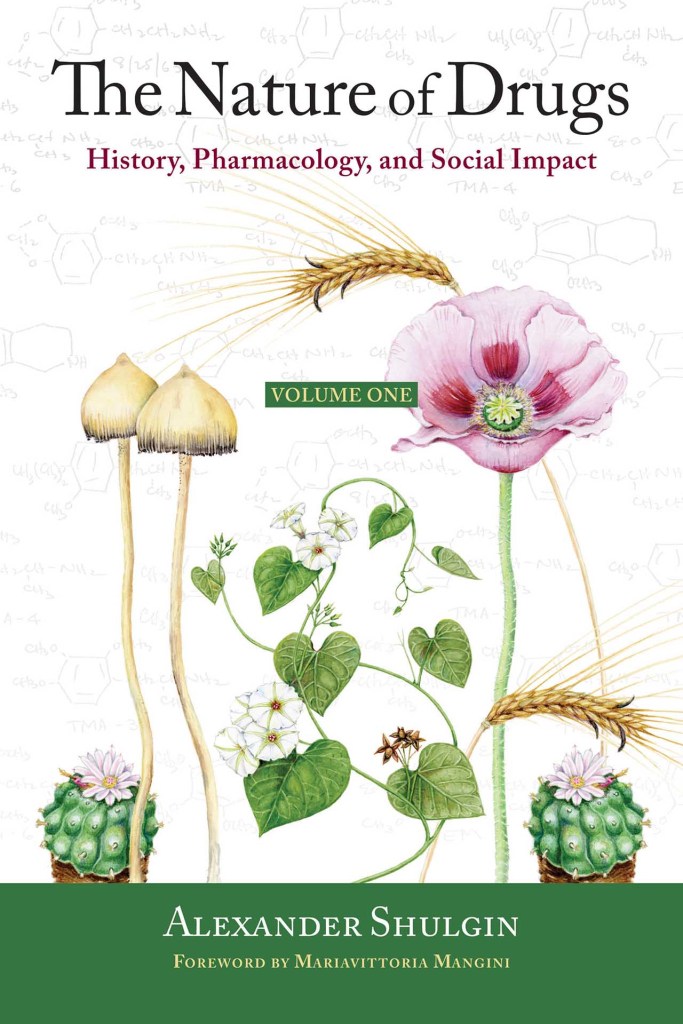
To preserve his independence, Shulgin supported himself by teaching, lecturing, and consulting. The Nature of Drugs: History, Pharmacology, and Social Impact presents the first semester transcripts of a pharmacology course Shulgin taught at San Francisco State University in 1987. The book is the first publication of his work in a decade, following Volume 1 of The Shulgin Index (2011) and The Simple Plant Isoquinolines (2002). These invaluable reference guides are, admittedly, rather impenetrable to the layperson, and offer little insight into Shulgin’s life and personality.

The Nature of Drugs marks a return to the merging of hard science and impassioned storytelling that made PiHKAL and TiHKAL so beloved to the psychedelic community. Shulgin’s personality is on full display in these lectures; he is always excited, taken by wonder, quick to share personal insights, and endlessly encouraging of his students’ own process of inquiry. Nearly every page is a treasure trove of fascinating facts and stories. Ann Shulgin is present in the class too; throughout the lectures, she chimes in with perfect questions to guide Shulgin’s teaching.​


Nature-of-Drugs.jpeg


The academic simplicity of the book’s title is deceptive. “Nature,” for Shulgin, means more than physiology and chemistry. His story of drugs, accordingly, takes the reader on a whirlwind journey through history, myth, anthropology, sociology, alchemy, medicine, politics, and law, as well as the far-flung corners of Shulgin’s own (very eventful) life.

Shulgin has a mythic way of teaching. In his hands, empirical science approaches pre-modern natural philosophy. He was clearly a gifted chemist, but refused to let his specialized knowledge get in the way of the Big Questions. His one-of-a-kind pedagogy makes this book far more than just a pharmacology primer (though it serves this purpose quite well too).

The straightforward task of defining what a drug is—a question he introduces in the first lecture, and to which he circuitously returns throughout the book—provides ample opportunity for what Shulgin calls his “manic extensions and examples.” He relates a practice from the Fore people in New Guinea, for example, who leave a carved piece of bamboo filled with ash and soil in front of a person’s door who has been condemned to death. The person dies shortly after simply seeing the bamboo, with no associated physical contact, usually within twenty-four hours.

The bamboo exerts no direct pharmacodynamic effect. Nevertheless, Shulgin insists that the piece of bamboo should be classified as a drug, since it “modifies the expected state of a living thing.” Ever the rational scientist, though, he assures his students that this ritual bamboo is also classified as a drug by the Goodman and Gilman Pharmacopeia, one of the pharmaceutical standards of medical practice today.

While covering the origin of drugs in Lecture 3 (the transcript of Lecture 2 is missing), Shulgin again takes the scenic route, beginning from the dawn of humankind and proceeding dreamily down through history. He speaks of the discovery of altered states, the societal role of the shaman, the aboriginal Dreamtime, Dark Age alchemy and the “demons of disease,” the rise of modern medicine, and the subsequent criminalization of drugs. Instead of devaluing earlier historical stages as primitive precursors of science, he allows the mythic and the rational to coexist. He emphasizes his point by telling stories of ancient man in the present tense, and confides that he often uses the old alchemical names for chemicals in his own laboratory.

Throughout the book’s lectures, Shulgin clearly and boldly states his opposition to draconic drug policy, especially that which is used as a tool for discriminatory social control and the curtailment of civil rights. The book provides a comprehensive timeline of drug policy and enforcement, taking the opportunity to lament the losses of personal freedom along the way, from The Harrison Act of 1914, which controlled drugs as taxable commodities and “established the flavor of the laws against drugs that persisted for fifty-five years,” to the 1920s, when the misuse of drugs (i.e. addiction) was considered an inherently criminal act, and The Controlled Substances Act of 1970, which enacted the drug enforcement framework that is still in place today.​


shulgin_alexander_square.jpg


Shulgin emphasizes how the legislation of the 1970s and 1980s led to unprecedented limitations of civil liberties, all in the name of drug control. For the first time in US history, the Controlled Substances Act allowed for criminal forfeiture of personal property (which was specifically prohibited by the first US Congress in 1790). 1982 brought similar milestones: the Defense Authorization Act marked the first allowance of military involvement in civil law enforcement, and the Tax Equity and Fiscal Responsibility Law removed all previous restrictions on tax record access during the prosecution of drug cases. Shulgin calls the 1986 Controlled Substance Analogues Act (the most recent drug policy legislation at the time of these lectures) “one of the most freedom restricting things that has ever been put into law.”

The middle portion of the book covers “the body’s plumbing and wiring” and “drug action.” These lectures feel most like a pharmacology course, but Shulgin’s teaching style is lucid, easygoing, and entertaining, even as chemical and anatomical terminology begins to pile up. He gives clear definitions in layman’s terms, and frequently provides analogies, metaphors, and mnemonics to facilitate comprehension.

Shulgin repeatedly tells his students to minimize neurotic notetaking and instead to listen to the “music” of his talks. It is Shulgin’s storyteller cadence that gives even his most technical lectures this musical quality—the way he returns to the same themes and terms, recapitulating them in different ways, weaving students’ questions together with personal stories and real-world examples.

While comparing fast-absorbing vs. slow-absorbing routes of drug administration, he detours into the “mystique of drug use” with reflections on indigenous snuff ceremonies and the “needle play” rituals of heroin addicts. A discussion of vaccines and other preventative prophylactics leads to an embryology tangent, a critique of “woefully inadequate” drug education (with inevitable comparisons to abstinence-only sex education), and a deconstruction of anti-drug propaganda.

Caveats are offered to basic assumptions of anatomy (e.g. Shulgin says it is “nonsense” that we cannot control our autonomic nervous system, and tells the story of teaching his ex-wife how to control her blood pressure with directed attention). He situates the dry details of pharmacology in the practical contexts of medicine, politics, and sociology, which highlights their significance while making them easier to learn.

The seventh lecture, on memory and states of consciousness, again offers a predictably wide range for Shulgin to roam. He shares stories from his time in the Navy during World War II, debates working definitions of consciousness with his students, and explores the nature of non-physical therapeutic interventions. One “manic extension” is dedicated to Franz Mesmer, whose animal magnetism realignment methods offered more effective and long-lasting pain relief than any available drugs of the time. Rather than dismissing Mesmer as a pseudoscientific quack, Shulgin acknowledges the efficacy of his methods and calls him “a true magician in his own way.”

In stream-of-consciousness fashion, Shulgin then moves seamlessly through hypnosis, brainwashing, paranoid delusions, and the dangers of defining mental illness with biochemical markers. He exposes the limitations of the biochemical hypothesis of schizophrenia, and in turn offers sage advice for budding scientists: “Do not fall in love with the hypothetical."

This mode of inquiry is continued in the final lecture, which covers Shulgin’s principles and critiques of research. His invaluable perspective on proper research methodology is all about questions, and how to ask them. Shulgin highlights the main pitfalls of scientific research (which are arguably as prevalent today as they were in 1987), and affirms an often compromised principle of the scientific method: “No number of successful experiments can ever prove something, but one unsuccessful experiment can totally disprove something.”

This careful inquiry has an important undercurrent: the real-world consequences of drug policy. Shulgin returns again and again to drug identification and criminal drug testing as subtle examples of unprovable hypotheses. Early in the lecture, he claims that the question “Is a person under the influence of a drug?” is nearly as unanswerable as “Is there a God?” In this manner, Shulgin suggests a rationally sound connection between the scientific method (rightly practiced) and the primacy of personal freedom. Drug policy, rightly enacted, would reflect these principles of rational inquiry and civil liberty.

“Choice,” Shulgin tells his students, “must be demanded by each of us continuously as a personal liberty.”

Shulgin openly shares this perspective amidst all the controversy of late-1980s drug war hysteria. At the time of these lectures, the illegalization of MDMA was one of its still-recent consequences. Shulgin was already well-known by this time as the “rediscoverer” of the compound, which was first synthesized at Merck in 1912 but soon forgotten. Shulgin tested the compound on himself, with profound results, so he sung the compound’s praises to friends practicing in the 1970s underground LSD psychotherapy scene. Within a few years, thanks in large part to Leo Zaff—the “Johnny Appleseed of MDMA”—thousands of trained MDMA-assisted psychotherapists were treating as many as 200,000 patients. Shulgin vehemently opposed the DEA’s decision to criminalize MDMA, but predicted that one day, the therapeutic value of this and other psychedelic compounds would be recognized.

It seems a fitting tribute to Shulgin’s (ever-expanding) legacy that the publication of The Nature of Drugs coincides with Phase 3 trials for MDMA-assisted psychotherapy in the treatment of PTSD. As the current psychedelic renaissance gains momentum, Shulgin’s compassionate, rational truth-seeking remains relevant and inspiring. His voice is alive in these pages, making pharmacology fun, and reminding us to root all our inquiries in freedom, self-understanding, and wonder.​
 
BS.jpg


The Last Interview with Alexander Shulgin

by Hamilton Morris, Ash Smith | VICE | 1 May 2010

I love Alexander Shulgin. I’ve loved him from the first moment I read about him. He is my idol, my hero, my sun, my O2. I love each of the 978 pages of his phenethylamine magnum opus, PiHKAL ~ Phenethylamines I Have Known and Loved, and every milligram of his 1.13-kilogram tryptamine treatise, TiHKAL~ Tryptamines I Have Known and Loved.

Shulgin is the grandfather of Ecstasy, the molecular magician, the atomic conquistador. Over the span of 50 years he has created more new psychedelic drugs than the Amazon jungle ever has. He is more of a mythological creature, a chemical centaur, than he is a real person. But he does exist, as I am about to attest.

After years of preparation I called the Shulgin residence, ostensibly for an interview. It was the sort of call that you prepare for by jotting down an index card’s worth of dialogue. The type of event that requires careful pre-call meditative deep breathing, positive affirmation, autohypnotic closed-eye success visualizations, and as many as five throat clears. I somehow managed to dial the number and, while I listened to the ring-back chirp two-second bursts of perfectly overlapping sinusoidal waves followed by four-second stretches of exophthalmic silence and yet another sinusoidal ring-back tone, my nose actually began to bleed with anticipation. The call was answered by Ann.

We had a conversation; she called me “honey,” which I enjoyed tremendously, and unexpectedly had a New Zealand accent. Ann told me that Sasha (Shulgin’s friends call him this) no longer grants interviews—he’s conserving his limited energy to finish his last book and work in the lab. After hearing this, I carefully explained that I did not specifically require an interview. I just wanted a meeting, an informal conversation. Eventually it was decided that I could visit for a few hours before an electrocardiogram appointment. She reminded me that he really does not give interviews anymore and if my meeting with him were to turn into one, it would be his last. I was elated.

Although Alexander Shulgin is not exactly a household name, he is unquestionably the most important psychedelic chemist who has ever lived. Those who do know of him are usually only familiar with his role in the rediscovery and popularization of MDMA. But MDMA is just one of 100-plus unique chemicals that compose Shulgin’s pharmacopeia, which extends so far into the unknown that he often has to invent new terms to describe the effects (“eye romp” is one of my favorites). The drugs are selective auditory and tactile hallucinogens, psychedelics that dilate time or send the user into a state of amnesiac confusion, antidepressants, aphrodisiacs, stimulants, empathogens, entactogens, neurotoxins, and at least one very profitable insecticide. They are also some of the most valuable medicines known to man, and although only a fraction of them have been formally studied, they are the best tools we have for understanding the chemical composition of the human mind.

Shulgin’s career started at the Dow Chemical Company, where he made a name for himself synthesizing Zectran, the first biodegradable insecticide. After this success he was given freedom to work on chemicals of his choosing. He chose psychedelics and went on to create an amphetamine called DOM, which at the time was second only to LSD in potency. A single large dose could last a solid 48 hours. In 1967, Brooklynite chemist Nick Sand realized the drug’s market potential. He built an industrial laboratory in San Francisco where he cooked DOM in a 150-gallon soup vessel and sold it by the kilo to the Hells Angels, who rode across America unleashing tens of thousands of excessively potent 20-mg DOM tablets on the public. The influx caused hordes of hippies to freak out at the Golden Gate Park Human Be-In.

Meanwhile, less than a block from Tompkins Square Park, the NYPD busted down the door of a psychedelic chapel called the Church of the Mystifying Elation in an early-morning raid. Police seized $8 million worth of psychedelics, including 1,500 doses of DOM, two marijuana plants, and “numerous mattresses.” Stories of emergency-room DOM freak-outs abounded in the press; one user in Manhattan ingested a dose and ritualistically performed seppuku, disemboweling himself with a samurai sword on Mother’s Day. At this point the drug was still largely unidentified and was reported in the New York Times to be a relative of a secret military to be a relative of a secret military nerve gas or as the “caviar of psychedelic drugs.” Eventually it was realized that DOM was the product of legitimate pharmaceutical research conducted by a then-unnamed chemist at Dow. Unsurprisingly, this made Dow very unhappy. Once the source was identified, Shulgin’s ties to the company were severed.

Free from Dow, Shulgin set up a personal laboratory in his backyard and began researching drugs with complete independence and with the realization that the chemicals he created had the potential to find their way into the heads of at least 1 million people. He tested each new compound personally and, if he deemed it worthy, on his wife and friends, with a special emphasis on the sex-enhancing properties of psychedelics (or as he calls it, “the erotic”). Over the course of 50 years, he completed the most exhaustive examination of psychedelic structures ever accomplished and manufactured an array of drugs that rivals the output of many large pharmaceutical companies. All the while he has maintained his sanity and gentlemanly composure by playing the viola, teaching university classes, and attending elite soirees at Bohemian Grove.
-----------------------------------

When I arrived at Shulgin’s home in Lafayette, California, he was peacefully sitting at the kitchen table. I walked through the sliding glass door, greeted him, and then embraced him, which produced a euphoria far greater than that of MDMA and a time dilation more profound than the effects of 2C-T-4. We disengaged and, without pause, he began to riddle me:

“Can you name the two words in the English language that begin with two consecutive a’s?”

I thought for a moment before answering, “Aardvark is one…”

“Yes, good, and the other?”

“I don’t know, I can’t think of another.”


He bent down his head and said in a low whisper, “Aardwolf."

“Aardwolf?”
I asked, and with that he had already risen from his chair and shuffled into the hallway to retrieve a giant yellow dictionary, which he dropped onto the kitchen table and pushed toward me. Sure enough, it’s there, and on his prompt I read the definition aloud:

aard·wolf -'wu·lf n, pl aard·wolves ·-lvz [Affric, fr. aard earth + wolf; akin to OE wolf wolf–more at WOLF]
1. a hyenalike quadruped of South Africa having a striped coat, five-toed forefeet, and a distinct mane, feeds chiefly on carrion and insects (as termites), and is usu. placed in the Hyaenidae though formerly separated in another family (Protelidae).
2. an (extremely) unexpected nonpsychedelic-related thing.

“OK,” Shulgin said, satisfied. “We’ve solved that problem. But now, for example, do you know what a lowena is?”

“No, what’s that?”
I asked credulously.

“It’s the opposite of a highena.”

“Aha!”
I changed the subject. “I brought you a peach pie. Would you like a slice?”

He answered the question with another question: “How many numbers are to the right of the decimal point in π?”

“Just one.”
I had nervously confused right and left, but Shulgin immediately adjusted his line of questioning.

“OK, so what is the value of π? 3.14159265… But how many numbers can appear in front of the decimal point in π or in any rational number?”

“Potentially an infinite amount of numbers...”

“Right, and how large is this infinity?”

“Excuse me?”

"How large is this infinity?"

“That’s a difficult question to answer,”
I replied.

“I’ll give you another question and let you do a comparison: How many numbers are there to the right of the decimal point? One? An infinite number? Not only an infinite number but an infinitely larger infinite number...”

“How can? OK, wait…”


From there on our conversation wound through similar territory. We spoke mostly in riddles, including but not limited to numerical palindromes, hyphenated palindromes (or the lack thereof), SI units of mass with an emphasis on the femtogram, words that begin with the letter x and words that begin with the sound x, the ambiguities of cactus identification, the correct pluralization of the word “fungus” (of which there are three variations and four pronunciations), and an analysis of the peach pie I brought as a hypothetical new psychedelic drug (5-MeO-PEACHPIE). I was asked to calculate an appropriate portion for my first taste. After extrapolating data from its closest analog (5-MeO-APPLEPIE), we decided on a one-femtogram slice (for safety reasons). Then he put his sandals on over his black socks, picked up his silver cane, and asked, “Should we go to the lab?”

Before we left, Ann brought out a large, frosty pitcher of strawberry lemonade. I had to remind myself that this was Ann Shulgin—the woman who pioneered the practice of MDMA psychotherapy—who in this very house, perhaps in this room, used MDMA and 2C-B to treat everything from nitrous-oxide addiction to demonic possession (or, technically, postexorcism demonic harassment), often with patients finding themselves cured in ways that years of conventional talk therapy could have only begun to remedy. I gazed past their Huichol yarn paintings through a window that perfectly framed the two-humped Mount Diablo, and sighed. “I hope you don’t mind my using my bare hands,” Ann said as she dropped additional ice cubes into my glass. “Not at all,” I said. I wouldn’t have minded if the ice cubes were dropped into my cup with her bare feet.


1440x810_269276.jpg


After sipping and savoring some lemonade, I took a nystagmic walk down the hall and entered the bathroom. The wallpaper’s lattice of black diamonds is the very same pattern that reached out and shook Shulgin’s hand during the first trials of TMA-6.

As I stood over the powder-blue toilet attempting to pee, I pondered the contents of his septic tank—a pharmacokinetic treasure trove, which undoubtedly contains the world’s most diverse collection of psychedelic urinary and fecal metabolites!

Even Shulgin’s modestly sized burgundy terrycloth hand towels and wintergreen mouth rinse demanded my attention. I could hardly pee.

I left the bathroom to find Shulgin waiting in the backyard. We walked down the glittering stone path to his laboratory. The sun was shining through the leaves, casting shadows on his gargantuan collection of psychedelic cacti, including an enviable Trichocereus bridgesii forma monstrose (a spineless phalliformic mescaline cactus, also known as the penis plant). We passed a coiled garden hose, which Shulgin once notionally unraveled while testing the effects of ALEPH-1, and crossed over a small metal bridge as the lab became visible. Overgrown with vines, it was a patchwork cottage of corrugated metal and plastic that emanated the sharp, musty scent of DMT. As he opened the door, he exclaimed, “Ho-ho-ho!”

The lab was a Pyrex jungle, a barrage of borosilicate, a bevy of beakers, a bouquet of burettes, all manner of vulcanized rubber bung. Desiccation bells, pinned butterflies, and mason jars crammed with a slurry of what I could only guess were pickled mushrooms. Pressed behind a sheet of glass were three blades of ryegrass infected with deep purple fingers of Claviceps purpurea, the fungal precursor to LSD and the mold responsible for the medieval scourge of Saint Anthony’s Fire. On his blackboard was a diagram of a yet-to-be-synthesized molecule, which I recognized as 3,4-MD-4-methylaminorex—a derivative of the highly euphoric psychostimulant 4-methylaminorex that, in the mid-80s, attained cult-drug status under the name U4E-uh. Beneath the molecular diagram was the simple caption “MAKE ME!”

There was a collection of round-bottomed flasks on the table, each containing a small scab of impure tryptamine crust. One flask was labeled 5-MeO-MALT, another 5-MeO-NALT. Shulgin began to explain, “DALT is the first one—it’s the diallyl—and the methylallyl is MALT. Then EALT and then,” he puckered his lips and pushed out a plosive, “PALT and iso-PALT and so forth. 5-MeO-DALT was an active compound, so I’m pursuing that line further. Usually they wait about four years after I get something out that becomes popular, and then they make it illegal. But I sent the synthesis for 5-MeO-DALT to a friend. He put it on the internet, and one month later it was synthesized in China and sent via Europe to this country. Now it’s available on the street!”

A bit of background on that statement: On May 24, 2004, Shulgin sent an email to a psychonaut named Murple regarding the synthesis and effects of 5-MeO-DALT. He formatted the description in the style of a TiHKAL entry and said that it would be included in his forthcoming book. That same day, Murple posted the 5-MeO-DALT synthesis on his personal website. On June 25, it became openly available from a gray-market laboratory for $200 per gram. On September 25, 2004, three months after the chemical hit the market, the first-recorded 5-MeO-DALT overdose occurred when a Floridian user accidentally ingested 225 mg (more than 11 times the maximum dose Shulgin tested) in the midst of Hurricane Jeanne. He survived the experience and shared numinous insights such as “Ozzy and the like do not mix well at all with this substance.”

If Shulgin whispers even a word of praise about a new drug, it is almost guaranteed to traverse international borders within a few months. If someone dies after taking one of these substances, there will be irresponsible media coverage, public outrage, and hurried scheduling by various drug-enforcement agencies. The UK went so far as to ban the entire roster of drugs presented in PiHKAL in a single act. Despite his detractors, Shulgin firmly believes that his research must remain openly available for educational purposes—whether it’s DEA officers or DXM addicts. But there is one instance where Shulgin deemed his chemical revelations too enlightening for public consumption. While testing an amphetamine he christened ALEPH-1, he wrote in his notebook, “Tell NO ONE about this drug so that it can never be identified and there can be no moves made to destroy it… Persisting in scientific publication in all peripheral areas as subterfuge, diversion. Keep all progressive work in my appendices. Code them ‘SH’—too informative.” It was “too informative” because Shulgin believes ALEPH-1 is the “essence of power,” and if the DEA discovered it they would attempt to destroy it. When I asked him whether he has ever felt that way since, he quickly said, “No, you must publish.” But part of me wonders whether there is in fact a special notebook labeled “SH” stashed away somewhere on a cobwebbed shelf.

rs-20163-20140603-alexander-x1800-1401830107.jpg


Later in the day, Paul D., Shulgin’s collaborator, joined us. He has known Shulgin for decades and began assisting him in the lab last year. I asked Paul whether he had tried any of the new tryptamines they were currently working on, and he shook his head, “No, Sasha is always the first to taste new materials.” The reason Shulgin is always the first to experience his creations is completely altruistic. Should a chemical have an unexpected toxic effect, such as inducing a seizure, he wants to protect his family and friends. Although I suspect there is another reason Shulgin likes to have the first taste: The sensation of synthesizing a completely unknown drug and ingesting it, a sensation that can only happen one time, is clearly druglike in and of itself. It’s the breaking of a transdimensional, neurochemical hymen. In a sense, it’s the one drug he keeps coming back to. Ask Shulgin what his favorite psychedelic is and he will say “2C-B” without hesitation. Ask him how many times he has taken it and he’ll say “a few.” This is a guy who has had approximately 10,000 psychedelic experiences. No drug, not even his cherished 2C-B, tastes better than the untasted.

Eventually Paul brought in dozens of green cardboard boxes full of chemicals. They contained a physical history of Shulgin’s entire pharmacopeia. A life’s work corked up in three-dram vials. The collection was supremely tantalizing and borderline pornographic. My heart rate increased and my brow began to perspire, as I tried my hardest to avoid undignified Tex Avery-type behaviors like panting, making an aroogah sound, or letting my eyeballs fall out of my head. He removed the lid, revealing 100 alphanumerically indexed cells that housed glass vials, with conspicuous lacunae once occupied by Schedule I drugs. Each vial’s gummed label was hand-inscribed with a small molecular diagram. Many of these substances don’t exist anywhere else in the known universe. Shulgin is not only a chemist, he is a collector. Early in his career he ambitiously sought to accumulate every psychoactive drug in the world but eventually realized he couldn’t keep up. According to the index card, the (partial) contents of the single box Paul opened included trichocereine, crude curare, isomescaline, amphetamine, R-DOM, MDMA, DET, DiPT, scopolamine, benz-phetamine, d-methamphetamine, aspirin, berberine, physostigmine, papaverine, pipradol, aconite, thebane, pilocarpine, oxycodone, oxymorphone, several forensic samples of PCP dated and labeled “illicit PCP 1975,” and my dear old friend Ritalin.

Outside the lab Paul was sorting through another box of boxes, which contained at least 1,000 additional vials. “These are mostly chemical intermediates—a trimethoxybenzaldehyde oil,” he said as he uncorked one and held a sample of black goo to his nose for a sniff. “It has an interesting smell,” he remarked as he passed it to me. I closed one nostril and took a hard whiff. It smelled like Vicks VapoRub and sent a horrific pulse of nausea through my body, which was accompanied by an instantaneous pounding headache. Still, I’m glad to have allowed a few femtograms of chemical from Shulgin’s collection into my bloodstream. Paul continued, “This is 2-ethoxy-benzaldehyde.” He took another sniff and passed the vial to me as if we were assessing the bouquet of a fine wine. “More intermediates in the production of amphetamines and phenethylamines…” He pulled out a vial full of canary-yellow crystals and began deciphering the molecular structure on the label. “This is a diphenyl…” I craned my neck over the vial, totally hypnotized until Shulgin exclaimed, “Let’s go and have some lunch!” Paul stayed behind while we walked back to the house and I enjoyed a piping-hot pizza with Ann, while Shulgin opted for an egg-salad-on-white-bread sandwich. It was a very casual, nervous, and astonishing midsummer lunch with the greatest psychedelic chemist in the world. Suddenly Paul burst into the room, short of breath: “A team of scientists in Japan just discovered a 12-step total synthesis of Salvinorin A!” Everybody began to murmur; Shulgin was impressed. “Oh my, that’s a difficult one,” he said. “A real treasure of symmetry. You know, Salvinorin has 128 possible isomers.” I wished the day would never end.

I sat looking at (and possibly ogling) Shulgin chewing his egg-salad sandwich and thought about the superhuman influence his work endued on the world. The hundreds of deaths, millions of freak-outs, tens of billions of dollars exchanged of which he has not received a dime, cumulative millennia of prison sentences, trillions of transformative experiences, decaliters of joy tears, decibels of laughter, and so forth. I wanted to tell him how much he has changed my life; I wanted to offer him 1,000 screaming genuflections of gratitude for everything that has happened to me on substances he has created and championed. My bed collapsing while I was on 2C-B. Being cradled like a child by a computer programmer as I lay dying on DOC. Biting a crisp Red Delicious in the seminary on 2C-E. Finding a nippy jug of milk on a stoop and being attacked by a dog on DiPT. The Central Park portrait artist who drew me as if I were Enrique Iglesias on 4-HO-MiPT. Memorizing the Hertzsprung-Russell diagram on 2C-D. Burying my face in a sopping-wet wig I found on the floor of a taxi on 4-HO-MET. These were all holy and wonderful things that I wanted to tell him. I would not be capable of giving him enough thanks.

Near the end of our meeting, I asked whether I could look through the lab once more while the Shulgins finished their meal. I was granted permission and went back to touch and smell and examine things in silence. There may be empty slots in the green boxes where the 5-MeO-DiPT, 2C-B, DOB, and DOM once stood—they are the scars that his collection bears—but there is no way to retract a molecule. The fact that he has created these chemicals and published their syntheses ensures their survival. It’s no wonder he is still tripping at 84. In fact, he said that his newest creation, 5-MeO-MALT, is showing activity at 1.8 mg, which suggests it may be quite potent. But he also said that, as he has grown older, the dose required to produce an effect has decreased significantly. “Threshold effects?” I asked. He pauses for a moment. “Oh, ‘effects.’ I thought you said ‘sex’!”

If, indeed, this non-interview was Shulgin’s last interview, it left me partially unfulfilled. I still have so many questions. But my visit with the Shulgins made me realize that maybe it’s time to answer my own questions. Which is fair and good, a gift even. He has, after all, answered more than enough. Regardless, it was difficult for me to leave his lab. I wanted to hide in the trash can or climb a tree; I really didn’t want this story to end.
 
Last edited:
AS.jpg


Alexander Shulgin ~ Guardian Interview, 1997

The US gave scientist Alexander Shulgin a licence to make and study illegal drugs. What they didn't know was that he would come out in favour of legalisation.

by Ros Davidson | The Guardian

It's quite a trip to visit maverick pharmacologist Dr Alexander Shulgin and his collaborator and wife, Ann, at their rustic home in California. It is a warm secluded place far from the UK's current controversy over drugs, fuelled by newspaper campaigns to legalise cannabis backed by Richard Branson, by Kevin Williamson's book Drugs And The Party Line (a scathing attack on drugs policy printed on hemp) and the Scotland Against Drugs campaign.

Sasha Shulgin, as he introduces himself, is the proud godfather of Ecstasy, the hit drug of so many raves. A respected chemist, his relationship with the substance started surprisingly long ago, in the 1970s, when a colleague sent him the 1912 German patent for what was then a little-known drug MDMA. He synthesised and tested the orphan compound - Merck, the drug company, had never used it commercially - and has been raving about it ever since. Three years ago, for example, it was Sasha's expert testimony that led Spanish authorities to categorise it as one of the least harmful drugs.

Sasha has invented about a hundred other mind-altering substances, no mean feat since there may only be around 200 synthetics out there, not counting nature's own hallucinogens - magic mushrooms, peyote cacti, toad venom and the red beans of the Arizona and New Mexico Indians, among others. And for decades Sasha, 72, and Ann, a 66-year-old writer and researcher originally from New Zealand, have also imbibed psychedelics. In the name of science, they have taken assiduous notes on their trips, especially the benefits, ranging from increased self-awareness, compassion or spirituality to relaxation and great sex.

Indeed their 'Farm,' as they jokingly call the shambolic place, has been the site of years of radical group research. After they had worked up a new mind-expanding compound, they would bring in eight or so fellow believers - from physicians to psychologists, scientists to businessmen - to test it and record their reactions. Until recently, however, the Shulgins were barely known beyond the world of government-controlled psycho-pharmacology.

Their white wooden home, with a panoramic view to the east, sits atop the dry hills that stretch inland from the college town of Berkeley. Suburban drivers whiz down the four-lane road at the end of narrow Shulgin Road, so named because Sasha's family has owned the land since leaving Russia 50-odd years ago.

For more than 15 years, Sasha held a rare government licence allowing him to study and synthesise illegal drugs. He has testified as an expert on both sides of drug trials and wrote the classic reference book on US law and drugs, Controlled Substances: Chemical And Legal Guide To Federal Drug Laws. Then, six years ago, and to the dismay of the authorities, the Shulgins declared their love of psychedelics and belief that all drugs should be legal.

Adamant that their life's work should never disappear, they published a landmark book, the 1,000-page, oddly-titled Pihkal: A Chemical Love Story. The acronym stands for Phenethylamines I Have Known And Loved, and refers to a drug family that includes Sasha's beloved and already-illegal Ecstasy or MDMA. It contains recipes for 180 mind-bending chemicals and notes on the 'highs', often with artistic references and Ann's Jungian take on experience. Pihkal gained a cult readership, although the recipes are gobbledygook for amateurs. In its third print run, it has sold more than 21,000 copies, which is remarkable for a self-published book.

The Shulgins are now in the news again. To the fury of drug officials on both sides of the Atlantic, they have just published a second book, Tihkal: The Continuation, which covers the 'tryptamines' from toad venom and magic mushrooms to LSD. In the first month, they sold 3,500 copies through their Transform Press in Berkeley, a figure boosted by a rave review in New York's Village Voice. At a certain point, they say they will simply publish it on the Internet as they did with Pihkal. Their aim is not to make money but to release the psychedelic genie from the bottle by disseminating their know-how irreversibly. They give copies out, only asking you to pass them on to others who might be interested. "It can't be exterminated now," says Sasha.

Perhaps it's not surprising that the late Timothy Leary said the Shulgins are among the century's most important scientists. And Albert Hofmann, the inventor of LSD, is a friend with whom Sasha co-wrote the introduction to a 1977 book on hallucinogens by Aldous Huxley entitled Moksha, from the Hindu term for spiritual awakening.

Drug-induced states, argue Sasha and Ann, are so intrinsic to human nature that the use of intoxicants such as tobacco, opium, cannabis, coffee or alcohol can be traced back to the dawn of time. They advocate legalising all drugs, addictive or not. It should be a matter for personal choice, they say, something that is taxed but as available as tobacco and booze. Drug-related crime would drop, drug-fighting money would be saved and drug use might even fall without the attraction of illicitness. "The only laws needed," Sasha says, "would be to prevent people driving when high, drugging someone else without their permission, or giving substances to children." "Drug users who get into trouble should be helped, not treated like criminals," adds Ann, "as are people addicted to valium or alcohol."

Has this argument become truly prophetic, a much-needed scientifically-informed salvo in a one-sided debate? Perhaps spiritual awakening, relaxation and chemical freedom should be within everyone's grasp, especially since life is so harsh. Or is the Shulgins' view well-intentioned but irresponsible - a sort of heroin chic for middle-class libertarians, another take on Andre Breton's 'derangement of the senses' from two utterly charming but idiosyncratic advocates? After all William Burroughs, trying to kick junk, tracked down the psychedelic 'ayahuasca' in South America in the hopes of substituting a new addiction. The 'yage' ceremonies were like night-long raves. But he later asked if dropping acid is like opening a door: once you've found it why keep reopening it over and over again? On a sunny afternoon, Sasha and Ann serve sandwiches and cake on their patio. In the middle of the table, next to the potato salad, is a Bolivian cactus growing in a pot. It's hallucinogenic rather than decorative, something you learn is true of almost every plant within a stone's throw of their house.

Sasha's pharmaceutical calling came in, of all places, Liverpool. Two decades before the psychedelia of the 1960s, his epiphany was nothing to do with the Beatles' Yellow Submarine or Lucy In The Sky with Diamonds. He was in the US navy and had been whisked to hospital for an emergency operation. 'Goofed up' on Royal Navy rum, morphine and a barbiturates, he says he was given orange juice and was so convinced he was being re-drugged, he fell unconsciousness for too long. "It was the ultimate placebo effect," he recalls excitedly. "I got interested in how you can modify the mind, how you can find out what's going on." For years, Sasha worked as a scientist at Dow Chemical, although he had taken a psychedelic, mescaline, back in the 1950s. "I saw colours I had never seen before," he says.

Ann, who experimented with mescaline-laced peyote at around the same time, adds: 'It opens up doors you wouldn't even know were there otherwise. It was a very extraordinary, sacred experience - everything you look at is infused with light.' On the way to Sasha's laboratory, he points out an acacia tree with psycho-active bark - DMT, often the source for an intoxicating snuff in the Caribbean and South America - and a mint used by Mexican Indians that he says often gives the user an 'out of body' or astral experience.

His lab is cobweb-entangled and autumn leaves are piled in the corners. Drawers are crammed with beakers and test-tubes. On the wall near an old fireplace is a Voodoo doll Sasha says he uses to invoke a certain copper reaction.

What about bad trips? I ask 'Oh, they're real,' he replies. "Even in the research group, we'd have idiosyncratically-sensitive people." Once, a friend became temporarily paralysed on one of Sasha's creations, 5-TOM. "A pretty heavy-duty experience," says PIHKAL. "The consensus is that it wasn't worth the struggle. The war on drugs," he says, "is a waste of money, more to do with political control, profit-making and fear of the unknown, than medical or social concerns. Is MDMA a dangerous drug?" he fumes. "'It's been used so much in the UK, and there's been one death in a million." he says.

"Think about recreation," says Ann. "Re-creation. Young people grow up in big cities, they have to be so street-wise and untrusting. At a rave, that can drop away, leaving a sense of sharing and commitment with people they just met." As if on cue, one of their fellow researchers drops by. Tony Sargent is a retired chemist who used to run radiology experiments at the respected Lawrence Berkeley Laboratory. He's now a wine-maker, and is dressed with a casual conservatism- quite a contrast to Sasha with his Einstein hair and baggy ethnic-patterned shirt. They talk about psychedelics and how pharmacologists used to describe them as creating a temporary psychosis. Sasha is recalling a scan on the brain activity of schizophrenics, or 'schitzies' as he calls them. But surely you can't liken taking a drug voluntarily to a psychosis that can condemn someone to a life of isolation? Later, Ann will announce that a new crate of cacti has arrived. One of the Shulgins' means of staying ahead of the authorities is to work with psycho-active substances that are not yet categorised or outlawed. They are preparing their third book, tentatively called Qihkal, the 'Q' standing for quinolines, the hallucinogenic substance in cacti. Since many of the plants originate in Central or South America, they are not properly classified by Western botanists let alone pharmacologists.

A few days later, we talk on the phone. The Shulgins' are excited about reports from a forum for police on 'more pragmatic approaches' to substance abuse at the conservative Hoover Institution, at Stanford University. Former Secretary of State George Shultz and Nobel economist Milton Friedman had told the police that America's war on drugs is a failure that has led to massive, cruel imprisonment, inner-city destruction and widespread drug gangs that thrive on high profits and violence.

For all their shamanistic talk, the Shulgins have experienced the war on drugs first-hand. Twice in 1994, US agents searched their home and lab, in part because drug officials were livid about the publication of Pihkal. Unable to halt the Shulgins' books because of the First Amendment, the authorities instead fined them $25,000, and made Sasha relinquish his drug-handling licence.

They might have had cold feet sooner had they known his dedication. Sasha has invented 100 or so psychedelics, some potent enough to get street credibility or to be used by maverick psychotherapists - 2C-B, DOM or STP, the now-illegal DOB and DOI. Ethical and sincere in his beliefs, Sasha tried them first on himself, as did Hofmann with LSD and Salk with the polio vaccine. With a subversive-sounding chuckle, he makes a final charming quip: 'Oh, so many drugs and so little time.' So little time indeed, and there must quite a few out there who wish his calling were inventing a vaccine for Aids.​
 
Last edited:
AS3.jpg


Professor X

Alexander Shulgin made millions for Dow Chemical. Then he synthesized MDMA.

by Ethan Brown | WIRED | 1 Sep 2002

JUST AFTER sunset on a cool California evening last fall, Alexander Shulgin prepared to test the effects of the cactus Pachycereus pringlei on himself, his wife, and 10 other subjects. The group, which included two chemists and an anthropologist, gathered in the living room of a redwood house deep in the woods to help Shulgin with his research into psychedelic cacti. A few months earlier, the anthropologist had told Shulgin that this particular variety was worth looking into — a cave painting in Mexico suggested it might have psychoactive properties. Through chromatography, Shulgin determined that P. pringlei probably was a mild psychedelic, but "the establishment of its human pharmacology requires that it be consumed by man." So Shulgin dissolved the extract of the cactus into fruit juice, then poured a 4-ounce cup for each person. But his experiment went awry. "At about the two-hour point, my visual experiences became totally swamped by an overwhelming fear of moving," recalls Shulgin, the 77-year-old chemist who introduced ecstasy to the world. His wife, Ann, had an even more severe reaction. Out on the deck, she remembers, "I could see the full moon shining down on me with what felt like chilling contempt, and I thought, What an awful, stupid way to die." With her pulse racing, she went inside to check on her husband, who was upstairs in one of the bedrooms, lying still in the dark. "He said he was OK as long as he didn't move." Early the next morning, Shulgin assembled his test group, still in pajamas, to assess the effects of the cactus extract. All 12 of them had taken the same compound, but half had become violently ill, while the other six had the kind of pleasant but unremarkable experience Shulgin expected.

The results, he decided, were inconclusive. Such unorthodox experiments are common for Shulgin, who might be described as practicing hard science with a blurry edge. With his gray beard, shock of white hair, and wrinkled tribal-patterned shirts, he certainly looks the part of a counterculture icon. But unlike Timothy Leary or Terence McKenna, Shulgin doesn't proselytize for psychedelic drugs. Instead, he invents new compounds, runs experiments to determine their pharmacological effects, and publishes his recipes. His 1976 synthesis of MDMA (3,4-methylenedioxymethamphetamine), aka ecstasy, is the best-known result of his work. But he's also created dozens of other psychoactive compounds, including DOM (2,5-dimethoxy-4-methylamphetamine), more commonly known as the potent '60s psychedelic STP, and 2C-T-7 (2,5-dimethoxy-4-(n)-propylthiophenethylamine), now sold on the street as "tripstasy"and suspected in the overdose death of a Tennessee teenager last year.

Together with Ann, Shulgin has written two books that have become cult classics: PIHKAL: A Chemical Love Story (short for "Phenethylamines I Have Known And Loved") and TIHKAL: The Continuation (about tryptamines). They have long tested his compounds on themselves, in the tradition of scientists a century ago, then written about them in a style that mixes dispassionate technical detail ("A suspension of 9.5 g LAH in 750 ml well stirred and hydrous Et20 was held at reflux under an inert atmosphere") with wide-eyed psychedelic utopianism ("I saw the cloud toward the west. THE CLOUDS!!! No visual experience has ever been like this."). His approach inspired the so-called psychonauts, a small group of scientifically sophisticated young explorers who post chemical syntheses, experimental results, and "Train Wrecks and Trip Disasters" at Erowid.org. "Shulgin has given the scientific approach a role model," says one psychonaut who, under the pseudonym Murple, self-publishes studies on next-generation psychedelics like 2C-T-7.

Shulgin's experiment with P. pringlei is part of his most ambitious project yet — to classify the psychoactive compounds that occur naturally in cacti. Hundreds of plants have such properties, but many have never been tested, and Shulgin's search to identify the effects of each have drawn him to botany guides, anthropology books, and ancient religious texts. He plans to publish his results in 2004, and the anticipation is such that online sites catering to the psychonaut scene have begun to sell the plants he's working with.

"I really appreciated what morphine did. It depersonalized the pain."

To these psychedelic adventurers, Shulgin is a postmodern Prometheus bearing the gift of chemical enlightenment. Even some scientists who speak out against drugs see value in his work: "There are merits to what Shulgin is doing, as the government does not allow real, unbiased studies with psychedelic drugs," says Jonathan Porteus, a psychologist at Cal State Sacramento who works with clients experiencing memory and mood problems as a result of ecstasy use. But to antidrug crusaders, Shulgin is a Frankenstein who has loosed frightening pharmacological monsters on the youth of the world. When Shulgin was invited to speak at a conference on drug policy in England, the head of an antidrug group said "it was like going to an asylum and asking the inmates about mental health."
----------------------------------------------

THE SHULGINS live in the hills of Lafayette, California, on a 20-acre ranch at the end of a winding dirt driveway that's been called Shulgin Road since the chemist's parents purchased the land in the '30s. It's a sunny summer day, and Ann sets out a plate of hummus and fruit on the patio. Then she thrusts out a story about Shulgin from Britain's Daily Mail headlined "HAS THIS MAN KILLED 100 BRITISH TEENAGERS?" "We're not sure if we want this interview to happen," she says coolly, gesturing at the article like it's a piece of evidence. "What kind of knowledge of psychedelics do you have?" She means personal experience. Finally, she allows, I can start asking questions, "but I'll put up a red a flag if you're inappropriate."

In the Shulgins' kitchen, a homey room decorated with a lifetime's worth of counterculture souvenirs — art by a peyote-worshiping tribe, a photo of Shulgin with New Age nutrition guru Andrew Weil — I ask the obvious question: How does he feel now that ecstasy has become an international phenomenon — and, to some, an international scourge? "It's pretty heavy-duty," Shulgin says solemnly. "I don't think it's being used the way it should." He disapproves of the potentially dangerous doses clubbers often take, and he worries that recreational use of his drugs will overshadow their higher purpose. Psychedelics are a means for adults to gain insight into themselves, Shulgin says. "The best words I can use are research tools."

"Speak for yourself, Sasha,"
Ann interjects, using her husband's nickname. "I like to turn on and observe the universe. Scientists try to explain that these drugs aren't for fun as if there's something wrong with fun." The divide between the Shulgins reflects the schism between those who see psychedelics as a way to expand the senses and those who see them as a method to unlock the mind. While ravers gobble pills with abandon, psychonauts carefully measure out their desired dose.

Shulgin says ecstasy is particularly good for breaking down personal barriers, which is why some therapists used it before it was made illegal. "You don't have that sense of psychic territory to keep a psychiatrist out of," he says.

To Shulgin, a self-proclaimed libertarian, publishing synthesis instructions is "totally responsible": "If you're going to make a drug and use a drug, you want accurate information." A regular reader of the Federal Register, Shulgin even has a legal argument. "If you look at the Constitution, the 10th Amendment says anything that isn't handled in the Constitution or mentioned in the previous nine amendments should be reverted to the people or the states." In any case, he says, the government has no business making laws about personal behavior."

What about driving under the influence, Ann asks. Bad driving itself should be illegal, Shulgin replies — whatever its cause.

In the study that adjoins the kitchen, Ann's 36-year-old daughter, Wendy, is helping Shulgin research adrenochrome, an oxidized version of adrenaline briefly in vogue in the early '70s thanks to a mention in Hunter S. Thompson's Fear and Loathing in Las Vegas. Medical studies have linked an excess of adrenochrome to brain dysfunction, and Shulgin believes the chemical could help scientists understand schizophrenia. "I've found a book on Amazon, but it's $75," Wendy shouts. "I need your credit card." Shulgin rises from his chair. "Take two," he says to her, pulling out his wallet, "$50 on one and $25 on the other."

The Shulgins can come across like a psychedelic version of the Osbournes — an ambling, eccentric paterfamilias, a kid who's caught up in the family business, and a savvier, more aggressive wife who protects them from the outside world. "Sasha made a decision a long time ago that he would never sell any drug," Ann says forcefully. Indeed, Shulgin has never played a role in getting any of the chemicals he's created onto the street. "As far as I know," he says at Ann's prompting, "I'm not doing anything illegal."

In fact, Shulgin has some establishment leanings. He belongs to the elite, all-male Bohemian Club (Dick Cheney and George Shultz are members), and in 1988 he published Controlled Substances: A Chemical and Legal Guide to the Federal Drug Laws. In one of the more ironic moments of the war on drugs, he and Ann were married on their ranch on July 4, 1981, by the administrator of a DEA lab he was friendly with. Exactly one year later, the man held his wedding in the same spot.

Shulgin never had a problem with the law until 1994, when the drug agency raided the lab behind his house. He wasn't charged with anything, but he surrendered the DEA-approved analytical license that allowed him to study certain scheduled drugs. (A spokesperson for the agency's San Francisco office would not comment on the raid.) "The issue is closed, and I have the freedom of doing whatever lab work I choose," Shulgin says. Nevertheless, "the separation between me and my friends at the DEA is now quite severe."
----------------------------------------------------​

AFTER A LUNCH of homemade pepperoni pizza, Shulgin leads me down to his lab on a hay-strewn path flanked by Salvia divinorum, an herb used by shamanic healers in Oaxaca, Mexico. On the door, a heavy, printed sign reads THIS IS A KNOWN AND APPROVED RESEARCH FACILITY; a smaller placard displays the international symbol for radioactive material, and a third lists a local contact number for the DEA. A harsh chemical odor wafts out when he opens the door. On one wall, there's a torn, browning copy of the periodic table; against another, shelves hold beakers containing bits of dissected cacti.

HE POINTS TO THE GRAPH:-BINGO! WE'VE GOT ACTIVITY.

"How does one know if a certain cactus is active?" Shulgin asks. There's often anthropological evidence that a plant is psychoactive, but many species have several names, while even experts have a hard time distinguishing between various types of cacti. Several that contain psychoactive material, including Trichocereus pachanoi, more commonly known as San Pedro, are sold at garden centers.

When questions of taxonomy arise, Shulgin isolates and identifies specific compounds through chromatography. "Here I'm totally caught up in the Western tools of science," he says, as classical music blares from a transistor radio hanging from a ceiling beam. "Get a bit of plant into the test tube, shove the wet residue into the chromatographic monster, and you discover 20 new things in the plant." He shows me a small notebook with pages displaying the peaks and valleys of printed-out chromatography. "Bingo!" he says, pointing to an upward shift. "We've got activity."

That's where the standard scientific method ends. Shulgin will sample an extremely low dose with Ann, then bring the substance to the group with whom he tried P. pringlei. Sometimes his psychedelic adventures scare him, Shulgin says, "but how else are you going to learn?" In case the worst does happen, "I always keep an anti-convulsant on hand."

These days, though, the group doesn't meet as much anymore. "We're getting too old," he says.

SHULGIN RARELY travels, but he's come to MIT for an American Chemical Society symposium on "The Chemistry and Pharmacology of Hallucinogens." During a wine and cheese reception before dinner, he's mobbed by chemistry students, who thrust out dog-eared copies of PIHKAL for him to sign. One tells Shulgin that he took a bus all the way from Indiana just to meet him. A Goth couple persuades him to pose with them for a few Polaroids.

In a crisp white shirt and blue-striped tie, Shulgin looks like an overwhelmed teenager forced to dress for some family function. During the presentations, several lecturers mention his work, and a researcher from the National Institute on Drug Abuse refers to a few psychedelics as "Shulgin analogs."

"Where are my dirty pictures?" Shulgin asks Ann in a panic. He means the transparencies he's made of the chemical structures of his compounds. Moments later he finds them in the knapsack he left by the bar and enlists me to keep track of his materials.

Shulgin is more at ease when the conference breaks for dinner, riffing on palindromes (his favorite is Soros), his views on drug laws (to prove a point, he pulls out a wallet-sized copy of the Constitution), and the asparagus ("Everyone check their urine later and let me know if it smells").

After dinner, as the sun sets over the Charles River, Shulgin steps behind the podium and explains some of his syntheses at such dizzying speeds that he has to stop a few times to catch his breath. As his creations are projected behind him, he talks about the hand-drawn diagrams of MDMA, MMDA, and 2C-T-7 the way anyone else might talk about photos of their vacation or wedding.

"It's the excitement of discovering something totally unknown," he tells me later.

"I feel an incredible tingle when I look at a white solid I've just synthesized that I know has never existed anywhere in the universe before this moment." He stops himself. "Oh, maybe someone on a planet around some sun way out there may have looked at it, but this is its first existence on Earth. And I'll be the first to know what it does."
 
Last edited:
SHULGINS.jpg


Shulgin's Nomenclature

Chemist Alexander "Sasha" Shulgin created an intuitive, shorthand naming system for his extensive library of novel psychedelic phenethylamines and tryptamines. Instead of using cumbersome IUPAC chemical names, his system uses concise acronyms and letter codes based on a drug's core chemical structure, carbon chain length, and specific substituents.​

Shulgin's naming system details key structural frameworks:

2C and 3C Families
  • 2C Series: These are phenethylamines featuring methoxy groups at the 2 and 5 positions. The "2C" designates the two carbon atoms located between the benzene ring and the amino group. The suffix denotes the substituent at the 4-position of the ring (e.g., 2C-B is 2,5-dimethoxy-4-bromophenethylamine).​
  • 3C Series: These are the amphetamine counterparts, which contain three carbons between the ring and the amine.
The DOX Series

This refers to substituted amphetamines where 2,5-dimethoxy groups are retained, and the 4-position substituent is varied.
  • The "DO" stands for desoxy.
  • The "M" usually stands for methyl (e.g., DOM is 2,5-dimethoxy-4-methylamphetamine).
Tryptamines (The "T" Series)

Shulgin standardized the nomenclature for tryptamines so that the last letter "T" stands for tryptamine. The letters preceding the "T" describe the substitutions on the molecule (e.g., AMT is alpha-methyltryptamine, and DET is diethyltryptamine).

For further reading on this nomenclature, Shulgin thoroughly detailed these naming conventions and the chemical history of these compounds in his books, PiHKAL: A Chemical Love Story (Phenethylamines) and TiHKAL: The Continuation (Tryptamines).

https://www.thevespiary.org/library/Files_Uploaded_by_Users/llamabox/PiHKAL.pdf

https://chemistry.mdma.ch/hiveboard/picproxie_docs/000532880-Alexander_Shulgin_and_Ann_Shulgin_-_TiHKAL.pdf

🙏
 
Last edited:

Alexander Shulgin | Ann Shulgin - Dirty Pictures


This documentary not only celebrates Shulgin's scientific achievements but also navigates the complexities of his role as a controversial figure in the realm of psychedelic studies. Nominated for the 2010 SXSW Grand Jury Award in Documentary Feature, 'Dirty Pictures' offers a rare glimpse into Shulgin's laboratory and his challenges, underscoring the documentary's deep exploration of science, society, and the quest for understanding the human psyche.​
 
SS.jpg

Alexander Shulgin and Drake Bennett

Dr. Ecstasy

by Drake Bennett | New York Times

Alexander Shulgin, Sasha to his friends, lives with his wife, Ann, 30 minutes inland from the San Francisco Bay on a hillside dotted with valley oak, Monterey pine and hallucinogenic cactus. At 79, he stoops a little, but he is still well over six feet tall, with a mane of white hair, a matching beard and a wardrobe that runs toward sandals, slacks and short-sleeved shirts with vaguely ethnic patterns. He lives modestly, drawing income from a small stock portfolio supplemented by his Social Security and the rent that two phone companies pay him to put cell towers on his land. In many respects he might pass for a typical Contra Costa County retiree.

It was an acquaintance of Shulgin's named Humphry Osmond, a British psychiatrist and researcher into the effects of mescaline and LSD, who coined the word "psychedelic" in the late 1950's for a class of drugs that significantly alter one's perception of reality. Derived from Greek, the term translates as "mind manifesting" and is preferred by those who believe in the curative power of such chemicals. Skeptics tend to call them hallucinogens.

Shulgin is in the former camp. There's a story he likes to tell about the past 100 years: "At the beginning of the 20th century, there were only two psychedelic compounds known to Western science: cannabis and mescaline. A little over 50 years later -- with LSD, psilocybin, psilocin, TMA, several compounds based on DMT and various other isomers -- the number was up to almost 20. By 2000, there were well over 200. So you see, the growth is exponential." When I asked him whether that meant that by 2050 we'll be up to 2,000, he smiled and said, "The way it's building up now, we may have well over that number."

The point is clear enough: the continuing explosion in options for chemical mind-manifestation is as natural as the passage of time. But what Shulgin's narrative leaves out is the fact that most of this supposedly inexorable diversification took place in a lab in his backyard. For 40 years, working in plain sight of the law and publishing his results, Shulgin has been a one-man psychopharmacological research sector. (Timothy Leary called him one of the century's most important scientists.) By Shulgin's own count, he has created nearly 200 psychedelic compounds, among them stimulants, depressants, aphrodisiacs, "empathogens," convulsants, drugs that alter hearing, drugs that slow one's sense of time, drugs that speed it up, drugs that trigger violent outbursts, drugs that deaden emotion -- in short, a veritable lexicon of tactile and emotional experience. And in 1976, Shulgin fished an obscure chemical called MDMA out of the depths of the chemical literature and introduced it to the wider world, where it came to be known as Ecstasy.

In the small subculture that truly believes in better living through chemistry, Shulgin's oeuvre has made him an icon and a hero: part pioneer, part holy man, part connoisseur. As his supporters point out, his work places him in an old, and in many cultures venerable, tradition. Whether it's West African iboga ceremonies or Navajo peyote rituals, 60's LSD culture or the age-old cultivation of cannabis nearly everywhere on the planet it can grow, the pursuit and celebration of chemically-induced alternate realms of consciousness goes back beyond the dawn of recorded history and has proved impossible to fully suppress. Shulgin sees nothing strange about devoting his life to it. What's strange to him is that so few others see fit to do the same thing.

Most of the scientific community considers Shulgin at best a curiosity and at worst a menace. Now, however, near the end of his career, his faith in the potential of psychedelics has at least a chance at vindication. A little more than a month ago, the Food and Drug Administration approved a Harvard Medical School study looking at whether MDMA can alleviate the fear and anxiety of terminal cancer patients. And next month will mark a year since Michael Mithoefer, a psychiatrist in Charleston, S.C., started his study of Ecstasy-assisted therapy for post-traumatic stress disorder. At the same time, with somewhat less attention, studies at the Harbor-U.C.L.A. Medical Center and the University of Arizona, Tucson, have focused on the therapeutic potential of psilocybin (the active ingredient in "magic mushrooms"). It's far from a revolution, but it is an opening, and as both scientist and advocate, Shulgin has helped create it. If -- and it's a big "if" -- the results of the studies are promising enough, it might bring something like legitimacy to the Shulgin pharmacopoeia.

"I've always been interested in the machinery of the mental process," Shulgin told me not long ago. He has also, from a very young age, loved playing with chemicals. As a lonely 16-year-old Harvard scholarship student soon to drop out and join the Navy, he studied organic chemistry. His interest in pharmacology dates to 1944, when a military nurse gave him some orange juice just before his surgery for a thumb infection. Convinced that the undissolved crystals at the bottom of the glass were a sedative, Shulgin fell unconscious, only to find upon waking that the substance had been sugar. It was a revelatory, tantalizing hint of the mind's odd strength.

When Shulgin had his first psychedelic experience in 1960, he was a young U.C. Berkeley biochemistry Ph.D. working at Dow Chemical. He had already been interested for several years in the chemistry of mescaline, the active ingredient in peyote, when one spring day a few friends offered to keep an eye on him while he tried it himself. He spent the afternoon enraptured by his surroundings. Most important, he later wrote, he realized that everything he saw and thought "had been brought about by a fraction of a gram of a white solid, but that in no way whatsoever could it be argued that these memories had been contained within the white solid. . . . I understood that our entire universe is contained in the mind and the spirit. We may choose not to find access to it, we may even deny its existence, but it is indeed there inside us, and there are chemicals that can catalyze its availability."

Epiphanies don't come much grander than that, and Shulgin's interest in psychoactive drugs bloomed into an obsession. "There was," he remembers thinking, "this remarkably rich and unexplored area that I had to explore." Two years later, he was given his chance when he created Zectran, one of the world's first biodegradable insecticides. In return, Dow gave him its customary dollar for the patent and unlimited freedom to pursue his interests.

As Shulgin turned toward making psychedelics, Dow remained true to its word. When the company asked, he patented his compounds. When it didn't, Shulgin published his findings in places like Nature and The Journal of Organic Chemistry. Eventually, however, Dow decided that Shulgin's work wasn't something it wanted to endorse and asked that he not use the company address in his publications. He began to work out of a lab he had set up at home, eventually leaving Dow altogether to freelance as a consultant to research labs and hospitals.

All along he made drugs: 2,5-dimethoxy-4-ethoxyamphetamine, or MEM for short, was his Rosetta stone, a "valuable and dramatic compound" that opened the door to a whole class of drugs based on changes at the "4 position" of a molecule's central carbon ring. A compound he dubbed Aleph-1 gave him "one of the most delicious blends of inflation, paranoia and selfishness that I have ever experienced." Another, Ariadne, was patented and tested under the name Dimoxamine as a drug for "restoring motivation in senile geriatric patients." Still another, DIPT, created no visual hallucinations but distorted the user's sense of pitch.

Shulgin tested for activity by taking the chemicals himself. He would start many times below the active dose of a compound's closest analog and work his way up on alternate days. When he found something of interest, Ann, whom he married in 1981, would try it. If he thought further study was warranted, he would invite over his "research group" of six to eight close friends -- among them two psychologists and a fellow chemist -- and try the drugs out on them. In case of a truly dangerous reaction, Shulgin kept an anti-convulsant on hand. He used it twice, both times on himself.

Shulgin's pace has slowed recently -- the research group hardly meets anymore. Nevertheless, Ann figures that she's had more than 2,000 psychedelic experiences. Shulgin puts his own figure above 4,000. Asked if they had suffered any effects from their remarkable drug histories, they laughed. "You mean negative effects?" Ann said. In more than a dozen hours of conversation, her memory proved sharp. But Shulgin, while a nimble conversationalist, can have trouble with names -- of people and places, never chemicals. At one point, while explaining a mnemonic device he uses to remember world geography, he paused and asked me, "Where's that place where Ann is from?" (She was born in New Zealand.) He is, though, also nearing 80. Once a Shulgin compound develops a reputation, it is almost invariably placed on the Drug Enforcement Agency's list of Schedule I drugs, those deemed to have no accepted medical use and the highest potential for abuse or addiction. It is therefore rather striking that Shulgin is not only still a free man, but also still at work. His own explanation is that, quite simply, "I'm not doing anything illegal." For more than 20 years, until a government crackdown, he had a D.E.A.-issued Schedule I research license. And many of the drugs in his lab weren't illegal because they hadn't existed until he created them.

Shulgin's knack for befriending the right people hasn't hurt. A week after I visited him, he was headed to Sonoma County for the annual "summer encampment" of the Bohemian Club, an exclusive, secretive San Francisco-based men's club that has counted every Republican president since Herbert Hoover among its members.

For a long time, though, Shulgin's most helpful relationship was with the D.E.A. itself. The head of the D.E.A.'s Western Laboratory, Bob Sager, was one of his closest friends. Sager officiated at the Shulgins' wedding and, a year later, was married on Shulgin's lawn. Through Sager, the agency came to rely on Shulgin: he would give pharmacology talks to the agents, make drug samples for the forensic teams and serve as an expert witness -- though, he is quick to point out, he appeared much more frequently for the defense. He even wrote the definitive law-enforcement desk-reference work on controlled substances. In his office, Shulgin has several plaques awarded to him by the agency for his service. (Shulgin denies that this had anything to do with his being given his Schedule I license.)

Nevertheless, in the early 80's, Shulgin began having grim fantasies of the D.E.A. throwing him in jail, ransacking his lab and destroying all of his records. At the same time, he was finding it harder to get his work published: journals were either uninterested in or leery about human psychedelic research. He decided to make as much of what he knew public as quickly as possible. He and Ann started work on a book called "PiHKAL" (short for "Phenethylamines I Have Known and Loved," after a family of compounds particularly rich in psychoactivity), self-publishing it in 1991.

It is a curious hybrid work, divided into two sections. The first, "The Love Story," is a thinly fictionalized account of Sasha's and Ann's comings of age, previous marriages, meeting, courtship (to which nearly 200 pages are devoted) and many drug experiences. The second, "The Chemical Story," is not a story at all, but capsule descriptions of 179 phenethylamines. Each entry includes step-by-step instructions for synthesis, along with recommended dosages, duration of action and "qualitative comments" like the following, for 60 milligrams of something called 3C-E: "Visuals very strong, insistent. Body discomfort remained very heavy for first hour. . . . 2nd hour on, bright colors, distinct shapes -- jewel-like -- with eyes closed. Suddenly it became clearly not anti-erotic. . . .

To date, "PiHKAL" has sold more than 41,000 copies, a figure nearly unheard-of for a self-published book. It introduced Shulgin's work to a whole new audience and turned him into an underground celebrity. An organization called the Center for Cognitive Liberty and Ethics has an online Ask Dr. Shulgin column that receives 200 questions a month. On independent drug-information Web sites like www.erowid.com, you can find the "PiHKAL" and "TiHKAL" entries for dozens of drugs, along with many anonymously posted accounts of Shulgin-style self-dosing drug experiments, some of them harrowing in their recklessness.

With all of these fellow travelers, some very bad experiences are inevitable. In 1967, a Shulgin compound called DOM enjoyed a brief vogue in Haight-Ashbury under the name STP, at doses several times larger than those at which Shulgin had found significant psychoactive effects, and emergency rooms saw a spike in the number of people coming in thinking they would never come down. And while the number of psychedelic-related deaths is orders of magnitude smaller than the number due to alcohol, prescription drugs or even over-the-counter painkillers, they do occur regularly. In October 2000, a 20-year-old man in Norman, Okla., died from taking 2C-T-7, a drug Shulgin describes in "PiHKAL" as "good and friendly and wonderful."

When I asked Shulgin whether he remembered the first time he heard that someone had died from one of his drugs, he said he did not: "It would have struck me as being a sad event. And yet, at the same time, how many people die from aspirin? It's a small but real percentage." (The American Association of Poison Control Centers, whose numbers are not comprehensive, attributed 59 deaths to aspirin in 2003; most, though, were suicides.) Asked whether he could imagine a drug so addictive that it should be banned, he said no. With his fervent libertarianism -- he says the only appropriate restriction on drugs is one to prevent children from buying them -- he has inoculated himself against any sense of personal guilt.

Shulgin's special relationship with the D.E.A. ended two years after the publication of "PiHKAL." According to Richard Meyer, spokesman for the agency's San Francisco Field Division: "It is our opinion that those books are pretty much cookbooks on how to make illegal drugs. Agents tell me that in clandestine labs that they have raided, they have found copies of those books." In 1993, D.E.A. agents descended on Shulgin's farm, combed through the house and lab and carted off anything they thought might be an illicit substance. Shulgin was fined $25,000 for violations of the terms of his Schedule I license (donations from friends and admirers ended up covering the whole amount) and was asked to turn the license in.

To the extent that Shulgin is known to the wider world as the godfather of MDMA, the substance was originally patented in 1914 by Merck. The byproduct of a chemical synthesis, it was thought to have no use of its own and was promptly forgotten. But Shulgin resynthesized it in 1976 at the suggestion of a former student. (He has never found out how she heard about it.) Two years later, in a paper written with his friend and fellow chemist David Nichols, he was the first to publicly document its effect on humans: "an easily controlled altered state of consciousness with emotional and sensual overtones."

Unlike many of its subsequent users, Shulgin did not find his MDMA experience transformative. For him the effect was like a particularly lucid alcohol buzz; he called it his "low-calorie martini." He was intrigued, though, by the drug's unique combination of intoxication, disinhibition and clarity. "It didn't have the other visual and auditory imaginative things that you often get from psychedelics," he said. "It opened up a person, both to other people and inner thoughts, but didn't necessarily color it with pretty colors and strange noises." He decided that it might be well suited for psychotherapy.

At the time, it was not such an unconventional idea. In the 50's and 60's, the use of LSD, psilocybin and mescaline in therapy was the subject of much mainstream scholarly debate. LSD was a particularly hot topic: more than a thousand papers were written on its use as an experimental treatment for alcoholism, depression and various neuroses in some 40,000 patients. One proponent was a psychotherapist and friend of Shulgin's named Leo Zeff. When Shulgin had him try MDMA in 1977, Zeff was so impressed that he came out of retirement to proselytize for it. Ann Shulgin remembers a speaker at Zeff's memorial service saying that Zeff had introduced the drug to "about 4,000" therapists.

In certain therapeutic circles, MDMA acquired a reputation as a wonder drug. Anecdotal accounts attested to its ability to induce in one session the sort of breakthroughs that normally took months or years of therapy. According to George Greer, a psychiatrist who in the early 80's conducted MDMA therapy sessions with 80 patients, "Without exception, every therapist who I talked to or even heard of, every therapist who gave MDMA to a patient, was highly impressed by the results."

But the drug was also showing up in nightclubs in Dallas and Los Angeles, and in 1986 the D.E.A. placed it in Schedule I. By the late 90's, household surveys showed millions of teenagers and college students using it, and in 2000, U.S. Customs officials seized nearly 10 million pills. Parents and public officials worried that a whole generation was consigning itself to a life of drug-induced depression and cognitive decay.

There is, in fact, little consensus about what MDMA does to your brain over the long run. Researchers generally agree on its immediate physiological effects: especially at higher doses, it can trigger sharp increases in muscle tension, heart rate and blood pressure. Hyperthermia, or raised body temperature, is a particular worry, along with the attendant risk of heatstroke or dehydration. MDMA also, at least temporarily, exhausts the brain's supply of serotonin (a neurochemical thought to play a role in memory and mood regulation). But as to the extent and duration of that depletion, and whether it has any measurable functional or behavioral consequences, there is fierce debate and surprisingly scarce data. Nationwide, fatality numbers are hard to come by, but a study by New York City's deputy chief medical examiner determined that of the 19,000 deaths from all causes reported to his office between January 1997 and June 2000, 2 were due solely to Ecstasy.

In recent years, MDMA's opponents have backed off from some of their stronger claims. (In one particularly embarrassing instance, a study linking MDMA to Parkinson's disease was revealed to have instead been based on the use of methamphetamine, which is known to be much more neurotoxic.) Emboldened, a few psychiatrists are bringing MDMA back into the news in a role closer to the one Shulgin originally imagined for it.

With the F.D.A.'s approval of the Harvard cancer-patient study on Dec. 17, all that's still needed is a D.E.A. license for MDMA. John Halpern, the psychiatrist heading the study, anticipates that happening in the next couple of months. At the same time, he cautions against making too much of his "small pilot study": eight subjects undergoing a course of MDMA therapy, with another four receiving a placebo. The Charleston study is similarly modest, with 20 subjects.

Still, according to Mark A.R. Kleiman, director of the Drug Policy Analysis Program at U.C.L.A., "there's obviously been a significant shift at the regulatory agencies and the Institutional Review Boards. There are studies being approved that wouldn't have been approved 10 years ago. And there are studies being proposed that wouldn't have been proposed 10 years ago."

The theoretical basis for MDMA therapy varies a bit depending on whom you talk to. Greer says that by lowering patients' defenses, the drug allows them to face troubling, even repressed, memories. Charles Grob, the psychiatry professor running the U.C.L.A. psilocybin study (also with terminal cancer patients) and a longtime advocate of therapeutic MDMA research, focuses more on the "empathic rapport" catalyzed by MDMA. "I don't know of any other compound that can achieve this to the degree that MDMA can," he said.

The medical community remains dubious. For Vivian Rakoff, emeritus professor of psychiatry at the University of Toronto, there is something familiar about the claims being made for psychedelics. "The notion of the revelatory moment due to some drug or maneuver that will allow you to change your life has been around for a long time," he said. "Every few years, something comes along that claims to be what Freud called the 'royal road to the unconscious."' Steven Hyman, professor of neurobiology at Harvard Medical School and former director of the National Institute of Mental Health, put it this way: "If you asked me to place a bet, I would be skeptical. In general, one worries that insights gained under states of disinhibition or mild euphoria or different cognitive states with illusions may seem strange and distant from the vantage of our ordinary life." Even so, both Hyman and Rakoff say that research should be allowed to proceed.

Shulgin has been credited with jump-starting today's therapeutic research, but he prefers to play down his role. While heartened by the MDMA studies and happy to play psychedelic elder statesman, he insists that he is not a healer or a shaman but a researcher. Asked why he does what he does, he replies, "I'm curious!" He is most animated when describing the feeling that accompanies the discovery of a new compound, no matter what its properties. Sometimes he compares the moment to that of artistic creation ("The pleasure of composing a new painting or piece of music"), and sometimes it sounds more like a close encounter of the third kind ("You're meeting something you don't know, and it's meeting something it doesn't know. And so you have this exchange of properties and ideas"). Shulgin's lab is in the concrete-block foundation of what used to be a small cabin, set into a ridge a few dozen yards from his house along a narrow brick path. On the door is a laminated sign that reads, "This is a research facility that is known to and authorized by the Contra Costa County Sheriff's Office, all San Francisco D.E.A. Personnel and the State and Federal E.P.A. Authorities." Underneath are phone numbers for the relevant official at each agency. He posted it after the sheriff's department and the D.E.A. raided the farm a second time a few years ago. (They later apologized.)

Shulgin gave me my tour late one afternoon. A weak light came in through the small, dusty windows. The smell -- synthetic and organic at once, like a burning tire doused in urine -- took some getting used to. Bulbous flasks were clipped into place above a counter crowded with glassware shaped like finds from the Burgess Shale. "Everything you need is right here," Shulgin declared, pulling out drawer after clattering drawer of test tubes, beakers, plastic tubing and syringes. At the far end of the room, beside the fireplace, was a small chalkboard covered with the traces of his brainstorming -- antennaed pentagons and hexagons ringed with N's, H's, C's and O's. Shulgin picked a short bit of scrap wood off the counter. He occasionally used it, he explained, to tear down the spider webs that festooned the rafters. "But the main problem is the squirrels," he said, pointing to where he had put up sheet metal to keep them out. "It doesn't look like the labs you see in the movies, but you get a chemist out here, and he'll say, 'Oh, my God, I'd love to have a lab like this."'

Of course, in a way, it's exactly the sort of lab that you see in the movies -- they're just movies in which the scientists wear frock coats, turn into monsters and abduct wan women in nightgowns. There's an undeniable romance to what Shulgin does. As he stood there with his spider-web stick, describing what it's like to be in the lab late on a cold night with the fire blazing and Rachmaninoff on the radio, it seemed to me that he realized it.

He might best be described not as a scientist in the modern sense but as a different type -- what Aldous Huxley, the novelist turned psychedelic philosopher, once described as a "naturalist of the mind," a "collector of psychological specimens whose primary concern was to make a census, to catch, kill, stuff and describe as many kinds of beasts as he could lay his hands on." Shulgin has on occasion run PET scans to see where in the brain some of his drugs go. He has offered theories as to mechanisms of action or, as with MDMA, even suggested an application for a drug. But his primary purpose, as he sees it, is not to worry about things like that -- much less about the political and social consequences of his creations. His job is to be first and then push on somewhere new. What to do with the widening wake of chemicals he leaves behind is for the rest of us to figure out.
 
Last edited:
Top